





































BIGF Boosts Bangladesh: Internet Governance for Inclusive Innovation



Vint Cerf, Vice President and Chief Internet Evangelist of Google, widely regarded as the father of the modern Internet, has emphasized the need for sustainable and inclusive digital infrastructure in Bangladesh, alongside citizen training to ensure meaningful and effective Internet use.
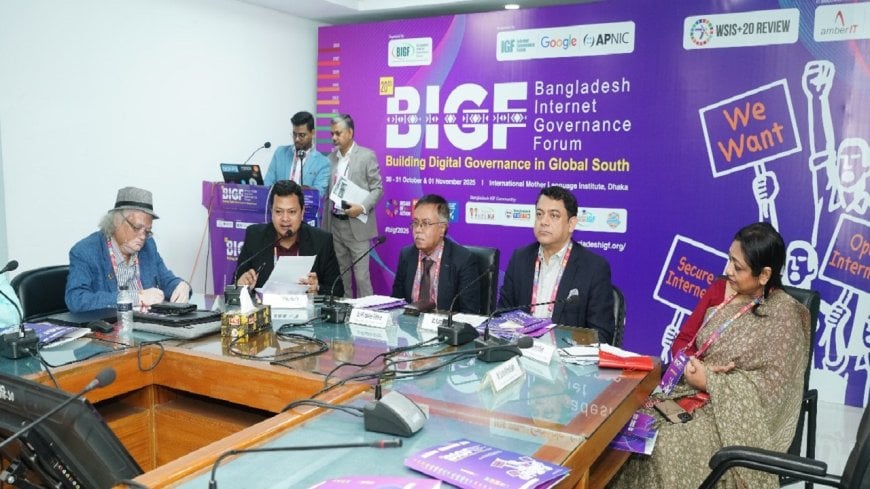
Delivering a virtual address at the inauguration of the 20th Bangladesh Internet Governance Forum (BIGF) on October 30 at the International Mother Language Institute in Dhaka, Cerf highlighted the growing importance of Internet access for all citizens.
Speaking during the three-day forum focused on digital governance, cybersecurity, and youth engagement, Cerf said, “It is equally important for every Bangladeshi citizen to access a useful and meaningful Internet. The Internet is central to the future economy, expanding across education, entertainment, and business. As the scope of Internet-based products and services grows, Bangladesh must prioritize establishing digital infrastructure akin to physical infrastructure. Every infrastructure must be affordable and technology-based, and citizens should also be trained to use applications and cloud-based services effectively.”
The session on digital governance was moderated by Md. Minhaj Uddin, Associate Professor at the Department of Mass Communication and Journalism, Jahangirnagar University. The welcome address was delivered by digital democracy expert and responsible AI ambassador A H M Bazlur Rahman.
The keynote paper on inclusive and intelligent digital governance frameworks was presented by Professor Dr. Mu. Hakikur Rahman, Chairman of the Department of Computer Science and Engineering at International Standard University. He stated, “Digital governance is a technology- and Internet-based management system. It must be innovative, inclusive, and justice-oriented.”
In the discussion following the keynote, Sharmin Khan of the U.S.-based International Center for Not-for-Profit Law (ICNL) highlighted the importance of personal data protection and AI policy for citizen welfare. Syed Almas Kabir, Chairman of Bangladesh ICT and Innovation Network (BIN), emphasized expanding inclusive digital services and increasing investment in new technologies. He noted, “It is not enough to focus only on youth dividends. We must work on skill development, conduct skill gap analysis, and establish a national skill pool. Upskilling and reskilling must be accessible to all. Internet users must be made aware of what is possible or restricted online.”
Sumon Ahmed Sabir, a member of the APNIC Executive Committee, stressed clear thinking in digital management. He cautioned, “Starlink is not a solution. Ending Internet shutdowns requires political consensus as well as robust emergency management.”
Earlier, BIGF Secretary Mohammad Abdul Haque Anu highlighted various Internet-based fellowships for youth, moderated by Yas Agarwal, Global Stakeholder Engagement Manager at ICANN. Mohammad Kausar Uddin, Vice President of ISOC Bangladesh Chapter, explained how young participants could easily access ICANN fellowships and funding.
Ashiqur Rahman Shunyo, NetMission Ambassador, announced that the NetMission fellowship program would begin on December 4, with registration closing on November 2. Applicants must be under 30 years of age.
Friday’s first session, chaired by Syeda Kamrun Jahan Ripper, Bangladesh Youth IGF Chairperson, focused on “Youth Voices for a Safe Digital Future”, with Ridhma Khan, Lecturer at North South University, as the keynote speaker. Subsequent sessions addressed AI and digital divide mitigation, digital empowerment of farmers and rural communities presented by Jarin Tasnim Rafa and Sanzida Tasnim, and cybersecurity and privacy, with a keynote by Mahedi Hasan from Dhaka University’s ICT Cell.
The forum’s opening day also featured a workshop on child safety and online abuse prevention, titled “Smart Kids, Safe Internet”, where school students engaged in team discussions on safe Internet practices. UNFPA and UN Women representatives spoke on technology’s role in preventing gender-based violence, followed by discussions on freedom of expression and cyber law. A session on “Cybersecurity Act and Freedom of Expression” was presented by Md. Al Amin Tushar, while Md. Yamin, Digital Verification Editor at AFP, emphasized the importance of digital verification in preserving media credibility.
The concluding session featured A H M Bazlur Rahman as the main speaker, chaired by M. Saimum Reza Talukdar, with a solidarity address by Anja Zengo from the UN IGF Secretariat.
This forum underscored Bangladesh’s commitment to inclusive, secure, and future-ready digital governance, aiming to equip youth, citizens, and policymakers with the tools and awareness necessary to thrive in an increasingly digital world.









