





































Land Fair Launches to Promote Digital Services and Transparency
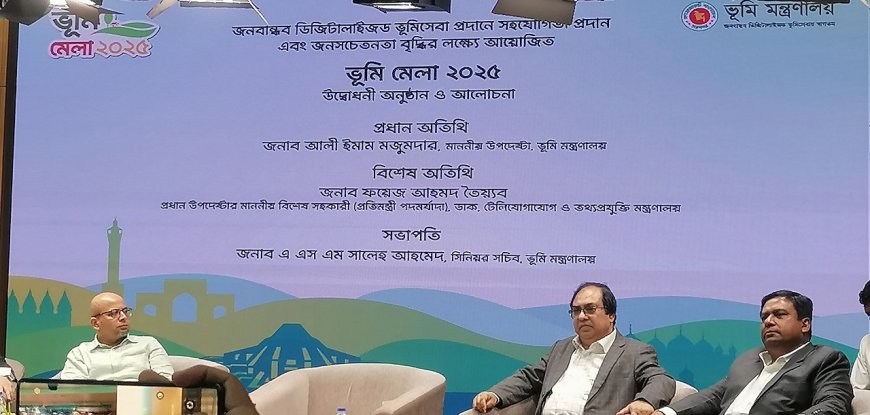



A nationwide three-day Land Fair is currently underway, aiming to ensure citizens' access to land services through digital platforms, establish transparent and efficient land management, and familiarize the public with new technology-based services.
At the opening ceremony held Sunday at the Land Bhaban in Tejgaon, Dhaka, Land Adviser Ali Imam Majumder instructed the Director General of Land Records to “redesign” the digital survey training module for personnel working in the land ministry.
“Digital transformation is not a cure-all,” said the adviser. “I see that, in many cases, we are failing to ensure justice for people. The issue is not with digitalization itself but with the laws and rules we’ve imposed. For instance, in surveys, the actual owner’s name is often not recorded. Someone else’s name is written instead. According to our current law, the collector can only correct clerical mistakes—everything else must go through the civil courts. This issue is especially common in flat ownership cases, where people face problems even after paying land tax and completing name registration.”
Admitting that the land ministry has been identified as the first step in corruption, the adviser noted, “There’s no doubt that we have achieved considerable digital progress, but that doesn’t solve all problems. Many of these problems won't be fixed by digital solutions alone. If the people working behind the digital services make mistakes or act unethically, those errors remain.”
He directed the redesign of the field workers’ training modules and stated, “In one month, we will assess how much progress has been made by those working with machines. Many Assistant Commissioners (Land) haven’t taken settlement training. From the certificates distributed in two recent training batches, I saw that 50 percent were from the administration, but the judiciary had much higher participation. Hence, moving forward, no one will be appointed in the administration without proper training. If you don’t know the disease, you can’t prescribe the cure.”
Speaking as a special guest, Faiz Ahmad Taiyeb, Special Assistant to the Chief Adviser, said that a competitive environment is being created between outsourced entrepreneurs and government officials through the “Nagorik Sheba” platform.
Explaining the government's approach, he said, “The government is working in two ways on digital transformation in services. Ministries will digitize their respective processes, while the ICT Division is working to bring all services under a unified ‘Nagorik Sheba’ platform, without allocating extra resources or funds. Through this, we aim to create healthy and meaningful competition between ministries and service providers. Rankings will be introduced, and underperformers will be terminated.”
He further noted, “In the past 15 years, Bangladesh has built several ‘digital islands’ in the name of Digital Bangladesh or Smart Bangladesh. Now we are establishing interconnectivity among these islands, integrating disconnected services so that a citizen does not have to visit thousands of websites across 57 ministries for various services.”
On the land services side, he added, “Gateways like land services operate within single ministries. By synchronizing both intra- and inter-ministerial efforts, our digital transformation will gain momentum.”
The special assistant also mentioned that efforts are underway to reduce the hassle of scanning and submitting copies of documents like Khatian and Dakhila. “Through API calls, individuals will be digitally identified via their national ID, and documents stored in other software systems will be pulled into the current system. Citizens will no longer need to manually upload photographs of documents.”
Presiding over the event, Land Ministry Senior Secretary Saleh Uddin Ahmed stated that 100 percent of land development tax collection is now processed online, which has significantly increased revenue.
“Currently, around 500,000 land mutation cases are resolved online every month. E-mutation is now operational in 516 upazilas and circle land offices, and 3,467 union land offices,” he said.
He revealed that from July last year to May 15 of this year, Tk 2.9 billion has been collected through this system. “Daily land development tax collection averages Tk 300,000 to Tk 400,000, while online Khatian services generate approximately Tk 321,000 per month. Over 65 million Khatian records are now online, and about 57 million holding data entries have been digitized. Nearly 11 million Dakhilas have been issued online. If the servers and other systems remain functional, daily revenue collection could reach Tk 1 to 1.2 billion,” he added.
The event was also attended by A. J. M. Salauddin Nagari, Chairman of the Land Reform Board; Muhammad Ibrahim, Chairman of the Land Appeal Board; and Md. Saidur Rahman, Director General of the Land Record and Survey Department.









