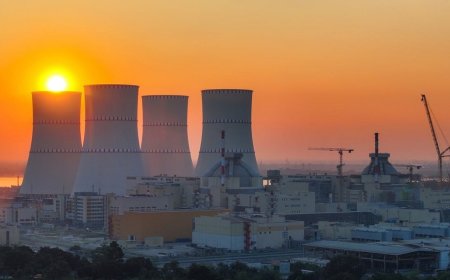












































First Grid Connection Test
Rooppur Power Set for Grid Trial
- Up to 240MW planned for Tuesday’s grid test
- Final grid connection targeted for November 21
- IAEA expresses satisfaction with emergency preparedness




Bangladesh’s first nuclear power plant is moving closer to supplying electricity to the national grid. After extensive testing and preparation, the first unit of the Rooppur Nuclear Power Plant may deliver up to 240 megawatts to the grid for a few hours on Tuesday, November 17, on a trial basis. Separately, a team of experts from the International Atomic Energy Agency (IAEA) has expressed satisfaction with the plant’s emergency preparedness, management and response capabilities.
According to information released on Monday, November 16, the trial connection will be followed by further technical tests. If all goes well, the unit will be reconnected to the grid after obtaining final approval from the Bangladesh Atomic Energy Regulatory Authority (BAERA). Project officials are targeting November 21 for the first unit’s final grid connection.
Trial connection does not mean commercial operation
Dr Khalequzzaman, deputy project director of the Rooppur project, said the plant was planning to connect electricity to the national grid on a trial basis on Tuesday. However, he clarified that the connection would not mark the start of commercial electricity supply.
Project sources said the first unit could supply up to 240MW to the grid for several hours during the trial. It would then be disconnected so that further tests could be conducted at the plant.
Several project officials, speaking on condition of anonymity, said tests to assess the performance of the reactor, turbine and other key equipment had already been completed successfully.
Bangladesh Power Development Board (PDB) Chairman Engineer Rezaul Karim said the national grid was ready. The PDB had been asked to keep a representative present during the connection process, and the board had made the necessary preparations.
BAERA Chairman Mahmudul Hasan said the plant must obtain regulatory approval before connecting electricity to the grid. The authority will issue approval only after ensuring that all required safety conditions have been met.
Power generation to increase in stages
Heat generated from nuclear fuel will be used to produce steam from water. The steam will drive a turbine to generate electricity.
The plant is initially planned to operate at only 3% capacity. Its output will then be increased gradually. Once capacity reaches 25% to 30%, regular electricity supply to the national grid could begin. At that stage, the plant may generate around 300MW.
Further safety, technical and performance tests will continue. It may take another five to six months for the unit to reach full capacity. Commercial operation will begin only after the trial electricity supply phase is completed.
IAEA satisfied with emergency preparedness
An IAEA expert mission has expressed satisfaction with the Rooppur plant’s emergency preparedness, institutional capacity, management and response arrangements.
The assessment was reported at a joint meeting held on Monday in the conference room of the Ministry of Science and Technology at the Bangladesh Secretariat. It was part of the IAEA’s on-site Emergency Preparedness Review (EPREV) mission in Bangladesh.
A 10-member IAEA team led by expert Mark Breitinger arrived in Bangladesh on November 8. The team spent around 10 days reviewing the Rooppur project and relevant emergency preparedness activities.
The review examined emergency readiness, institutional capacity, management and response arrangements against international standards.
The meeting was attended by Science and Technology Secretary Md. Anwar Hossain, BAERA Chairman Mahmudul Hasan, Chief Scientific Officer Dr. Mahabubur Rahman, Nuclear Safety Division Chief Dr. Md. Abdur Rab Sheikh and other officials.
The IAEA assessment is an important part of reviewing Bangladesh’s institutional readiness to respond to a nuclear emergency. However, the mission’s satisfaction with emergency preparedness should not be interpreted as approval for commercial operation. Grid supply remains subject to regulatory approval and completion of the required technical tests.
Two units planned to add 2,060MW to the grid
The Rooppur plant in Ishwardi, Pabna, has two units, each with a designed capacity of 1,200MW. The target is to generate at least 1,150MW from each unit. After deducting up to 120MW for the plant’s own consumption, each unit is expected to supply at least 1,030MW to the national grid.
Once both units operate at full capacity, they are expected to add at least 2,060MW to the grid.
Built with financial and technical assistance from Russia, Rooppur is the largest single project in Bangladesh’s history. The Bangladesh Atomic Energy Commission, under the Ministry of Science and Technology, is implementing the project. The state-owned Nuclear Power Plant Company Bangladesh Limited (NPCBL) is responsible for operating the plant.
The project deadline has been extended twice, with the latest completion date set for June 2028. Its estimated cost now stands at Tk 138,686 crore.
Preparatory and construction work on the second unit is also progressing. If plans remain on schedule, nuclear fuel is expected to be loaded into the second unit next year.
Once both units are fully operational, the plant is expected to increase Bangladesh’s electricity generation capacity. It could also help reduce load-shedding and save foreign currency by lowering dependence on imported fuels for oil- and coal-based power generation.
//DBTech/SCDR/DSE/FOE//