








































Human Capabilities Must Remain Central
AI Era Demands Institutional Transformation
- Bangladesh ranks 105th among 139 countries in the Global Innovation Index
- BTRC chairman proposes an accelerator, clutch and brake framework for AI
- Faster AI adoption in healthcare, with safeguards for jobs and human rights




Bangladesh must transform its institutional governance, human thinking and workplace processes to unlock the full potential of artificial intelligence (AI), rather than relying solely on technological investment. BTRC Chairman retired Major General Md. Emdad Ul Bari has called for faster AI adoption in healthcare and agriculture, technology-assisted workforce development in employment-intensive industries, and strict safeguards where AI could threaten human rights.
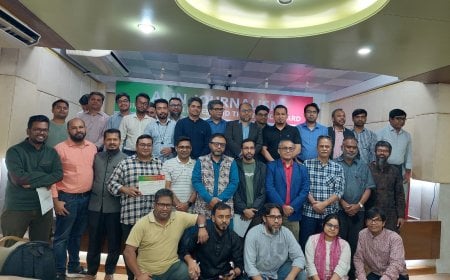
He made the remarks as a special guest at an event organised by Grameenphone at a hotel in Dhaka on Tuesday (10 November).
The event was attended by Prime Minister's Adviser on the Ministry of Posts, Telecommunications and Information Technology Rehan Asif Asad as the chief guest. Other attendees included Norwegian Ambassador to Bangladesh Håkon Arald Gulbrandsen, Grameenphone Chief Executive Officer (CEO) Yasir Azman, Chief Human Resources Officer Syeda Tahia Hossain, and Chief Strategy and Transformation Officer Andreas Högberg.
Highlighting Bangladesh's position in the Global Innovation Index, the BTRC chairman pointed to a significant gap between the country's infrastructure and human capital development.
“We have a highly talented and technology-loving young generation. Yet, we rank 105th among 139 countries in the Innovation Index. Even though we rank 84th in infrastructure, our position in human capital is 127th. This means there is a visible disconnect between our infrastructure and our innovative young people,” he said.
Criticising the return-focused mindset of the telecommunications and corporate sectors, as well as institutional fragmentation, he said:
“Over the past three decades, corporations have invested heavily in infrastructure expansion, and the entire country is now under network coverage. But instead of ensuring proper optimisation of this infrastructure, we are only increasing video consumption. As a result, the actual needs of marginal users remain unmet.
“Our governance system is also trapped in separate departments and silos. One department builds a road, while another cuts it open a few months later. This lack of coordination is a major barrier to connecting innovation with infrastructure.”
Addressing AI's impact on employment, Emdad Ul Bari emphasised that innovation remains a human activity.
“AI does not innovate by itself; humans create innovation. AI accelerates processes and provides insights through data analysis. However, AI is having its greatest impact on white-collar and entry-level jobs, such as call centres, customer support and software support.
“Experiences around the world have shown that AI alone cannot address human emotions. Swedish company Klarna, after becoming fully dependent on AI, was forced to rehire human representatives when customer complaints increased,” he said.
He proposed a three-tier framework for AI adoption, describing the approach as the Accelerator, Clutch and Brake model. The framework identifies where AI should be deployed rapidly, where it should support rather than replace workers, and where its use requires strict controls.
He recommended accelerating AI adoption in sectors such as healthcare and agriculture, where shortages of medical professionals and specialists create significant challenges. As an example, he cited the International Centre for Diarrhoeal Disease Research, Bangladesh (icddr,b), where AI models are being used to analyse chest X-ray reports in just 60 seconds.
`In employment-intensive sectors such as the ready-made garment industry and call centres, AI should be introduced without directly eliminating jobs. Instead, the technology should strengthen human capabilities and improve workplace efficiency and productivity'- btrc Boss added.
He called for strong restrictions on AI applications that could undermine human rights. Referring to the Netherlands childcare benefits scandal, he said biased and erroneous algorithmic decisions had affected 26,000 families, eventually forcing the entire Dutch cabinet to resign.
Emphasising the need for institutional reform, the BTRC chairman concluded: “When electricity arrived, simply replacing steam engines with electric motors did not increase production. The entire production line had to be redesigned and reorganised. The same applies to AI. We must fundamentally change our old workflows. Instead of blindly chasing technology, we need to slow down when heading in the wrong direction, because the faster we move in the wrong direction, the longer it takes to return to the right path.”
Other speakers at the conference also discussed Bangladesh's overall digital transformation, the ethical use of artificial intelligence and the future roadmap for the telecommunications sector.
//DBTech/IH/RESME/FOPTE//









