











From ‘Mess’ to ‘Star’: Call for Secure, Data-Driven Digital Transformation in Bangladesh
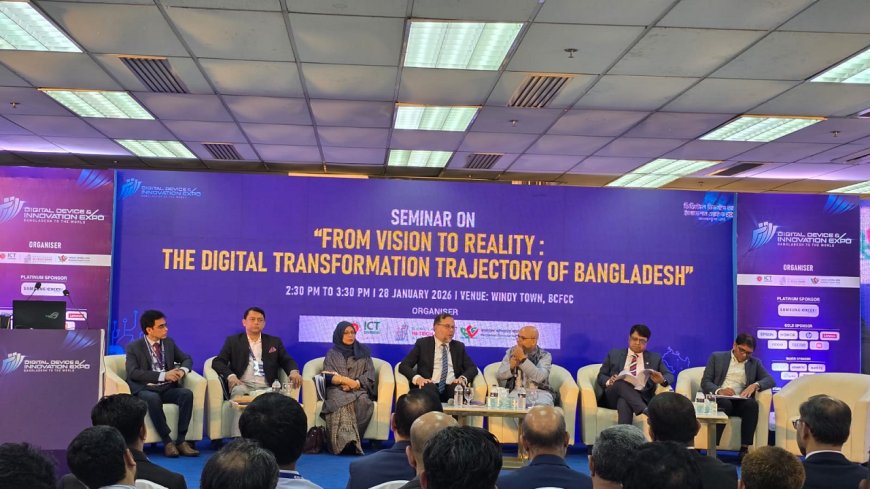



Sector stakeholders have stressed the need to bring fragmented digital development initiatives under an inclusive management framework, placing strong emphasis on data-driven decision-making. They have advised giving the highest priority to personal identity verification and data security, noting that there can be no compromise on cybersecurity in digital development. With this objective in mind, the interim government has begun transitioning its digital transformation approach from a “mess” model to a “star” model. However, concerns have been raised by business leaders over data security, as the work on VAT Online has reportedly been outsourced to a Vietnamese company.
These views were expressed at a seminar titled “Bangladesh’s Digital Transformation: From Vision to Implementation”, organised on the occasion of the Digital Device and Innovation Expo 2026. The seminar was held on Wednesday, January 28, at the Windy Town Hall of the Bangladesh-China Friendship Conference Centre. The keynote speaker was Faiz Ahmad Taiyeb, Special Assistant to the Chief Adviser in charge of the Ministry of Posts, Telecommunications and ICT.
During his address, Faiz Ahmad Taiyeb highlighted the legal framework for data governance, saying that the relevant laws have already been passed and the authorities are now in the implementation phase. He noted that citizen services have been tested through APIs, but to ensure cybersecurity while handling large volumes of data, work funded by the World Bank will begin in March. As the Estonian model is costly, Bangladesh will instead develop a central data exchange system. The government, he said, is moving from the existing “mess” model to a “star” model, where all entities will be interconnected. Although AI initiatives are currently being undertaken in a fragmented manner, the new approach will enable work under a national interoperability framework.
Criticising the earlier overemphasis on connectivity at the expense of services, Faiz Ahmad Taiyeb said efforts are underway to make fibre connectivity as cheap as water, while mobile operators are being encouraged to invest more. Although political will existed to implement initiatives such as digital identity and exchange, the country now requires a unified “One ID”. To this end, steps are being taken to recreate the NID system. He added that this would require algorithms capable of preventing unauthorised data changes, while blockchain technology would be used for mutable information.
The keynote paper was presented by Md Mamunur Rashid Bhuiya, Managing Director of the Hi-Tech Park Authority, a co-organiser of the expo. In his presentation, he outlined the costs of fragmented digital transformation and stressed the urgency of implementing Digital Public Infrastructure (DPI). He argued that no concessions should be made if targets are not met. He also said the government is now building inclusive digital infrastructure by transitioning from the mess model to the star model, and eventually to a star-mess hybrid model, which will create bridges between public and private data centres.
The discussion was moderated by ICT Division Secretary Shish Haider Chowdhury. Panelists included Zaheda Parveen, Secretary (Coordination and Reforms) of the Cabinet Division; academic Dr Abdus Razzaq; former BASIS President Syed Almas Kabir; and Mushfiqur Rahman, Managing Partner of Spectrum Software and Consulting Limited.
In her remarks, Zaheda Parveen emphasised prioritising interoperability over DPI in delivering citizen services, noting that the government has issued an ordinance on inclusive development and that all ministries and divisions should be informed about it. Dr Abdus Razzaq stressed the importance of process interoperability rather than API-centric development and called for programmes to enhance skills not only among students but also professionals. Mushfiqur Rahman advised aligning technological change with business processes, pointing out data gaps in sectors such as health tech and agri-tech beyond telecom, despite the critical need for data-driven decisions for a sustainable future.
Highlighting data security concerns, Syed Almas Kabir questioned the government’s lack of trust in local software service providers. Referring to the automation of VAT Online being entrusted to a Vietnamese company, he said that sensitive data of Bangladeshi businesses are now in the hands of a firm from a competing country, urging a shift away from such a vendor-buyer mindset.
During the expo, four additional seminars and four panel discussions are being held on practical and commercial aspects of information technology. The event is drawing participation from leading IT professionals, experts, entrepreneurs, and key policymakers. Visitors will also experience specialised exhibitions of IT products and quiz competitions, while the entire venue is being covered by Wi-Fi through satellite internet technology, allowing attendees to directly experience this advanced connectivity.
DBTech/IH/EK/OR