




































Government Prioritises Innovation Over AI Models
Bangladesh Targets First AI Infrastructure Within 12 Months, Says Rehan Asif Asad
- Bangladesh plans its first AI infrastructure and data centre within 12 months
- Over 7,000 students submitted 1,130 ideas from more than 70 universities
- Three winning projects address heart disease, river erosion and speech therapy




Bangladesh is working to establish its first artificial intelligence (AI) infrastructure and AI data centre within the next 12 months, aiming to strengthen the country's position in the global AI race. The planned infrastructure will provide computing capacity through graphics processing units (GPUs), high-bandwidth memory, advanced neural processing units (NPUs) and AI inference capabilities. However, the government's objective is not to develop another ChatGPT-like model. Instead, it aims to create an accessible technology foundation that enables young innovators, researchers, entrepreneurs and businesses to develop practical AI-powered solutions.
Rehan Asif Asad, Adviser to the Prime Minister for the Ministry of Posts, Telecommunications and Information Technology, said Bangladesh had missed much of the software revolution of the 1990s but could not afford to miss the ongoing AI revolution.
He stressed that young people should move beyond simply adopting AI technologies and develop innovative platforms capable of solving real-world problems.
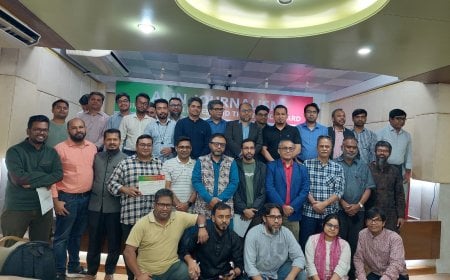
The remarks came at the grand finale of the second edition of Grameenphone FutureMakers 2026, an AI-based innovation competition focused on addressing social challenges. Held at a hotel in Dhaka on Tuesday (November 10), this year's competition carried the theme ‘AI for Social Good’.
More Than 7,000 Students Submit 1,130 Ideas
More than 7,000 students from over 70 universities across Bangladesh submitted a total of 1,130 AI-based ideas this year.
Student participation increased by approximately 40% compared with the inaugural edition in 2025.
Participants from both science, technology, engineering and mathematics (STEM) and non-STEM disciplines presented innovations across seven designated areas. These included digital inclusion and education, healthcare and mental well-being, skills development and employment, gender equality, and environmental protection.
Team LubDub Wins with AI-Powered Heart Screening Device
Team LubDub emerged as the champion of FutureMakers 2026 with its project, EchoClip.
The AI-powered clip-on device transforms conventional stethoscopes into tools that can help detect potential early signs of heart disease.
Team River Sentinel secured the First Runner-up position with an AI-powered river erosion prediction system. The solution is designed to identify vulnerable areas and provide early warnings to communities at risk.
Team Jinxed was named Second Runner-up for Spasto AI, an AI-supported speech therapy application. It combines personalised treatment plans with guided home practice and progress tracking.
BTRC and Grameenphone Executives Evaluate Finalists
The finalists presented their solutions before a judging panel comprising senior officials from BTRC and Grameenphone.
The panel included Brig Gen Iqbal Ahmed, ndc, afwc psc (retd), Commissioner of the Engineering and Operations Division at the Bangladesh Telecommunication Regulatory Commission (BTRC); Yasir Azman, Chief Executive Officer of Grameenphone; Sayeda Tahya Hossain, Chief Human Resources Officer; Andreas Høgberg, Chief Strategy and Transformation Officer; Solaiman Alam, Chief Product Officer; Dr. Asif Naimur Rashid, Chief Business Officer; and Dr. Niranjan Srinivasan, Chief Information Officer.
The judges assessed the projects based on innovation, feasibility, potential social impact and practical application of AI.
The champion team received Tk 300,000, while the First Runner-up and Second Runner-up received Tk 200,000 and Tk 100,000, respectively.
In addition to the financial awards, the winning teams will receive an accelerated opportunity to join Grameenphone's flagship talent development programmes, Next Business Leader (NBL) and Nextern Internship Program.

Three Fundamental Layers of AI Technology
In his keynote address, Rehan Asif Asad outlined three fundamental layers underpinning the global AI ecosystem.
The first is the computing layer, built around GPUs and the next generation of processors, including NPUs.
The second is high-bandwidth memory (HBM), while the third is the language model layer.
He noted that South Korean companies Samsung and SK Hynix dominate a significant share of the global high-bandwidth memory market. In the language model segment, he referred to companies and platforms including OpenAI, ChatGPT, Anthropic and Groq.
Highlighting South Korea's technology-driven economic growth, the adviser said semiconductors and AI were playing a major role in the country's development. He cited two companies as contributing to approximately 80% of its growth and development.
He also highlighted the global semiconductor supply shortage. According to him, a single chip can cost around US$250,000, and even buyers with sufficient funds may have to wait until 2031 or 2032 for delivery.
Sharing a personal memory, Asad recalled receiving his first computer from his father in 1994. It was a Compaq Presario 8210 powered by an Intel chip.
He said he still remembered how proud he felt owning a personal computer running on Intel technology.
“The last 30 years of the world was driven by CPU. The next 30 years of the world would be driven by GPU and TPU,” he said.
Five Strategic Layers of Bangladesh's Technology Development
The adviser outlined five strategic layers that the government considers essential for Bangladesh's technological advancement. The first layer involves establishing the necessary laws, guidelines and policies for technological development.
He praised the BTRC chairman, commissioners and other officials for their role in developing the country's regulatory foundation.
Emphesisised on connectivity, Asad described reliable and secure connectivity as essential for Bangladesh's technological future. He specifically highlighted Grameenphone's responsibility in this area.
He said he had held multiple meetings with Grameenphone's leadership and personally requested the company to consider its responsibility in providing robust and secure connectivity.
Such connectivity, he said, would allow young innovators and FutureMakers to develop new digital services and solutions.
`The third layer is digital public infrastructure (DPI)'- he aded.
Asad said Bangladesh currently lacks a robust e-governance system and a comprehensive digital public infrastructure.
To address this gap, the government is pursuing a programme built around the concept of ‘One Citizen, One ID, One Wallet’.
He identified Estonia as one of the world's leading examples of digital public infrastructure.
According to the adviser, the government has been working with an Estonian team that developed the country's e-governance and DPI systems. He said a meeting with the team had taken place that morning.
The team is assisting Bangladesh in developing an e-governance framework based on X-Road, an open-source model developed by Estonia and MIT, as described by the adviser.
Under the proposed system, every citizen will have both a physical identity document and a digital identity.
The digital identity will be connected to essential personal records, including population information, birth certificates, educational certificates and marriage certificates.
It will also be linked to financial services, including debit cards, credit cards and digital wallets.
The objective is to provide these facilities to every citizen, regardless of their identity or place of residence in Bangladesh.
The government also plans to connect all ministries through an integrated e-governance system, allowing them to operate through an interconnected digital framework.
Focusing on Artificial Intelligence and Cybersecurity, `the fourth and most critical layer', according to Asad, is AI and cybersecurity.
He stressed that AI could enable remarkable innovations but could also help malicious actors develop more sophisticated cyberattacks.
As AI adoption expands, networks and digital infrastructure may become increasingly vulnerable without adequate protection.
He therefore emphasised the need to develop secure and robust infrastructure alongside AI capabilities.
The fifth layer focuses on expanding domestic manufacturing of consumer electronics, semiconductors and technological devices.
Asad said the government had made a commitment to develop this sector, referring to commitments made by the Prime Minister before the election and the support of the Finance Minister.
He expressed confidence that Bangladesh could raise its electronics manufacturing industry to a level comparable to the achievements of its garment sector within the next five years.
He also said significant changes had been introduced in the electronics manufacturing sector following the latest budget.
According to the adviser, apart from Apple, nearly every high-end Android phone is now being manufactured in Bangladesh.
He specifically mentioned Samsung S26, Vivo and Honor as examples.
Government to Build Infrastructure, Not Another ChatGPT
Asad urged journalists to distinguish clearly between AI infrastructure and AI models, stressing that the two are fundamentally different.
He said the world's four major AI companies were spending around US$750 billion to US$800 billion, approaching US$1 trillion, on AI models.
Developing a similar model is not the Bangladesh government's intention, he said.
Instead, the government's focus is on building GPU capacity, memory infrastructure, high-end NPUs and inference capabilities.
These resources will be made accessible to students, private-sector businesses, government institutions and innovators.
The infrastructure is expected to reduce the financial barriers associated with accessing expensive GPU computing capacity.
Young innovators will be able to use population data, government datasets, weather information and agricultural data to develop new services, applications and technology-based solutions.
However, Asad emphasised that data protection and preventing the misuse of information would remain essential responsibilities.
He said the government would build the infrastructure, while young FutureMakers and innovators would be expected to develop new technologies and services on top of it.
He also encouraged young people not to assume that they must become experts in large language models, TPU programming or high-bandwidth memory chip design.
Instead, they should learn how to use language models to perform their tasks better, faster, more affordably and more efficiently.
Bangladesh Cannot Afford to Miss the AI Revolution
Reflecting on the global software revolution of the late 1990s and early 2000s, Asad said countries and universities that embraced the transformation early had gone on to lead the global technology industry.
He acknowledged that Bangladesh had produced outstanding talent and achieved notable progress in several areas. However, he said the country had not collectively embraced the software revolution early enough.
He described the current AI transformation as a once-in-a-lifetime opportunity for Bangladesh.
The country must not repeat the missed opportunity of the late 1990s and early 2000s, he said, adding that Bangladesh must embrace the AI revolution from the mid-2020s onwards.
Asad said the government's commitment to technology development and AI had been clearly outlined in its election manifesto and subsequent public statements.
Working with international partners, the government is making preparations to establish the country's first AI infrastructure and data centre within the next 12 months.
He said the necessary components had already been secured and the government was confident about meeting the timeline.
An announcement outlining the implementation process and the participating partners is expected soon.
The adviser reiterated that the initiative would focus on building infrastructure for the people of Bangladesh rather than developing another expensive AI model.
The special guest at the event was BTRC Chairman Major General Md Emdad Ul Bari (retd), who praised the young participants for their digital and responsible innovations.
Norwegian Ambassador Håkon Arald Gulbrandsen and Grameenphone Chief Executive Officer Yasir Azman, along with senior officials of the company, also attended the event.
//DBTech/IH/SMP/MIST//









