














Digital Deception at Fuel Pumps Raises Metrology Trust Concerns
লোকাল ডেস্ক ৮ ফেব্রুয়ারি, ২০২৬
সিনিয়র স্টাফ করেসপন্ডেন্ট ২৯ নভেম্বর, ২০২৫
স্টাফ করেসপন্ডেন্ট ২৭ সেপ্টেম্বর, ২০২৫
স্টাফ করেসপন্ডেন্ট ২ এপ্রিল, ২০২৬
স্পেশাল করেসপন্ডেন্ট ১৪ মার্চ, ২০২৬
Almost every customer keeps an eye on the digital display while refueling a vehicle’s fuel tank. Once the meter shows 5 liters, 10 liters, or the specified monetary amount, customers generally assume they have received the correct quantity of fuel. Most people consider these technology-driven dispensing units to be nearly flawless. However, that very digital technology has now turned into a sophisticated tool for fraud.
Amid this troubling reality, World Metrology Day will be observed on Wednesday, May 20, under the theme: “Metrology for Trust in Policy Making.” Yet in Bangladesh, public confidence in the system of weights and measurements is increasingly being questioned. Recent drives conducted in different parts of the country, including Chattogram, Khulna, and Bhairab, uncovered multiple filling stations supplying less fuel than displayed, according to the Bangladesh Standards and Testing Institution (BSTI).
During operations carried out throughout March in Chattogram, authorities found that several filling stations were dispensing 40 to 120 milliliters less fuel per 5 liters. In some cases it involved diesel, in others octane fuel. Although the digital displays showed accurate measurements, the actual quantity delivered into vehicle tanks was lower. Several establishments were fined during the operations.
Similar incidents have also been reported outside Dhaka. In Khulna, a filling station was fined by a mobile court over allegations of under-dispensing fuel. In Bhairab of Kishoreganj, another filling station was fined Tk 100,000 for the same offense.
Concerns over irregularities in the fuel sector are also growing in the capital, Dhaka. Recently, the government made the “Fuel Pass” system mandatory at 68 filling stations in the city to strengthen monitoring of fuel distribution. Experts, however, say that despite improvements in digital tracking, an effective central monitoring system to prevent software-based manipulation of dispensing units has yet to be established.
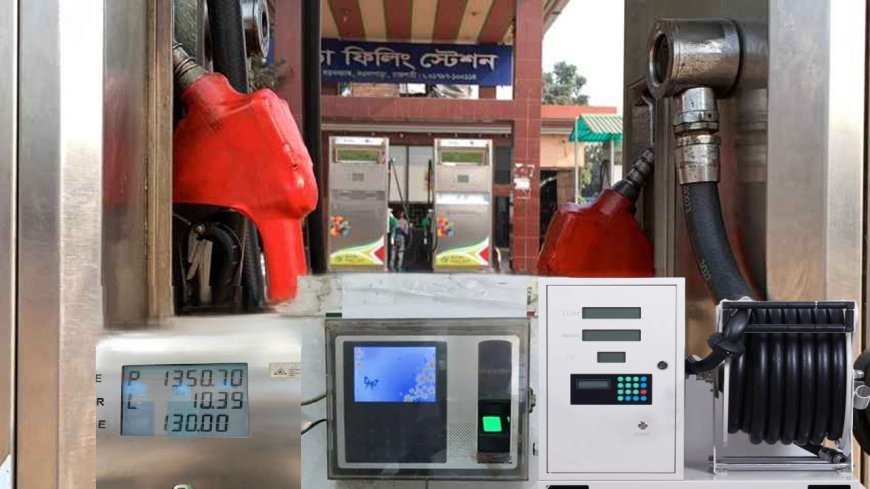
BSTI officials say that modern dispensing units operate through an integrated system of sensors, pulse generators, control circuits, and software. Fuel flow data is converted into digital signals and then displayed on the screen — and this is where manipulation occurs.
In many cases, fraudsters install additional chips on the motherboard or alter the software’s “pulse ratio” to configure the machine in such a way that, although the display shows 1 liter, the actual amount dispensed is slightly less. In some instances, hidden switches or remote-control systems are reportedly used to activate fraudulent modes during busy hours.
Bulbul Ahmed Joy, Inspector (Metrology) at BSTI Chattogram Divisional Office, said that during inspections, fuel is dispensed into standard 5-liter or 10-liter measuring containers and then compared with the digital display readings. This is when discrepancies become apparent.
In his words, “The assumption that digital machines are completely secure is incorrect. Technology has increased convenience, but it has also made fraud techniques more sophisticated.”
Mohammad Arif Hossain, a private car owner in Chattogram, said that even after purchasing the same amount of octane fuel, he now gets 5 to 10 kilometers less mileage compared to before. Ride-sharing drivers have also raised similar complaints. However, since the digital meters appear accurate, customers have little opportunity to lodge direct complaints.
S M Nazer Hossain, Vice President of the Consumers Association of Bangladesh (CAB), believes ordinary consumers have no practical way to detect such manipulation.
According to him, “How can consumers understand there is a discrepancy in the meter? If the authorities do not take action, consumers can do nothing.”
Under Bangladesh’s Standards of Weights and Measures Act-2018, under-dispensing in measurement is punishable by up to one year’s imprisonment and a fine of Tk 100,000. In practice, however, most enforcement drives are complaint-based or conducted during specific periods. As a result, many filling stations remain outside monitoring coverage for large parts of the year.
Experts argue that enforcement drives alone will not be enough. They say software audits of digital dispensing units, real-time monitoring, and centralized control systems are essential to prevent such fraud. BSTI officials also believe that direct regulatory control over dispensing software could significantly reduce manipulation.
The foundation of the international measurement system was established on May 20, 1875, through the signing of the “Metre Convention” in Paris. One hundred and fifty years later, the core challenge facing measurement systems is no longer mechanical — it is digital. As a result, the central message of World Metrology Day has become increasingly clear: in the age of technology, building trust requires not only modern equipment, but also honest measurement, effective monitoring, and accountability.
DBTech/IH/MUM/OR
এ. এইচ. এম. বজলুর রহমান ১৭ মে, ২০২৬
১৭ ফেব্রুয়ারি, ২০২৬
১৬ ফেব্রুয়ারি, ২০২৬
৫ জানুয়ারি, ২০২৬
২২ অক্টোবর, ২০২৫
২ ফেব্রুয়ারি, ২০২৬
৯ মার্চ, ২০২৬
২০ মে, ২০২৬
২০ মে, ২০২৬
২০ মে, ২০২৬
Total Vote: 15
আশীর্বাদ
Total Vote: 18
আস্থাশীল