





































Bangladesh in 2025: A Data-Driven Turning Point
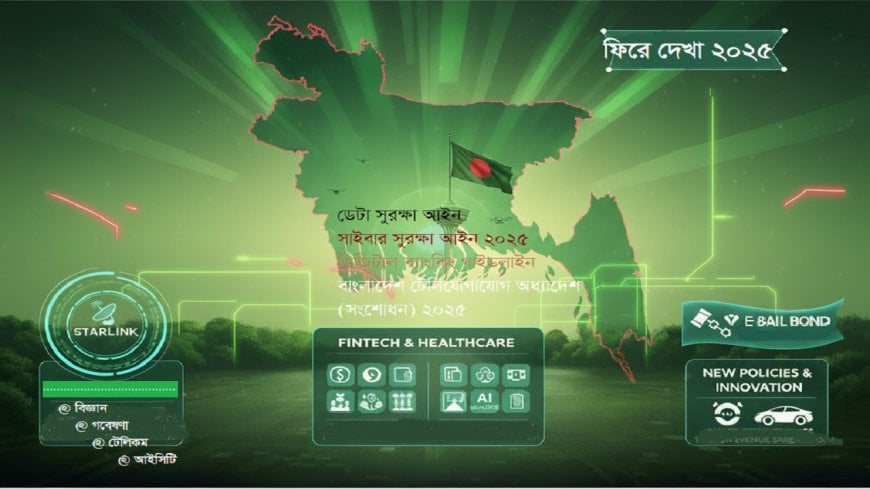



As the pendulum of time swung forward, another year slipped into history. Riding the raft of 2025, Bangladesh entered 2026 with a mix of questions, expectations and unfinished ambitions. For the country, 2025 marked a decisive shift towards a data-driven economy, positioning the technology and innovation sector at a critical crossroads.
Amid political transition and mounting pressure from the digital economy, the year reflected a constant tug of war among citizens, entrepreneurs, researchers and policymakers. It was not merely a year of change, but one of key decisions—some long delayed, others transformative.
Satellite and Submarine Cables: A New Chapter in Connectivity
After prolonged legal complexities, the interim government approved the Non-Geostationary Satellite Orbit (NGSO) Policy in 2025. As a result, Starlink began commercial operations in Bangladesh towards the end of the year, delivering internet speeds of up to 310 Mbps in char areas and hilly regions. This development significantly boosted the sale of international bandwidth and positioned Bangladesh as an emerging data transit hub.
To reduce operational leakage, state-owned Bangladesh Satellite Company Limited partnered with Starlink, alongside the publicly listed Bangladesh Submarine Cable Company Limited (BSCCL) and private mobile operators. Before operators even began retailing Starlink services, BSCCL sold nearly 4.5 terabits per second of bandwidth, including 200 Gbps directly to Starlink. Overall, internet speeds improved in remote regions, disaster-time backup connectivity became viable, and stable networks were established in border and coastal areas.
For the first time in telecom history, Bangladesh Satellite Company emerged not as a cost centre but as a strategic national asset. BSCCL maintained consistent net profits, while work on the SEA-ME-WE-6 cable was completed at the Cox’s Bazar landing station. Once operational, it will add an additional 34 Tbps of bandwidth, expected to further reduce internet prices in 2026. With BSCCL’s total capacity projected to exceed 41 Tbps, Bangladesh is likely to eliminate its reliance on bandwidth imports from India.
Meanwhile, the long-delayed 5G rollout gained momentum in 2025, extending services beyond Dhaka into industrial zones. However, negotiations over spectrum pricing between operators and the government remain unresolved. Commercial use cases for 5G have yet to mature, prompting operators to adopt a cautious investment approach.
The Year of Internet “Democratisation”
In many ways, 2025 became the year of internet democratisation. According to BTRC data, by mid-year commercial 5G services were launched in all city corporations and at least 30 district towns. With speeds reaching 1 Gbps, industrial productivity reportedly increased by 25 percent.
Policy and legal reforms dominated discussions throughout the year. Key developments included reforms in data protection, cybersecurity frameworks, digital banking guidelines and telecom licensing. Breaking long-standing taboos, the government passed the Blockchain Framework 2025, while pilot assessments began on the institutional use of Bitcoin or digital currencies.
Following the internet blackouts of July–August 2024, Bangladesh entered 2025 with a pledge of transparency. To uphold this commitment, the interim government introduced major amendments to telecom laws, eliminating political interference in licensing. Towards the year’s end, internet access was recognised as a fundamental right through the Bangladesh Telecommunication Ordinance (Amendment) 2025. The reforms strengthened BTRC’s independence and accountability, rebalanced authority between the ministry and the regulator, and repealed controversial provisions from 2010.
The newly enacted Cyber Security Act 2025, aligned with international standards, defined cyber offences more clearly and included safeguards to prevent abuse of power, protecting freedom of expression. A Personal Data Protection Board was established, making digital consent mandatory for collecting personal data—marking a major step towards data sovereignty.
Advancing Towards a Wallet-Free Society
Bangladesh took a major step towards a “wallet-free” society in 2025. In the first quarter, Bangladesh Bank successfully completed its Central Bank Digital Currency (CBDC) pilot project, extending digital financial inclusion to nearly 30 million unbanked citizens.
Three private mobile operators received licences to offer mobile financial services (MFS). Around 75 percent of retail transactions are now conducted via QR codes and smartphones. Banks have begun issuing micro-loans to small entrepreneurs based on AI-driven credit scoring rather than traditional collateral.
Platforms such as bKash, Nagad and Rocket evolved beyond money transfers with the launch of a domestic Unified Payment Interface (UPI)-style system, reducing transaction costs by 20 percent and accelerating the cashless ecosystem. According to Bangladesh Bank’s December report, MFS transactions exceeded Tk 300 trillion in 2025.
Cyber threats intensified alongside digital growth, with attempted attacks on the banking sector rising by 300 percent in the past six months. However, AI-driven threat detection and dark-web monitoring helped thwart 98 percent of attacks. Digital forensics initiatives increased cybercrime detection rates by 15 percent, while a Central Cyber Threat Intelligence Hub was established to protect key financial institutions.
Smart Agriculture, Health and Robotics
Micro-insurance services were integrated with fintech platforms for the first time, enabling farmers to receive crop insurance directly into digital wallets. Under the Ministry of Agriculture’s Smart Agriculture 2025 initiative, 50,000 solar-powered smart irrigation pumps were installed nationwide, saving nearly 40 MW of electricity.
Hydroponic and vertical farming gained commercial traction around Dhaka and Chattogram, ensuring year-round vegetable supply. IoT sensors reduced water wastage by 30 percent, while drones began commercial use in diagnosing crop diseases in haor and northern regions—though high costs remain a barrier for small farmers.
In healthcare, AI-powered X-ray and MRI analysis was introduced at major hospitals, including BSMMU, raising diagnostic accuracy to 95 percent. For the first time, robotic surgery was successfully conducted in remote regions using 5G networks. Efforts also began to integrate health data with biometric national IDs, a move expected to revolutionise healthcare delivery in 2026.
Startups, Skills and Smart Governance
In 2025, entrepreneurial activity shifted from freelancing to startup creation, particularly in agri-tech and fintech. EdTech platforms launched adaptive learning apps tailored to individual student capabilities. A government-led reskilling portal trained over 300,000 professionals displaced by AI.
Virtual reality-based science labs were installed in 1,000 government schools, alongside the launch of a National Education Dashboard to digitally track student performance.
Public services were consolidated through Citizen Service Centres launched simultaneously in six areas of Dhaka. BTRC conducted virtual public hearings via the local platform Konve, introduced e-licensing, and rolled out smart driving licence printing nationwide. The launch of e-TIN services using domestic software highlighted technological sovereignty, while e-Bail Bonds and postal voter registration apps enabled expatriate Bangladeshis to vote in national elections for the first time.
Electric Mobility and Research Gaps
The Power Division completed the installation of 500 EV charging stations in 2025 and introduced subsidies for converting conventional vehicles to electric. Import duties on EV batteries were reduced from 15 percent to 5 percent, resulting in 22 percent of newly registered private vehicles being electric. Two private firms began EV battery assembly in Gazipur and Chattogram, reducing vehicle prices by 20 percent.
Despite progress, research funding remained below 1 percent of GDP. While global competition surged in AI, quantum computing and biotechnology, Bangladesh continued to struggle with laboratory infrastructure. Nevertheless, Bangladeshi researchers published notable work in international journals on agricultural genomics, climate-resilient crops and health data analytics.
An Applied AI Year
2025 marked Bangladesh’s first truly applied AI year. Full-scale AI assistants replaced chatbots at land offices and the National Board of Revenue, enabling citizens to access records via WhatsApp. In December, the ICT Division launched Bangla-language AI platform Kagoj.ai. However, the government’s Bangla Large Language Model project remained incomplete due to dataset complexities, carrying over into 2026—along with the long-awaited telecom and ICT sector white paper.
As technological progress accelerates at a geometric pace, the foundations laid in 2025 will shape Bangladesh’s future. Standing on this base in 2026, the nation looks ahead—not with fear of change, but with the resolve to embrace it.
DBTech/IH/BIN/OR









