





































Breakthrough with Bubble CPAP in Pediatric Pneumonia Treatment
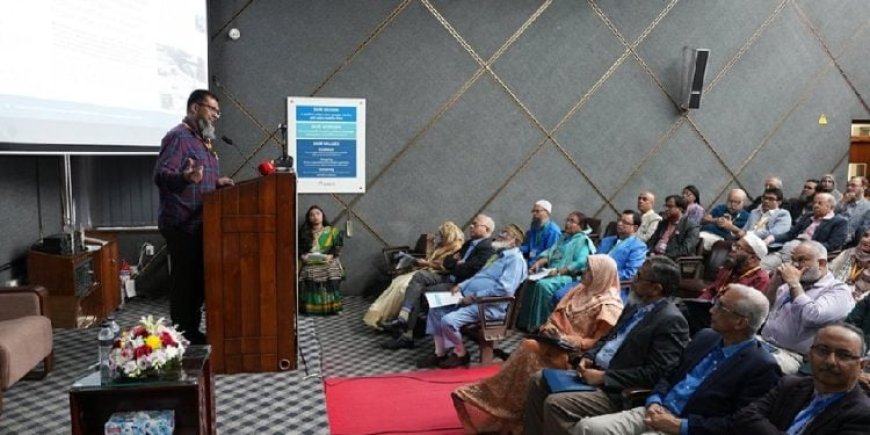



Researchers from icddr,b have developed a locally-made Bubble Continuous Positive Airway Pressure (Bubble CPAP) device for treating pneumonia in children. Highlighting the potential of this affordable respiratory support innovation, icddr,b organized a special seminar on Sunday, December 29. The researchers stated that BCAP has proven more effective than the World Health Organization's standard oxygen therapy and plays a critical role in reducing pneumonia-related child mortality rates in resource-limited regions.
The seminar, titled “Bubble Continuous Positive Airway Pressure (BCAP): A Locally Developed, Affordable, and Life-Saving Innovation for Treating Severe Pneumonia in Children – A Global Scale-Up Roadmap,” was attended by Professor Dr. Sayeba Akhter, Chairperson of the Bangladesh Medical Research Council, as the chief guest. Special guests included Professor Dr. Mesbah Uddin Ahmed, President of the Bangladesh Pediatric Association, and Professor Dr. Md. Mazharul Shaheen, Principal of Sir Salimullah Medical College.
In a keynote presentation, Professor Dr. Md. Abid Hossain Mollah from the Pediatrics Department of BIRDEM General Hospital (Child and Mother Wing) explained that clinical trials conducted at icddr,b demonstrated BCAP’s effectiveness in reducing pneumonia mortality by 75% compared to WHO-recommended low-flow oxygen therapy. BCAP also showed significantly lower treatment failure rates compared to high-flow and low-flow oxygen therapies. Despite its simple design and cost-effective production, the device proved more effective than many advanced respiratory support systems.
Professor Dr. Sayeba Akhter expressed her appreciation, stating, “I have always heard about Bubble CPAP but did not realize how effective it is. I thank our pediatricians for promoting this locally-developed innovation. If we face any problem, we must strive to solve it ourselves. I commend icddr,b for such innovations and for working with scientists who are tirelessly improving public health.”
Dr. Tahmeed Ahmed, Executive Director of icddr,b, remarked, “The success of Bubble CPAP exemplifies the impact of locally-developed innovations. Our next step is to expand its use in Bangladesh to save more children’s lives from pneumonia.”
Senior Scientist at icddr,b, Dr. Mohammad Zubair Chisti, shared findings from research, including clinical trials conducted in Bangladesh and Ethiopia, which confirmed that BCAP is more effective than many conventional methods. The technology is already being utilized in 37 hospitals in Africa, including 24 in Ethiopia, 12 in Nigeria, and one in Malawi, through implementation research. Dr. Chisti emphasized the importance of expanding this life-saving innovation to Bangladesh and other Asian countries.
The seminar also showcased the successful implementation of BCAP in Ethiopia. Trials conducted across 12 district-level hospitals revealed that BCAP reduced treatment failure by 74% and mortality by 86% compared to standard low-flow oxygen therapy.
Researchers concluded that the success in Ethiopia, coupled with ongoing efforts in Bangladesh, positions BCAP as a key player in reducing global pneumonia mortality rates. Expanding its use in Nepal and other countries aligns with icddr,b’s mission and contributes to achieving Sustainable Development Goal 3.









