

































Genetic Relationships Identified in Seconds
BAU Develops Faster DNA Analysis Software
- Researchers claim it is 55 to 1,747 times faster than MEGA
- Memory use is reportedly reduced by 30–99 per cent
- Desktop and web versions are now publicly available




Researchers at Bangladesh Agricultural University (BAU) have developed new software to identify genetic similarities and relationships between DNA sequences. They claim it can perform analyses 55 to 1,747 times faster than the popular software MEGA, while using 30 to 99 per cent less computer memory than conventional methods. Both desktop and web versions have been made publicly available.
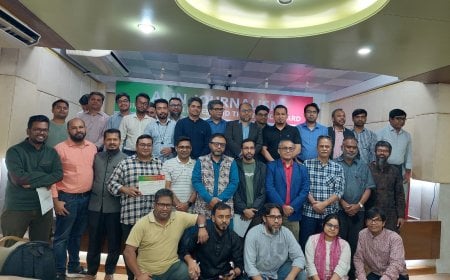
The researchers presented the software’s capabilities and applications at a workshop held on Monday afternoon, November 2, at the conference room of the Dean’s Office of the Faculty of Agricultural Engineering and Technology.
The research team was led by Dr Meshbah Uddin, Associate Professor in BAU’s Department of Computer Science and Mathematics (CSM). Other team members included postgraduate student Maifi-ul Asad and undergraduate students Muhammad Ishmam ul Haque and Md Asifuzzaman from the Department of Bioinformatics Engineering.

The researchers said DNA analysis is used to identify hereditary characteristics and relationships among organisms. However, analysing large volumes of DNA data through conventional methods can be time-consuming and requires substantial computer memory. The new software was developed with support from the government’s Information and Communication Technology Division to address these limitations.
The software is designed to quickly identify similarities between two or more DNA sequences. Conventional methods generally require individual sections of DNA to be compared separately. The new approach instead examines similarities among smaller segments of DNA. It also considers similarities in both the direct and reverse-complement arrangements of DNA sequences.
Based on these similarities, the software generates a numerical list for each DNA sequence. It then compares the lists to determine relationships among the sequences. These relationships can be used to construct a phylogenetic tree, which helps researchers understand genetic similarities and differences among organisms.
The research team claims that phylogenetic trees generated through the new method achieved 95 to 100 per cent accuracy in tests. A research paper on the work has been published in the international scientific journal Molecular Genetics and Genomics.
Dr Meshbah Uddin, head of the research team, said conventional methods can sometimes take nearly a month to identify structural similarities in DNA or proteins. In contrast, their software can produce accurate results within seconds, he said. It also requires comparatively less computer memory.
He added that both desktop and web versions of the software had already been released for public use, allowing researchers and students to access the tool.

The workshop, titled “Efficient Identification of DNA Sequence Similarity through Graphical User Interface-Based Desktop Software Development”, was attended by Professor Dr Md Abdul Majid, Dean of the Faculty of Agricultural Engineering and Technology, as the chief guest. The session was chaired by Md Said Iftekhar Yusuf, Head and Associate Professor of the CSM Department. Heads of departments, teachers and students from different departments of the faculty were also present.
In his remarks, Professor Dr Abdul Majid described the development of software for research applications through programming as a commendable initiative. He said the software, developed through three months of research, could play an important role in science and technology. He also stressed that ensuring practical use was as important as developing new technology.
Those involved in the project hope the software will reduce the time and memory required for DNA analysis while creating new opportunities for biotechnology and bioinformatics research in Bangladesh.
//DBTech/Arafat Hossain/SMP/MIST//