











































Call to Amend Controversial Clauses
Rights Groups Raise Concerns Over Cybersecurity Bill
- Speakers warned that proposed amendments could undermine free expression and civil rights
- They called for bail provisions and safeguards against arbitrary arrests
- HRSS presented 11 recommendations to revise the proposed amendments




Human rights activists, university teachers, journalists and lawyers have warned that proposed amendments to Bangladesh’s Cybersecurity Act could undermine freedom of expression and civil rights. They called for revisions to controversial provisions, expressing concern that the proposed changes could enable arbitrary arrests, criminal cases and pre-trial harassment.
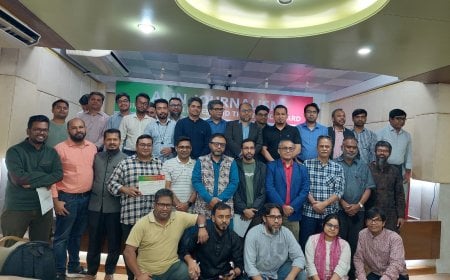
The concerns were raised at a roundtable titled “Freedom of Expression and Cybersecurity: Law, Reality and Human Rights” on Wednesday (18 November 2026). The event was held at the Tofazzal Hossain Manik Mia Hall of the National Press Club. Human Rights Support Society (HRSS) organised the discussion.
The session was chaired by HRSS Executive Director Ijazul Islam and moderated by the organisation’s Programme Officer Md Saiful Islam.
Speakers included Md Nur Khan, former member of the Disappearance Investigation Commission and the National Human Rights Commission; Shafiqul Alam, editor of the Daily Wada; Barrister Priya Ahsan Chowdhury, Supreme Court lawyer and adviser to BLAST; Dr Shibbir Ahmed, assistant professor in the Department of Economics at North South University; Fahim Mashrur, co-coordinator of Voice for Reform; Jaima Islam, senior reporter at The Daily Star; Mabrur Mohammad, adviser to Ain o Salish Kendra (ASK); and Saima Shannon, assistant human rights officer at the United Nations human rights office.
Two people who said they had suffered because of their expression also shared their experiences and the difficulties they faced.
One was Sathi Akter, a woman entrepreneur who was detained after expressing anger and criticising the government during a Facebook Live session in Bhaluka, Mymensingh. The other was content creator A M Hasan Nasim, who is an accused in a case filed under the Cybersecurity Act over criticism of the Prime Minister and the Chief Whip on social media.
At the beginning of the discussion, HRSS Executive Director Ijazul Islam presented an analytical report and recommendations titled “Concerns Over the Proposed Amendments to the Cybersecurity Act: Risks to Freedom of Expression and Civil Rights, and Calls to Amend Controversial Provisions”.
HRSS Monitoring Officer Abu Sadat Mohammad Sayem also presented a special report on the state of freedom of expression in Bangladesh from January to October this year.
Nur Khan questioned the effectiveness of successive digital and cyber laws introduced over nearly a decade.
“Almost a decade has passed since one digital and cyber law after another was introduced. But what has been the actual outcome?” he asked.
He said ordinary citizens were not receiving adequate protection. Instead, he argued, efforts were being made to protect the ruling political party and its members. Even people making reasonable criticism, he said, were facing consequences.
“Sometimes a journalist or an editor becomes the accused in more than a hundred cases. Their time is spent running from one court to another,” he said.
Nur Khan also raised concerns about criminal defamation provisions. He argued that defamation should not be treated as a major criminal matter, warning that such cases could lead to social, psychological and financial harassment.
Shafiqul Alam said he did not want the Cybersecurity Act to contain provisions for imprisonment. He called on civil society, human rights defenders and journalists to speak out collectively on the issue.
He said meetings had been held with different groups over the proposed amendments after the cyber law came into effect. Written information and opinions had also been collected from journalists. However, he said, the central question in reforming the law should be how much freedom people have to express their views.
Barrister Priya Ahsan Chowdhury said restricting opportunities to speak and limiting the free flow of information could create more room for misinformation to spread. She argued that legal measures alone would not be sufficient and that institutional reforms were also necessary.
She said the revised draft had classified speech-related offences as cognisable and non-bailable. This, she warned, could allow arrests without warrants and make pre-trial harassment the main form of punishment.
At the roundtable, HRSS presented 11 recommendations and demands to the government. These are:
1. All controversial provisions of the proposed law must be revised to ensure consistency with Article 39 of the Constitution, international human rights instruments and the International Covenant on Civil and Political Rights (ICCPR).
2. Criminal defamation provisions in cyberspace should be removed, with civil remedies given priority. Legal protection must be ensured for news, information and criticism published in the public interest.
3. The definitions of offences related to rumours and misinformation must be precise. Publishing inaccurate information alone should not provide grounds for bringing criminal charges against anyone.
4. Political satire, cartoons, opinions, criticism of the government, investigative journalism and peaceful expressions of dissent must be protected from misuse of the law.
5. Blocking or removing online content must require independent judicial approval. Transparency, written explanations and prompt opportunities to appeal must also be guaranteed.
6. Speech-related offences must be made bailable. Effective legal safeguards must be introduced to prevent arbitrary arrests and harassment through criminal cases.
7. Searches, the seizure of digital devices and arrests must be subject to proper judicial oversight. Protection of personal data and compliance with due process must be mandatory.
8. Equal rights to freedom of expression and legal protection must be guaranteed not only to registered media outlets but also to journalists, human rights defenders, researchers, online content creators and ordinary citizens.
9. The National Cybersecurity Council must be made independent, inclusive of multiple stakeholders and politically neutral. The chairperson of the National Human Rights Commission should be reinstated on the council, while private-sector experts should be selected through a transparent process.
10. Alongside the immunity provision under Section 52, the law must provide compensation and effective remedies for citizens subjected to unlawful arrests, unjustified content blocking or abuse of power.
11. Before the proposed law is finalised, meaningful consultations must be held with human rights organisations, journalist associations, legal experts, technologists, civil society groups and other relevant stakeholders.
//DBTech/ANSCN/RESME/FOPTE//









