








































AI for Impact: Experts Stress Real-World Applications of Artificial Intelligence



Experts have emphasized the importance of applying artificial intelligence (AI) technology effectively in everyday life, healthcare, education, agriculture, and urban management instead of limiting it to research laboratories. They said the true social impact of AI can only be ensured by using research-driven knowledge to solve real-world problems.
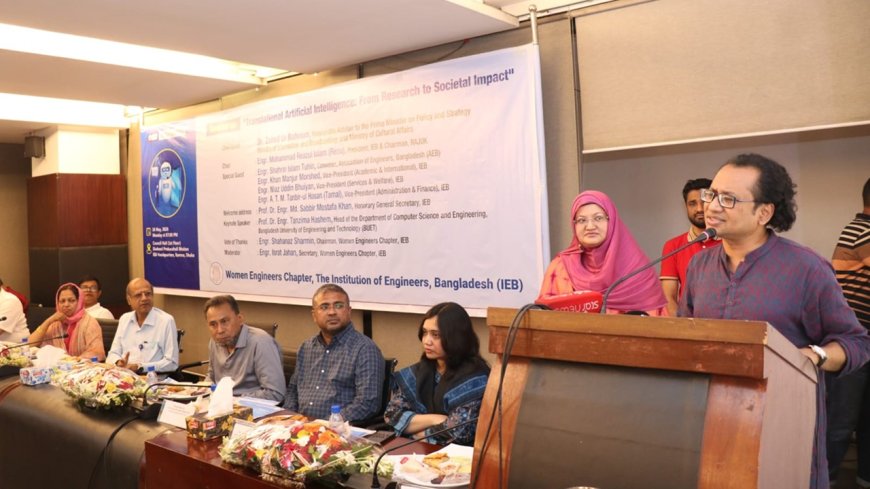
The remarks were made at a seminar titled “Translational Artificial Intelligence: From Research to Societal Impact,” held on Monday evening, 18 May, at the Council Hall of the headquarters of the Institution of Engineers, Bangladesh in Ramna, the capital. The seminar was organized by the IEB Women Engineers Chapter.
Speaking as the chief guest, Dr. Jahed-ur Rahman, Adviser (Policy and Strategy) to the Ministry of Information and Broadcasting and Ministry of Cultural Affairs, said there is no alternative to acquiring AI expertise in order to keep pace with the rapidly evolving technology-driven world. Highlighting the role of AI in making human life easier, he said the technology could be especially helpful in healthcare, including behavioral analysis and improving therapy effectiveness for children with autism.
As a special guest at the event, Engineer Shahreen Islam Tuhin, Convener of the Association of Engineers Bangladesh, emphasized the importance of AI in smart city management through advanced cameras, sensors, and digital networks to ensure rapid response during accidents or emergency situations.
In the welcome speech at the beginning of the program, IEB Honorary General Secretary Professor Dr. Engineer Md. Sabbir Mostafa Khan highlighted both the positive impact of increasing AI and robotics usage in the global ready-made garment industry and the need to consider its effects on employment and the risks of technology dependency.
The keynote paper was presented by Professor Dr. Engineer Tanjima Hashem, Head of the Department of Computer Science and Engineering at Bangladesh University of Engineering and Technology. She explained that when AI technologies developed in research laboratories create an impact on society and the economy by solving practical problems, it is referred to as “Translational Artificial Intelligence.” She elaborated on various applications and possibilities of AI-based technologies in disease diagnosis in healthcare, crop disease detection and production enhancement in agriculture, and personalized learning systems in education.
The seminar, chaired by IEB President and RAJUK Chairman Engineer Mohammad Riazul Islam (Riju), also stressed the importance of ensuring the proper use of approved parking systems in buildings alongside the application of technology in urban management.
The chair stated that important recommendations emerging from the seminar would be forwarded to the relevant ministries and departments for implementation initiatives.
Delivering the vote of thanks, Engineer Shahanaz Sharmin Sarkar, Chairman of the IEB Women Engineers Chapter, described the initiative to formulate AI-related policies for the 2026–2036 period as timely and called for ensuring women’s participation in the technology sector.
Moderated by Women Engineers Chapter Secretary Engineer Ishrat Jahan, the seminar speakers also placed special emphasis on enriching Bangla-language data repositories.
Leaders from various departments of IEB, members of the central council, and representatives from different engineering organizations were present at the event.
DBTech/FA/MI/OR









