





































Power Problems Persist Despite Rising Generation Capacity



Despite having power plants and increased electricity generation capacity, Bangladesh is still unable to produce electricity at full scale according to demand due to a severe fuel shortage. High production costs, import dependency, and rising government subsidies have further intensified the crisis. Policymakers and experts have stressed the need to prioritise renewable energy, energy efficiency, and long-term planning to overcome the limitations facing the power sector.
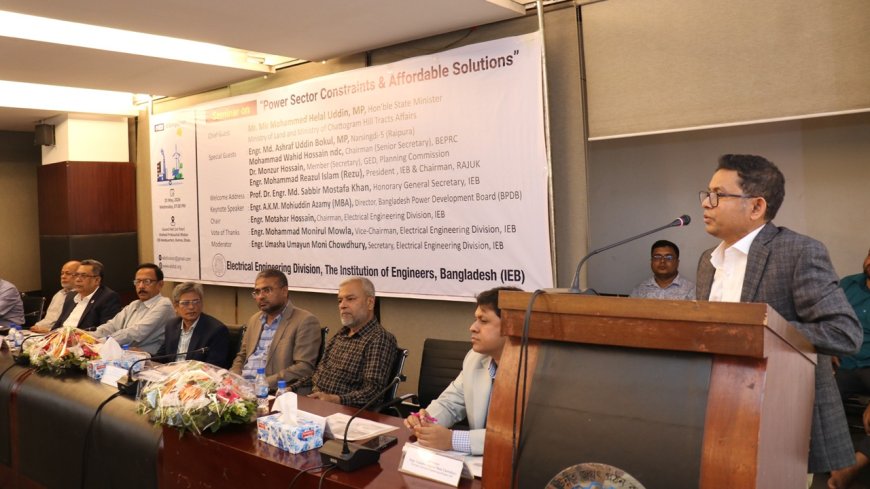
The remarks were made at a seminar titled ‘Power Sector Constraints & Affordable Solutions’ held on Wednesday evening, May 20, at the headquarters of the Institution of Engineers, Bangladesh (IEB) in Ramna, Dhaka. The seminar was organised by the Electrical Engineering Division of IEB.
State Minister for Land and Chittagong Hill Tracts Affairs Mir Mohammad Helal Uddin attended the seminar as the chief guest. He said that greater emphasis must be placed on renewable energy to ensure the country’s energy security. According to him, there is significant potential to increase solar power generation through rooftop solar systems, agricultural land, government khas land, and unused land.
The state minister said the government is working toward a target of generating 5,000 megawatts of electricity from renewable sources. He added that not only the government but also private sector organisations must come forward to invest in this sector. The use of renewable energy can be expanded through joint public-private initiatives.
Referring to environmentally friendly transportation systems, he said initiatives have been taken to import electric vehicles in order to save fuel and reduce pollution. In particular, there are plans to gradually convert vehicles used in educational institutions into electric vehicles.
Speaking as a special guest, Bangladesh Energy Regulatory Commission (BERC) Chairman Mohammad Wahid Hossain said the country’s main challenge in the energy sector is now the fuel shortage. At the same time, Bangladesh still lags far behind in the use of renewable energy.
He said long-term planning is essential to address the crisis. He also stressed the need to restructure or gradually shut down unprofitable and unnecessary energy-related institutions. In addition, he emphasised effective negotiation in fuel imports and tariff determination.
Planning Commission General Economics Division (GED) Member (Secretary) Dr. Monjur Hossain said that although the country has electricity generation capacity, it cannot fully utilise it due to a lack of fuel supply. Many power plants are unable to operate at full capacity because of insufficient fuel availability.
He said the use of alternative energy sources such as solar and wind power must be expanded to overcome the situation. This would reduce import dependency and make it easier to ensure long-term energy security.
In his welcome speech, IEB Honorary General Secretary Professor Dr. Engineer Md. Sabbir Mostafa Khan said that although quick rental power plants were established in the past to address electricity shortages, operating them now requires massive subsidies. In the long term, such expenditures are creating pressure on the national economy.
He added that expanding the use of gas-based technologies could reduce electricity generation costs. However, land scarcity remains a major challenge for solar power projects. In a densely populated country like Bangladesh, implementing large-scale solar power projects faces serious land constraints.
Presenting the keynote paper, Bangladesh Power Development Board (BPDB) Director Engineer A K M Mahiuddin Azmi said that despite development in the power sector, dependence on imported fuel, high production costs, and infrastructural limitations have become major challenges.
He said that increasing solar power generation through rooftop solar systems, solar parks, solar panels on agricultural land, and the use of government khas land would reduce production costs in the long run and strengthen energy security.
The seminar was chaired by Engineer Motahar Hossain, Chairman of the Electrical Engineering Division of IEB. It was moderated by the division’s Secretary Engineer Umashah Umayun Moni Chowdhury, while Vice Chairman Engineer Mohammad Monirul Mawla delivered the vote of thanks.
Leaders of the IEB central and Dhaka centres, along with representatives from various engineering organisations, were present at the event.
DBTech/FA/EK/OR









