



































WASH Funding Fall Fuels Public Health Fears
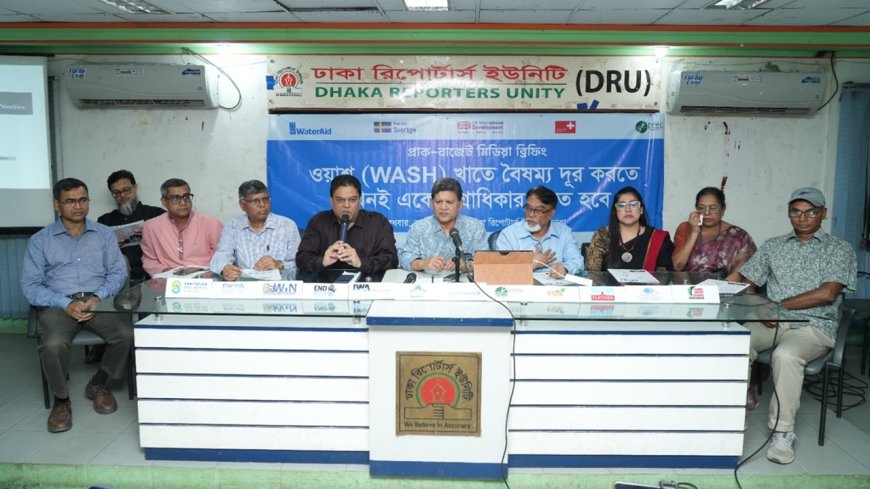



The Network of WASH Networks has expressed deep concern over the decline in government allocations for the Water, Sanitation and Hygiene (WASH) sector. The concern was highlighted on Wednesday at a pre-budget press conference held at the Dhaka Reporters Unity in Segunbagicha of the capital.
At the press conference, the policy brief was presented by Dr. Hossain Zillur Rahman, Executive Chairman of the Power and Participation Research Centre (PPRC). The policy brief was prepared by Dr. Hossain Zillur Rahman and Senior Fellow Mohammad Abdul Wazed in consultation with leaders of the Network of WASH Networks.
It was stated at the press conference that allocations for the WASH sector have declined by nearly 40 percent over the past three years. In the 2022–23 fiscal year, the allocation for the sector stood at Tk 18,728 crore. It has dropped to Tk 10,901 crore in the 2025–26 fiscal year. Due to the impacts of climate change, rising sea levels and repeated flooding are causing latrines in coastal areas to overflow, contaminating water sources. Meanwhile, in the Barind region of northern Bangladesh, uncontrolled use of thousands of submersible pumps, excessive irrigation, and the absence of groundwater recharge initiatives are causing groundwater levels to fall alarmingly.
Presenting the policy brief, Dr. Hossain Zillur Rahman said the decline in allocation has put the achievement of Sustainable Development Goal-6 and climate resilience at risk. He noted that the WASH sector allocation had reached a peak of Tk 187.28 billion (Tk 18,728 crore) in the 2022–23 fiscal year. However, since then, the sector has experienced a sharp and continuous decline in allocations. In the 2023–24 fiscal year, the allocation dropped to Tk 149.81 billion.
He further said that in the 2024–25 fiscal year, the allocation declined further to Tk 116.17 billion, and in the current 2025–26 fiscal cycle it has fallen to its lowest point at Tk 109.01 billion. In other words, allocations in the sector have decreased by nearly 40 percent within just three years, exposing a stark contradiction between the country’s growing national development budget and shrinking allocations for essential sectors such as public health, local government infrastructure, and water management.
The press conference also stated that although 98 percent of the country’s population uses improved water sources, only 55 percent have access to safe drinking water. While 71 percent of urban residents have access to safe water facilities, the figure is only 48 percent in rural areas.
The event also highlighted urban-centric disparities in the WASH sector. Although a major portion of the development budget is allocated to cities and WASAs, vulnerable regions such as chars, haors, coastal, and hilly areas have received only 10.22 percent of the allocation.
It was further stated that Dhaka WASA alone received nearly 29 percent of the country’s total WASH allocation. On the other hand, several major cities received no allocation at all in the current fiscal year.
Advocate Faiyazuddin Ahmed, Head of Policy Advocacy at WaterAid Bangladesh, said the safe water crisis is becoming more severe in rural areas due to arsenic and bacterial contamination. He said that according to the preliminary Multiple Indicator Cluster Survey (MICS) 2025 report, although 98 percent of the population uses improved water sources, only 55 percent of people nationwide actually receive safely managed drinking water that is available within household premises, accessible when needed, and free from chemical and microbial contamination.
He added that arsenic and bacterial contamination in rural tube wells, along with structural financing disparities, have created a massive 23 percent gap between urban safe drinking water access (71 percent) and rural access (48 percent).
The press conference recommended increasing allocations for the WASH sector, prioritising rural and climate-vulnerable areas, introducing WASH allowances for poor families, and installing gender-friendly toilets in schools.
Among others present at the event were Mohammad Zobayer Hasan (International Water Association), Ishrat Shabnam (FSM Network), Mohammad Anowar Hossain (BWWA), Rebecca San Yat (CUP), Muhammad Saiful Islam (BAUWIN), Joseph Halder (FANSA), and Md. Fazlul Haque (EWP).
DBTech/FI/EK/OR









