





































Experts Warn of Mounting Economic Burden in Bangladesh’s Power Sector



Experts have warned that Bangladesh’s power sector is creating a major economic burden due to excess generation capacity, dependence on imported fuel, capacity charges, and rising subsidies. They stressed the need for coordinated policies, realistic planning, and greater emphasis on renewable energy to address the long-term crisis.
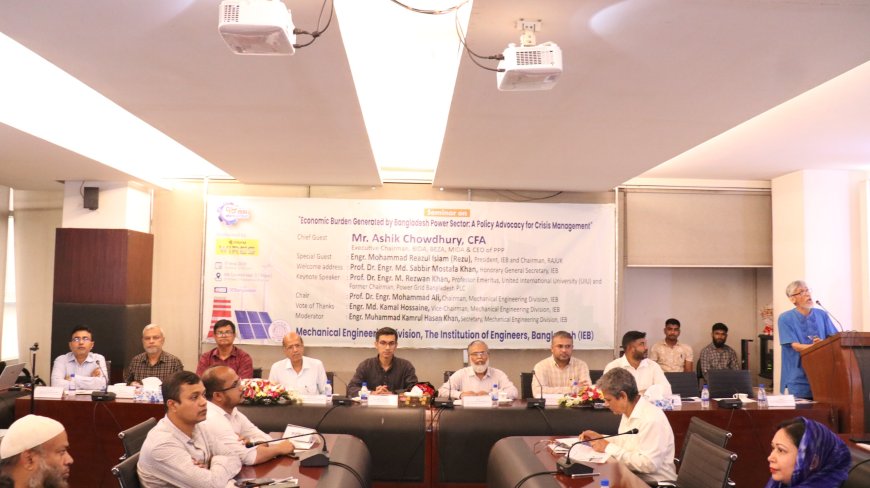
The observations came during a seminar titled “Economic Burden Created in Bangladesh’s Power Sector: Policy Recommendations for Crisis Management”, held on Sunday at the Council Hall of the Shaheed Prokousholi Bhaban at Institution of Engineers Bangladesh headquarters in Ramna, Dhaka. The seminar was organized by the Mechanical Engineering Division of the institution.
While speaking as the chief guest, Ashik Chowdhury, Executive Chairman of Bangladesh Investment Development Authority (BIDA), Bangladesh Economic Zones Authority (BEZA), and the Myanmar Economic Zone Authority (MIDA), as well as Chief Executive Officer of Public-Private Partnership (PPP), said reliable energy systems are essential for economic growth and industrialization.
However, he noted that Bangladesh’s energy sector is currently operating in a “negative position” due to multiple limitations and financial pressures.
Ashik Chowdhury said the government is now carrying major obligations stemming from previously signed international agreements and understandings. In particular, he warned that capacity charges in the power sector are creating long-term pressure on the national economy, as payments must be made to power plants even when no electricity is produced.
He urged greater focus on renewable energy, especially solar power, saying Bangladesh’s geographical location and abundant sunlight could help reduce import dependency and ease economic pressure.
While speaking as a special guest, Mohammad Riazul Islam, President of Institution of Engineers Bangladesh and Chairman of Rajdhani Unnayan Kartripakkha (RAJUK), said years of mismanagement and waste have severely damaged the country’s gas sector.
He said the lack of proper planning and unwise utilization of gas resources has negatively affected industries, electricity generation, and the daily lives of ordinary citizens.
In his welcome address, Professor Dr. Engineer Md. Sabbir Mostafa Khan, Honorary General Secretary of IEB, said many past power-sector projects were undertaken without adequate assessment of long-term effectiveness or economic viability, resulting in excessive pressure on the national economy.
He added that because most power plants in Bangladesh depend on imported fuel, production costs rise sharply whenever international energy prices increase. To overcome the situation, he recommended expanding the use of domestic energy resources alongside renewable energy development.
The keynote paper was presented by Professor Dr. Engineer M. Rezwan Khan, Emeritus Professor at United International University and former Chairman of Power Grid Bangladesh PLC.
He stated that although Bangladesh’s electricity generation capacity has increased significantly over the past decade, the sector is now facing a deep financial crisis.
According to him, generation capacity has exceeded actual demand, leaving many power plants idle. Yet under existing agreements, the government must continue paying capacity charges to those plants, creating a major financial liability for Bangladesh Power Development Board (BPDB).
Professor Rezwan Khan further said that declining domestic gas production has forced the power sector to become increasingly dependent on imported LNG, coal, and oil. As international fuel prices continue to rise, the government is being compelled to provide larger subsidies, putting additional pressure on foreign currency reserves.
The seminar was chaired by Professor Dr. Engineer Mohammad Ali, Chairman of the Mechanical Engineering Division of IEB. The session was moderated by Engineer Muhammad Kamrul Hasan Khan, while the vote of thanks was delivered by Engineer Md. Kamal Hossain.
The event was attended by IEB central leaders, council members, representatives from different engineering divisions and chapters, and engineers from various organizations.
DBTech/SI/MUM/OR









