

































Draft National AI Policy Released for Public Review and Feedback
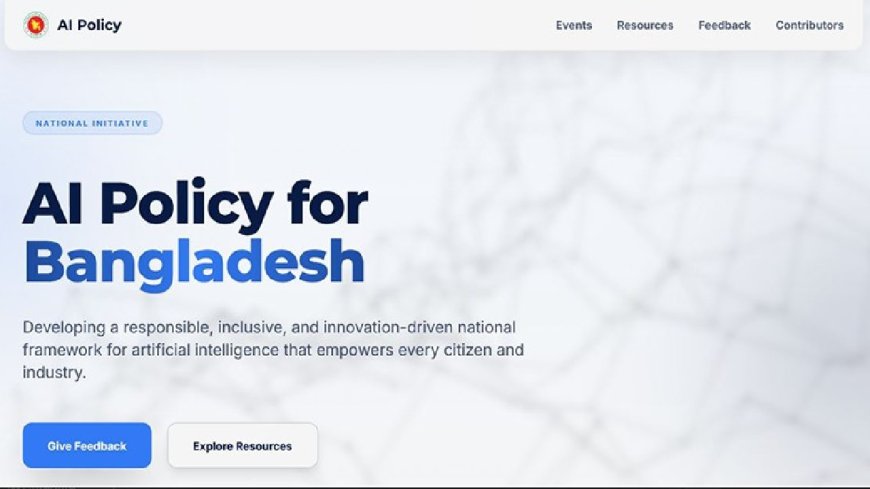



The interim government has published the draft of the Bangladesh National Artificial Intelligence (AI) Policy (2026–2030) for public review and opinions. An online feedback page has been opened to solicit views from citizens, relevant industry stakeholders, civil society representatives, academics, and all interested parties. Feedback can be submitted through the designated portal at https://aipolicy.gov.bd/feedback. Details of the draft policy itself are available on the official policy platform.
The draft policy proposes mechanisms to ensure secure data sharing among government agencies by leveraging the National Data Management Ordinance (2025). At the same time, it places strong emphasis on safeguarding citizens’ privacy and maintaining digital sovereignty over critical national data assets. Human rights, transparency, and accountability have been established as essential and non-negotiable core principles. Under this framework, mandatory “algorithmic impact assessments” are required for high-risk AI systems, alongside specific safeguards to prevent discrimination.
The policy adopts a tiered, risk-based regulatory framework that outright bans unacceptable uses of AI, such as social scoring and mass surveillance. It also ensures appropriate protective measures for the deployment of high-risk systems in critical sectors, including law enforcement, healthcare, employment, and public services.
Significant emphasis has been placed on combating crimes such as deepfakes, AI-generated misinformation and disinformation, technology-facilitated gender-based violence, and the exploitation of children. These measures are designed to align with the Cyber Security Ordinance (2025). To encourage innovation, the policy proposes the establishment of an “AI Innovation Fund” and the creation of a “regulatory sandbox” to enable safe experimentation. Additionally, initiatives have been outlined to build a skilled and AI-ready workforce by integrating AI education into secondary, higher, and technical curricula.
The policy presents a vision for fostering an ethical and innovation-driven AI ecosystem aligned with Bangladesh’s digital transformation goals and the United Nations Sustainable Development Goals (SDGs). Priority has been given to the use of AI in modernising public services, increasing agricultural productivity, improving healthcare, enhancing disaster response capabilities, and generating high-quality employment.
The framework also connects Bangladesh to international AI governance architectures, including the OECD AI Principles, UNESCO’s Recommendations on AI Ethics, the Council of Europe’s AI Framework Convention, and ASEAN AI guidance. Through this alignment, Bangladesh aims to position itself as a responsible and competitive partner in regional and global AI development, facilitating knowledge exchange and economic cooperation.
According to the ICT Division, the policy has been formulated to establish a safe, ethical, and innovation-centric AI ecosystem in Bangladesh. In a press release issued by the ministry on January 28, it was stated that the National AI Policy marks a fundamental shift from previous approaches to digital policymaking. The earlier AI policy, formulated under the Awami League government, was largely service-oriented and closely linked to the political agenda of “Smart Bangladesh.” In contrast, the new framework prioritises the foundational requirements necessary for responsible AI development and deployment.
The statement further noted that the policy builds on recent initiatives of the interim government, including the establishment of a national data management framework and the enforcement of the Personal Data Protection Ordinance (2025). These foundational steps provide the legal and technological infrastructure essential for secure and equitable AI development in Bangladesh.
DBTech/Press Release/EK/OR