





















Engineer Quamrul Islam Siddique Is Now More Relevant Than Ever: Hossain Zillur Rahman
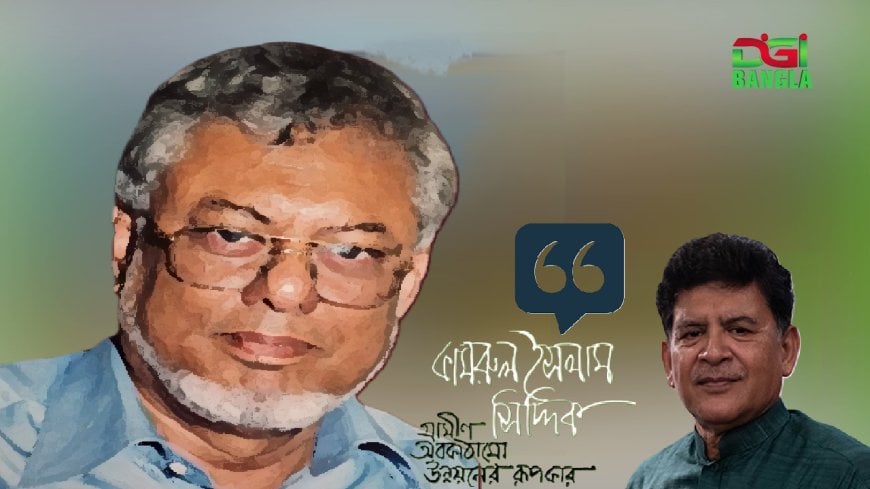



Today marks 20 January, the birth anniversary of Quamrul Islam Siddique, born on this day in 1945 in Kushtia. While serving as an assistant engineer at the district council, he plunged into the Liberation War of Bangladesh. After independence, he dedicated his life to engineering-led development aimed at achieving socio-economic emancipation.
He went on to establish the Local Government Engineering Department (LGED) and, by effectively engaging donor agencies such as the World Bank and JICA, brought about a fundamental transformation in Bangladesh’s rural communication infrastructure. He emerged as the principal architect of rural Bangladesh’s infrastructural development.
The development framework he laid down extended far beyond roads. It encompassed environmental improvement, integrated water resources management, strategies to secure Bangladesh’s rightful share of international river waters, the vision of a modern, clean and dynamic Dhaka through metro and underground rail systems, and pioneering initiatives in renewable energy infrastructure to ensure uninterrupted electricity and commercial fuel supply. This visionary engineer left behind an enduring legacy through his forward-looking leadership.
On the occasion of the 81st birth anniversary of this “exceptional personality,” Dr Hossain Zillur Rahman, former adviser to the caretaker government, underscored the renewed relevance of discussing Quamrul Islam Siddique’s life and work. The BRAC chairperson called for nationwide engagement with his philosophy and contributions.
In his words, Bangladesh today suffers from a national malaise where sycophancy and bureaucratic file-pushing overshadow results. Addressing this ailment, he said, requires multiple-fold discussion of the life and professionalism exemplified by Quamrul Islam Siddique. He added that he was not surprised by the fact that such a towering figure has yet to receive formal state recognition.
“Honours themselves have been devalued,” he said. “In such a context, his absence from official recognition is itself a reality. But his dignity will remain preserved in history. His competence, professionalism, mental strength and humanism must be nurtured in the national interest. Otherwise, our own credibility will come into question.”
Dr Rahman noted that Quamrul Islam Siddique placed little importance on formalities; his focus was unwaveringly on professionalism—a quality whose absence is starkly visible today. “Professionalism combined with social responsibility defined his work. He prioritised solution-oriented thinking,” he added.
Recalling Siddique’s unique role in installing rubber dams in Cox’s Bazar, the economist and educationist said that when the Bangladesh Water Development Board showed little interest in the project, Siddique’s patriotism and foresight led to LGED’s involvement. As a result, the region was able to overcome both flooding and drought, long-standing curses for local communities.
Though an engineer by profession, Quamrul Islam Siddique had a deep love for nature, Dr Rahman noted. He possessed a strong aesthetic sense and prioritised environmental considerations. LGED buildings were designed to preserve existing trees, and each LGED office included a garden. Long before climate discourse became mainstream, he was already environmentally and climate conscious.
Dr Rahman highlighted three lesser-discussed yet groundbreaking qualities of this unconventional chief engineer. Throughout his career, Siddique actively integrated women and marginalised communities into the development mainstream. He recalled the formation of Labour Contracting Societies (LCS) to engage poor women in LGED projects, including roadside afforestation initiatives.
“Such examples of professionalism deserve far greater remembrance,” he concluded.
DBTech/IH/MUM/OR