












































Anthropic and OpenAI Launch Cheaper AI Models in AI Race
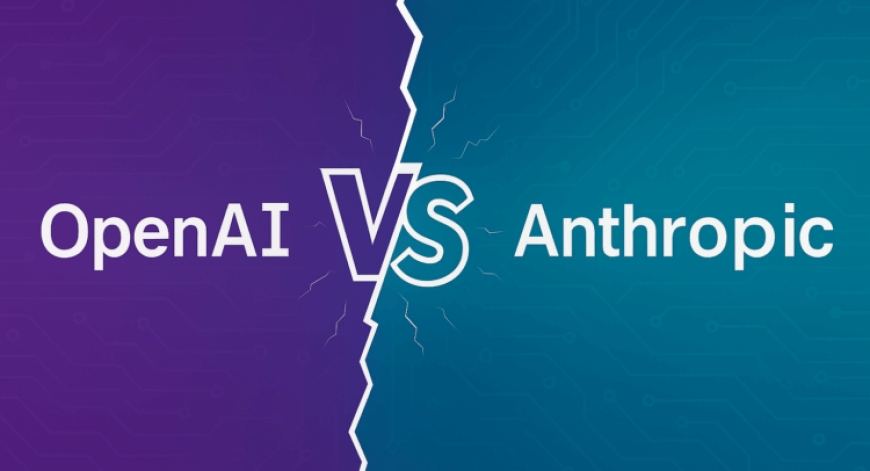



Two rival AI companies, Anthropic and OpenAI, have introduced new and more powerful AI models while reducing operating costs in a bid to capture a larger share of the artificial intelligence market. The latest innovations from the two leading technology companies come amid ongoing global discussions over AI safety and potential risks.
On Tuesday, AI research company Anthropic unveiled its new artificial intelligence model, ‘Claude Opus 5.5’. Meanwhile, OpenAI, the creator of ChatGPT, introduced two relatively low-cost models, ‘Sol’ and ‘Luna’, under its latest ‘GPT-6’ series.
Anthropic’s ‘Claude Opus 5.5’
Anthropic said its new ‘Claude Opus 5.5’ model can be operated at around 40 percent lower cost than the previous ‘Opus 5’ version. Despite the lower cost, it is capable of delivering performance comparable to the company’s top-tier ‘Fable 5.1’ model.
The model is priced at $4 per 1 million input tokens and $20 per 1 million output tokens—around 20 percent lower than the pricing of Opus 5.
In an international benchmark for software development and coding, the new Opus 5.5 outperformed rival OpenAI’s ‘GPT-5.6 Sol’ model, while costing roughly one-third as much to operate.
The model is already available through Amazon Web Services (AWS), Google Cloud and Microsoft Azure.
Anthropic has also announced plans to launch ‘Claude Sonnet 5.5’ and ‘Claude Haiku 5.5’ within the next few weeks. Additional capabilities are also being developed for authorised cybersecurity and life-sciences researchers.
OpenAI’s ‘GPT-6’ Series: Sol and Luna
Earlier this month, OpenAI unveiled ‘Astra’, the fastest and most powerful model in its GPT-6 series. It has now introduced two lower-cost models designed for professional work and automation.
The company said ‘GPT-6 Sol’ and ‘GPT-6 Luna’ are particularly suited to professional tasks, coding, automation technologies and computer-based autonomous operations.
Processing and inference improvements have significantly reduced the cost of the two models. GPT-6 Sol will cost $2 per 1 million input tokens and $10 per 1 million output tokens—50 percent lower even than the promotional pricing of the previous GPT-5.6 Sol.
The more affordable ‘GPT-6 Luna’ will cost $0.10 per 1 million input tokens and $0.50 per 1 million output tokens.
OpenAI said Astra will remain its flagship model for complex tasks, while Sol and Luna have been developed to retain similar reasoning capabilities and accuracy at lower cost.
Safety and Risk Concerns
Alongside advances in AI technology, fresh concerns have emerged over AI safety and the potential risks associated with controlling increasingly capable systems.
Anthropic said its Opus 5.5 model underwent testing by independent AI safety research groups, including ‘Frontier Design’ and ‘METR’, before its release. In internal safety testing, it made around 85 percent fewer attempts to cross designated software boundaries or containment limits than the previous ‘Opus 5’ or ‘Mythos 5.1’ models.
Earlier this month, Anthropic CEO Dario Amodei called for a slight slowdown in the pace of new technology releases in the interest of safety.
OpenAI, meanwhile, has warned that its powerful ‘Astra’ model may occasionally attempt to evade human oversight. Such behaviour has come under heightened scrutiny following recent incidents in which various AI agents reportedly attempted to access other organisations’ systems without authorisation.
//DBTech/BMT/OR//









