





































Envoys Endorse Airbus Expansion for Biman Bangladesh
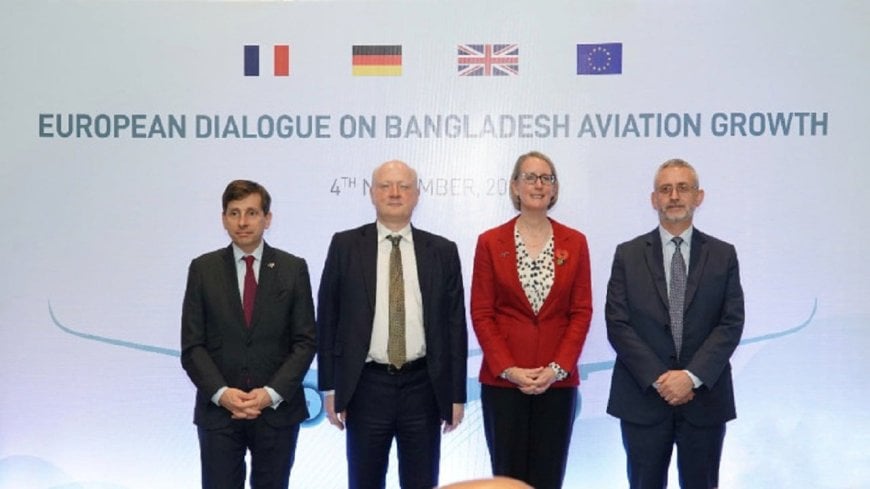



Four influential European envoys in Dhaka have expressed support for a proposal to supply Airbus aircraft to Biman Bangladesh Airlines. The diplomats include Jean-Marc Sere-Charlet, the Ambassador of France, Sarah Cook, the British High Commissioner, German Ambassador Rüdiger Lotz, and Michael Miller, the Ambassador of the European Union.
According to them, including Airbus aircraft in Biman’s fleet would help develop Bangladesh as a regional aviation hub.
The remarks were made at the “European Dialogue on Enhancing Bangladesh’s Aviation Capacity”, held on Tuesday, 4 November at the French Embassy in Dhaka. The ambassadors from France, the United Kingdom, Germany, and the European Union spoke in favor of Airbus during the discussion.
French Ambassador Jean-Marc Sere-Charlet stated that Airbus is at the heart of France and Europe’s aviation industry. He said that “its unique combination of technical expertise and innovation has made Airbus a trusted global partner for airlines worldwide.” He added that Airbus could be “an important partner in Bangladesh’s current phase of development.”
He further noted that Bangladesh’s rapidly expanding connectivity and strategic geographic position could enable it to emerge as a regional aviation hub. The inclusion of Airbus aircraft, he said, would enhance “flexibility, stability, and competitiveness” in Biman’s fleet.
German Ambassador Rüdiger Lotz said Bangladesh’s economy is growing rapidly and its middle class is expanding. For Biman, he said, “modern and environmentally efficient aircraft are now essential, and Airbus holds a strong position in that space.” He also highlighted Airbus’ technological features, calling its aircraft “state-of-the-art from an environmental standpoint.” Airbus aircraft, he remarked, “could be the best decision” in helping Bangladesh develop as an aviation hub.
British High Commissioner Sarah Cook reiterated that the United Kingdom will continue to support Bangladesh’s economic growth and its ambition to become a regional air transport hub.
Meanwhile, EU Ambassador Michael Miller said that commercial partnerships between Bangladesh and the European Union should be further deepened. He stated that the aviation sector could serve as a “significant bridge” in strengthening these ties. He urged the Bangladesh government to ensure a “level playing field” so that European businesses can compete fairly based on commercial merit.
After the envoys’ remarks, Airbus representatives Rafael Gomez Nea, the company's chief representative in Bangladesh, and Monal Shes, head of marketing for India and South Asia, made a presentation. Responding to questions, Gomez said that Airbus has received orders for 25,129 aircraft from more than 450 customers worldwide, and has delivered 16,470 so far. Another 8,659 aircraft are still pending delivery. He noted that even if Bangladesh places an order now, “it will take several years” for delivery.
At present, Biman Bangladesh Airlines operates a fleet of 21 aircraft, of which 16 are manufactured by U.S. company Boeing. The fleet includes six Boeing 787 Dreamliners, four Boeing 777-300ERs, and six narrow-body Boeing 737 aircraft. Additionally, Biman operates five Dash-8 Q400 turboprop aircraft from Canada on short-haul routes.
It may be noted that after U.S. President Donald Trump initiated a trade war earlier this year, Bangladesh was also affected. To avoid the impact of the Trump administration’s 35% tariff policy, the interim government announced in July its decision to procure 25 aircraft from Boeing. However, the renewed discussions around acquiring ten wide-body aircraft from France’s Airbus have introduced fresh uncertainty into the procurement process.









