










































Emphasizing skilled workforce for technology
AI summit highlights cyber security, job risks
- AI Business Summit discussed artificial intelligence prospects and risks
- Government emphasized building supportive environment and responsive policies
- Experts urged adopting AI in e-commerce, agriculture, education




With the rapid advancement of information technology in the era of the Fourth Industrial Revolution, the increasing adoption of artificial intelligence (AI) across enterprises and workplaces reduces costs and boosts efficiency, yet experts remind of cybersecurity and employment risks. Experts state that alongside expanding AI adoption, focus must be placed on framing policies to manage risks and developing a skilled workforce.
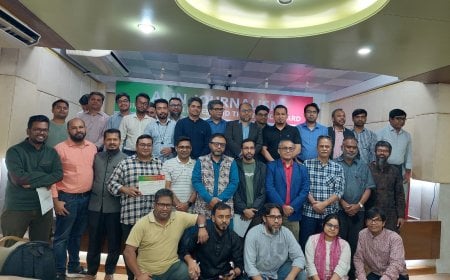
Speakers elaborated on these issues during a session at the three-day 'Bangladesh AI Business Summit 2026' held at the Bangladesh-China Friendship Conference Center in Sher-e-Bangla Nagar, Dhaka on Thursday, November 5. Jointly organized by the Ministry of Science and Technology and the Dhaka Chamber of Commerce and Industry (DCCI), the day-long conference was inaugurated by President Mirza Fakhrul Islam Alamgir.
During the session titled 'Transformation and Navigating AI Revolution: Applications, Prospects and Challenges', audience member Abu Hurairah stated, "We definitely need AI. But while it offers prospects, it also brings risks. Just as there are cyber risks, it will also create employment risks. Government policies should be formulated considering these factors."
In the following Q&A session, Secretary of the Ministry of Science and Technology Anwar Hossain stated that the government's role is to facilitate and support an AI-friendly environment, and the government is doing that work. However, remarking on the shortage of skilled human resources in various sectors including healthcare, he noted that the time has come to integrate AI into public administration to save time and accelerate workflows.

He stated, "It takes our officials 5 to 7 days to prepare meeting minutes. If we can develop an AI in Bangla that generates minutes right after a meeting ends, it will save time." Highlighting risk considerations, Anwar Hossain added, "We also need to observe whether an AI bubble occurs. However, we will not close our doors; we will keep them open. Discussions are required on how much we will adopt." Addressing the impact of AI on the garments industry, he noted that while workforce numbers in the RMG sector might decrease, AI implementation remains costly. Although job opportunities might decrease in one sector due to AI, new employment opportunities could emerge in others.

Observing that while robot adoption in the RMG sector is rising, its initial investment and maintenance costs are high, he assured that there is no immediate fear of massive job losses in labor-intensive sectors. However, he emphasized that being a general worker will not suffice in the future; acquiring specialized skills will be necessary.
Participating in the discussion, Tasfia Tasbin, co-founder of Bangladeshi startup Markopolo AI, stated that now is the time to increase investment and adoption in the AI sector. Pointing out that most transactions in Bangladesh, especially in e-commerce, are still conducted in cash, she noted that AI implementation can bring significant changes in this area. Meanwhile, audience member Mohammad Mostafa demanded an increase in AI usage in government operations, along with policy formulation and the formation of a dedicated task force. Raisul Kabir, CEO of AI firm Brain Station 23, stated that cybersecurity risks will always exist. Citing the recent major cyber theft incident at Binance, one of the world's largest cryptocurrency exchanges, he noted that despite risks, AI holds immense potential, and Bangladesh will prosper if it embraces this technological shift. Speakers in the session also demanded the use of AI to ensure transparency in Bangladesh Railway and Biman ticketing, as well as in managing capital market transactions.
Moderated by DCCI President Taskeen Ahmed, the session featured contributions from North South University Assistant Professor Zulkarnine Jahangir, Revora Founder and CEO Shubho Rahman, and Pathao CEO Fahim Ahmed.
In another panel discussion in the afternoon, State Minister for Foreign Affairs Shama Obayaid Islam stated, "AI is now needed everywhere. AI is now a reality in our jobs, businesses, and daily lives. The current government is focused on developing a technology-driven economy. We are working to use AI responsibly in current and future work. The current government is working so that marginal farmers can use AI not only for crop production but also to face climate challenges."

Alongside displaying various AI-driven technologies at the conference, their key applications were highlighted. K M Imrul Hasan, founder of IeedSkill, stated, "We have developed an AI-based educational portal. Artificial intelligence is bringing an unprecedented change in the education sector. Going beyond traditional educational methods, AI plays a vital role in gaining skills suited for future demands. To keep pace with this change, it is essential to bring timely changes to our education system and skill development strategies."
Elaborating on innovative services, Raisul Kabir, Founder and CEO of Brain Station 23 PLC, stated, "We are working by creating multiple AI agents. We are using AI agents for tax processing and HR recruitment, making life easier. With AI, we will be able to deliver global-standard work. People's lives will improve, and anxieties will decrease. A time may come in the future when AI handles all tasks while we just converse."
Highlighting livestock management integration, Nadim Mahmud, CEO of 'Goruseba', stated, "We are integrating AI into livestock management. Our platform features AI-driven tools including livestock tracking and live tracking."
Elaborating on office automation, Sarowar Shubho, Product Manager of ERP provider 'Smart Office', stated, "We are providing AI-based SaaS office management services. Using AI on our platform, employee work logs and all office management tasks can be handled seamlessly."
Demonstrating environmental tech solutions, Kazi Sumehra Tasnim, a CSE student at Brac University, stated, "We have built a smart bin named Green Sync. Wherever this dustbin is installed, it can be directly monitored using AI."
//DBTech/IH/SCD/EFOE//









