


































Family cards to be introduced in 8 pilot sub-districts
Digital MIS, NID–Household Database Integration Drive Family Card Pilot
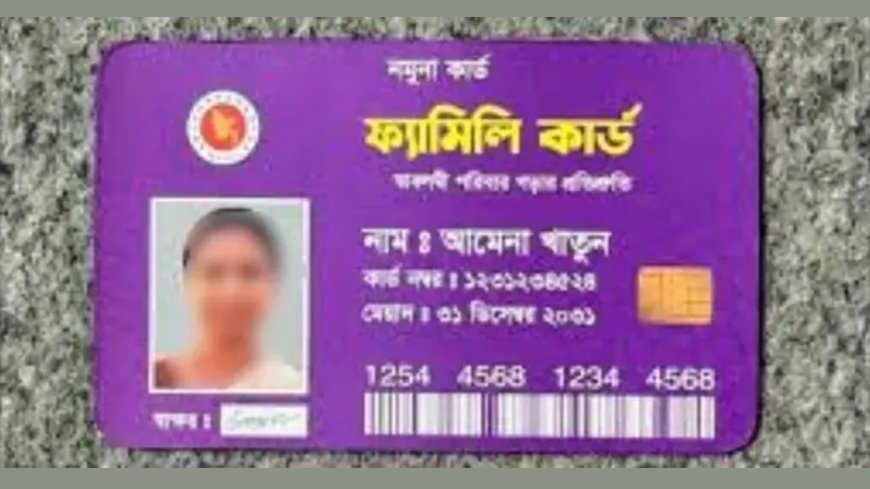



The government’s plan to pilot the “Family Card” program in eight upazilas—one in each of the country’s eight divisions—will be anchored in a unified digital database and Management Information System (MIS), with strong emphasis on integrating National ID (NID) and the National Household Database.
According to a gazette notification issued on Thursday (February 19) by the Cabinet Division, a 15-member Cabinet committee has been formed, headed by the Finance Minister, to oversee the design and rollout of the Family Card initiative. The committee’s core mandate includes developing an appropriate implementation design, finalizing beneficiary selection criteria, and recommending a robust digital MIS architecture.
Centralized Digital Infrastructure
At the heart of the initiative is the proposed interoperability between the National ID database and the National Household Database. Officials say this integration will enable:
-
Prevention of duplicate or fraudulent beneficiary entries
-
Automated cross-verification of socio-economic eligibility criteria
-
Creation of family-based digital profiles linked to unique NID numbers
-
Real-time monitoring through a centralized dashboard
Technology analysts note that using the NID as a unique identifier could allow the government to build a scalable, family-level digital registry that may later integrate other social protection schemes, including food assistance, subsidies, or direct cash transfers.
Leveraging Existing Women-Focused Programs
The committee has also been tasked with examining whether any existing women-focused social safety net program can serve as a foundational framework for the Family Card rollout. If adopted, existing beneficiary databases under the Ministry of Women and Children Affairs could be integrated into the new MIS to accelerate pilot implementation.
However, experts stress that data governance, privacy safeguards, and cybersecurity protections must be embedded into the system architecture from the outset. The success of the pilot, they argue, will depend not only on technological integration but also on the legal and regulatory frameworks governing data sharing and personal information protection.
Timeline Ahead of Eid
The committee has been instructed to submit a preliminary report by February 24, aiming to facilitate distribution of the Family Card ahead of the upcoming Eid-ul-Fitr. The report is expected to outline technical infrastructure requirements, server capacity, data validation mechanisms, and field-level digital verification processes.
The committee includes ministers, state ministers, advisers, the Cabinet Secretary, and secretaries from seven ministries. The Ministry of Women and Children Affairs will provide secretarial support, and the committee is authorized to co-opt additional members if necessary.
A Test Case for Digital Social Protection
If successfully implemented, the digital MIS-driven Family Card program could serve as a prototype for a unified social protection platform in Bangladesh. A consolidated, family-based database would streamline targeting accuracy, enhance transparency, and reduce leakage in public welfare distribution.
Yet, as policymakers move swiftly toward pilot deployment, the critical test will be whether the government can balance speed with secure, interoperable, and accountable digital infrastructure.
DBTECH/SH/SMEH









