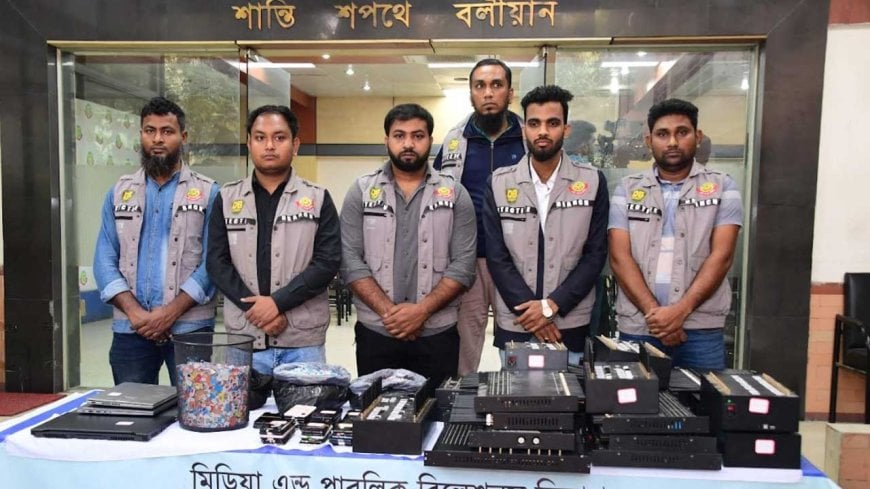
Detective Branch (DB) of the Dhaka Metropolitan Police (DMP) has recovered 51,251 SIM cards of various operators, 51 mobile phones and 21 VoIP gateway devices in separate raids conducted in the capital’s Bhatara and Uttara West police station areas. Eight members of a Telegram-based fraud syndicate, including five Chinese nationals, were arrested during the operations.
The arrestees are Chen Ling Feng, Zeng Kong, Zeng Zhaqiar, Wen Jian Qiu, Huang Zheng Jiang, and three Bangladeshi nationals—Md Zakaria (26), Niaz Masum (20) and Kamrul Hasan alias Hasan Joy (38).
The information was disclosed at a press briefing held on Tuesday (January 13) afternoon at the DMP Media Centre on Minto Road by Deputy Commissioner (DC) of DB Cyber North Hasan Mohammad Naser Rikabdar.
He said the Web-Based Crime Investigation Team of the DB Cyber and Special Crime (North) Division uncovered the syndicate while probing allegations related to online job scams, Telegram group-based fraud and other cybercrimes. Based on intelligence gathered, DB conducted a raid on January 7 in a residential area under Bhatara Police Station and arrested Niaz Masum and Kamrul Hasan alias Hasan Joy. During the operation, 14 VoIP gateway devices, 51,067 SIM cards of different operators, four mobile phones, two CPUs and one laptop used in online fraud were seized.
The DB official further said information was later received about more online fraud rings operating in different parts of the capital. As part of the continued operation, DB carried out another raid on Monday (January 12) in Sector 9 of Uttara West Police Station area, arresting six more individuals, including five foreign nationals. The raid led to the recovery of seven illegal VoIP gateway devices, 47 mobile phones of various brands, 184 SIM cards and five laptops.
According to DB, the arrested fraudsters used different tactics to deceive people—luring victims with fake job offers, promising high returns on investments, or advertising essential goods at unusually low prices—to siphon off money.
Explaining how Bangladeshi nationals worked with Chinese fraudsters, the DB official said such crimes are carried out by networks involving multiple people. “Foreign nationals cannot speak Bangla over the phone or understand local culture. That’s why both locals and foreigners work together in these syndicates,” he noted.
When asked how such a large number of SIM cards were collected despite mandatory biometric registration, he said investigators were also surprised and are tracing the origin of the SIMs. “We will reach the root of how and through whom these SIM cards were obtained. Everything will become clear through investigation,” he added.
Responding to questions on how the stolen money was transferred abroad, the official said funds defrauded from Bangladeshi victims were being laundered out of the country through cryptocurrency using these devices.
He also urged the public to remain vigilant, warning people not to conduct bKash or any other financial transactions with unknown individuals or accounts. “Fraud rings often use accounts of unsuspecting people by tempting them. Many unknowingly allow their accounts to be used and later face serious legal complications,” he cautioned.
Regarding the Chinese nationals’ visa status and duration of stay, the DB official said their passports are being verified. He also revealed that all recovered mobile phones contained Chinese software.
DBTech/DPO/MUM/OR