






















































































































































ICT Division Releases White Paper on 15 Years of Irregularities




The Information and Communication Technology (ICT) Division has published a long-awaited white paper detailing irregularities and corruption in Bangladesh’s information technology sector over the past 15 years. The white paper was released on Thursday, January 8, on the ICT Division’s official website.
The report investigates corruption allegations involving multiple agencies and projects, including the ICT Directorate, Bangladesh Computer Council (BCC), Hi-Tech Park Authority, and various initiatives under a2i. Beyond documenting allegations, the white paper was prepared after interviewing individuals accused in each case.
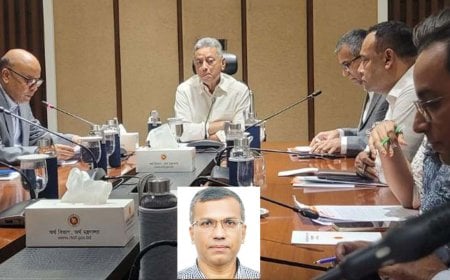
Spanning 472 pages across 13 chapters, the report compiles findings based on investigative follow-ups of reports published in national media on mismanagement, corruption, and financial irregularities in the sector. It also includes data illustrating what the authors describe as the irony and distortion carried out in the name of digital transformation. The white paper was prepared by a committee led by development and economics expert Professor Dr. Niaz Asadullah, along with seven others: PGCB Chairman Professor Rezwan Khan, BRAC Universisty, Professor Chowdhury Mofizur Rahman, Purdue University, USA, Professor Muhammad Mustafa Hossain, BUET Professor Rifat Shahriar, legal expert Barrister Afzal Jami Syed Ali, technology expart Asif Shahriar Sushmit, and journalist Md. Shariat Ullah.
According to the report, various political agendas were implemented under the banner of digital transformation in recent years. An estimated BDT 4,211.22 million was spent on establishing Sheikh Russell Digital Labs and producing films such as Mujib Bhai through the Centre for Research and Information (CRI). Another BDT 160 million was allocated for producing the film Khoka. The white paper alleges that hi-tech parks and IT training centers were established without assessing actual needs, largely to serve political objectives. It also found evidence that commercial organizations in the ICT sector were used for political purposes.
Serious questions have been raised over favoritism, syndication, and the justification of expenditures in several large projects, including 12 IT parks, DEIID, EDC, iDEA, and Tier-IV data centers. In many cases, a significant gap was found between project planning and implementation, resulting in intended services failing to reach the public. The white paper also notes allegations that certain projects were approved and implemented under political influence.
In areas such as IT training, freelancing, and e-commerce, the report found widespread duplication and poor planning in many politically motivated training programs. It also revealed that laptops were distributed among party affiliates under the guise of freelancing, only after confirming that recipients were not involved in opposition political activities. Fake trainers were reportedly identified in the LEDP project as well.
The white paper further states that over the past decade, a beneficiary group centered around the ICT sector exerted disproportionate influence over policymaking. This, it says, hindered the development of a competitive market and deprived a significant segment of the domestic IT industry of its expected growth.
In its preface, the white paper clarifies that the document is not intended as an act of retaliation against any individual or political group. Rather, its objective is to establish an evidence-based foundation to ensure transparency in future policymaking. The report recommends institutional reforms, stronger independent audit mechanisms, and enhanced accountability across the technology sector to address the identified weaknesses and irregularities.
Experts believe the findings and observations of the white paper will spark renewed national-level discussions. However, they also warn that without political will and effective oversight mechanisms, the recommendations risk remaining confined to paper.
DBTech/MUM/EK/OR