





































Bangladesh Introduces E-Registration Through Amendment to 1908 Registration Act
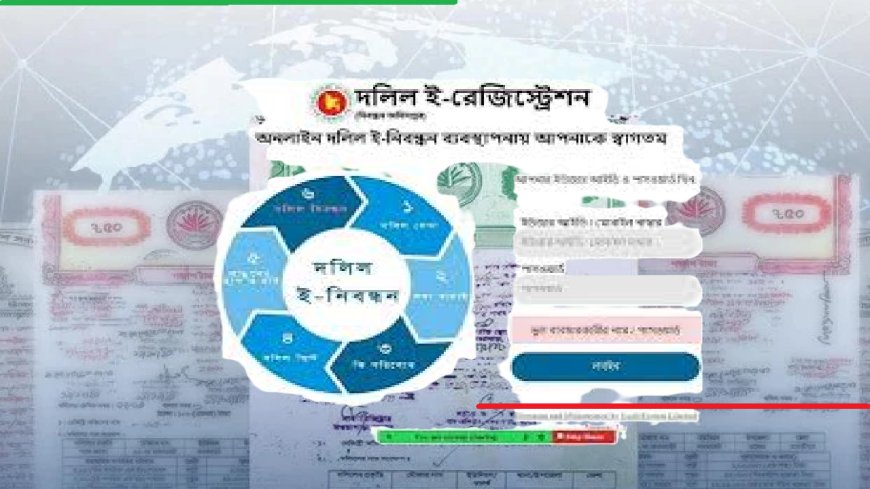



Bangladesh is set to introduce electronic registration (e-registration) by amending the century-old Registration Act, 1908, aiming to ensure the legal validity of property deeds and other important documents through a fully digital process. Under the new system, deeds will be presented and registered digitally using government-approved software.
To modernise, update and digitise the country’s deed registration system, the Legislative and Parliamentary Affairs Division of the Ministry of Law, Justice and Parliamentary Affairs has promulgated the Registration (Amendment) Ordinance, 2026.
The ordinance introduces a new Part Twelve-A, incorporating Section 77A, which allows deeds to be presented, accepted for registration and registered digitally through government-approved software. Detailed rules in this regard will be framed by the government through gazette notifications.
Section 80 of the Act has been replaced to stipulate that all fees, taxes, service charges and duties must be paid at the time of deed presentation. The methods of collection and utilisation of service charges will also be determined through gazette notifications.
According to the gazette issued on Thursday, 1 January, the ordinance was promulgated by the President under Article 93(1) of the Constitution of the People’s Republic of Bangladesh, citing the dissolution of Parliament and the existence of an urgent situation. The ordinance has come into effect immediately by presidential order.
Under the amended provisions, the time limit for registering documents mentioned in Section 17A (clauses ‘ka’ to ‘chha’), sub-section (2) of the Registration Act, 1908, has been extended from 30 days to 60 days. Similarly, the timeframe under Section 26, clause (b), has been increased from four months to six months.
The scope of registration for hiba (gift under Islamic law) and donations has also been expanded through amendments to Section 52A. In addition to sales, declarations of hiba under Muslim Personal Law (Shariah), as well as declarations of donation under Hindu, Christian and Buddhist personal laws, have been brought under mandatory registration. Accordingly, the words “or donor” have been added alongside the term “seller”.
To ensure accountability in cases of irregularities, Section 68 has been amended by adding a new sub-section (3). It states that if any registering officer registers a deed without collecting the appropriate fees, taxes, service charges or duties, the act will be treated as misconduct, and the unpaid amount will be recovered from the concerned officer.
For appeals and applications, Section 72 has been amended to include sub-section (1A), requiring the registrar to dispose of appeals within 45 days of filing. Section 73 has also been amended by adding sub-section (3), mandating disposal of applications within 30 days from the date of submission.
DBTech/DPO/IHM/OR









