





































Policy Gaps and Security Risks Stall Digital Banking Growth in Bangladesh
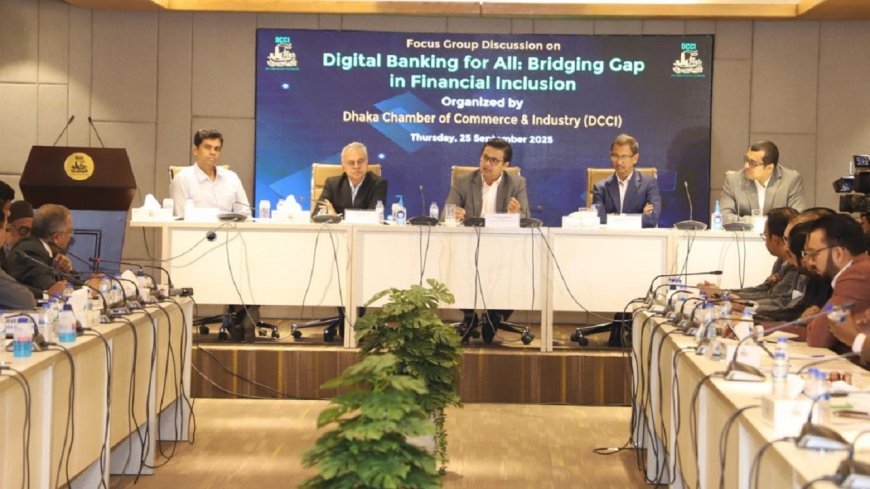



Despite immense potential, Bangladesh’s digital banking sector has yet to fully develop due to a lack of policy support, weak infrastructure, trust deficits, and poor coordination among regulatory bodies, according to industry stakeholders. These observations came during a focus group discussion titled “Digital Banking for All: Bridging the Financial Inclusion Gap” organized by the Dhaka Chamber of Commerce & Industry (DCCI) on Thursday, September 25, at the DCCI Auditorium in Motijheel.
The event was graced by Shish Haydar Chowdhury, Secretary of the ICT Division, as the chief guest, while Dr. Md. Ejazul Islam, Executive Director of Bangladesh Bank, attended as special guest. DCCI President Taskin Ahmed presided over the session.
Presenting the keynote paper, Sanjid Hasan, Head of Commercial Partnership at Robi Axiata, said, “The digital banking market in the Asia-Pacific region will reach USD 4,678.47 million in 2025, and by 2033 it will rise to USD 11,238.6 million.” He emphasized the need for a comprehensive cybersecurity ecosystem to ensure safe transactions. “There is a lack of trust in our traditional banking operations, where digital operations create opportunities for growth. The country’s digital banking market has the potential to grow to USD 30 billion,” he noted. However, he warned, without a unified and secure cybersecurity framework, major risks remain, stressing that central bank oversight should also be intensified. He added that the availability of smartphones and internet access at affordable rates must be ensured to extend digital services to rural and marginalized areas.
Joining virtually, ICT Secretary Shish Haydar Chowdhury said, “The government, private sector, and academic institutions are working jointly to expand digital services.” He announced that the government is in the final stages of formulating a Data Protection Ordinance to safeguard personal information and has already introduced one-stop citizen services, with ten centers launched in Dhaka.
Highlighting government priorities, he said modernization of digital systems is focusing on four aspects: inclusion, accessibility, integration, and expansion. Referring to the risks of weak data registration, he cautioned that data of nearly 50 million citizens had already appeared on the dark web. “Data encryption and surveillance must be strengthened. The Personal Data Protection Ordinance is expected to be finalized within a month,” he said, adding that infrastructure, manpower, and facilities for digital banking exist, and the government will provide necessary policy support.
Special guest Dr. Md. Ejazul Islam, Executive Director of Bangladesh Bank, stated, “Until August this year, money circulation in the country amounted to BDT 31.5 trillion, of which BDT 22.7 trillion remains outside banks in the hands of the general public, while only BDT 2.9 trillion is held by banks. Still, only 27 to 28 percent of total transactions in the country occur digitally, with the remaining 70 percent confined to conventional methods.”
In his welcome speech, DCCI President Taskin Ahmed said, “Since the launch of Mobile Financial Services in 2011, nearly 54 percent of people now use this service. However, due to cyber risks, lack of consumer protection, and low confidence, the sector has not realized its full potential. Building trust and ensuring security in digital banking is the biggest challenge.” He further called for making digital services more affordable, strengthening financial and digital literacy, and improving coordination among banks, fintech companies, and regulators. He pointed out that only 30 percent of the population uses financial cards, while rural women, the ultra-poor, and coastal communities remain most excluded from financial inclusion due to high costs, low literacy, weak technology use, and consumer protection gaps.
Among other participants, Additional Deputy Commissioner (DB) of Dhaka Metropolitan Police, Md. Elias Jiko, said, “Every day, digital fraud worth BDT 1 to 2 billion is taking place. Digital banking will remain at risk if customer safety is not ensured.”
Arif Khan, Vice Chairman of Shanta Asset Management Limited, remarked, “Although there are 64 banks in the country, there is still no roadmap for launching an effective digital bank.” He attributed rising default loans to mismanagement in the financial sector and emphasized reforms in adjudication of financial irregularities.
ADC Elias Jiko also revealed that 90 percent of fraud complaints relate to bKash customers. He suggested that mobile banking service providers could implement regular updates of customer information to reduce fraud.
Kazi Azizur Rahman, Additional Managing Director of City Bank, stated that 30 to 40 percent of the population still remains outside the banking system.
Rezwan Ali, Director of Omega Exim Limited, said, “Incorporating blockchain technology into export-import activities would increase transparency.”
Shahi Mirza, Chief Cyber Officer of Bettles Cyber Security Limited, proposed forming a unified cybersecurity framework while ensuring the safety of agent banking systems.
The event was also attended by DCCI Senior Vice President Rajib H. Chowdhury, Vice President Md. Salim Solaiman, board members, and entrepreneurs from related sectors.









