




































BCSIR Broadens Scientific Support for Industry, Environment and Halal Certification



Bangladesh’s premier national scientific and industrial research organization, the Bangladesh Council of Scientific and Industrial Research (BCSIR), is set to achieve a new milestone in laboratory-based quality control for the country’s industrial, healthcare, environmental, and ICT sectors. With funding from the Japan International Cooperation Agency (JICA), the organization is preparing to sign agreements to provide technical and scientific support to the Ministry of Environment for regular roadside air quality monitoring across the country and to the Islamic Foundation for halal food testing.
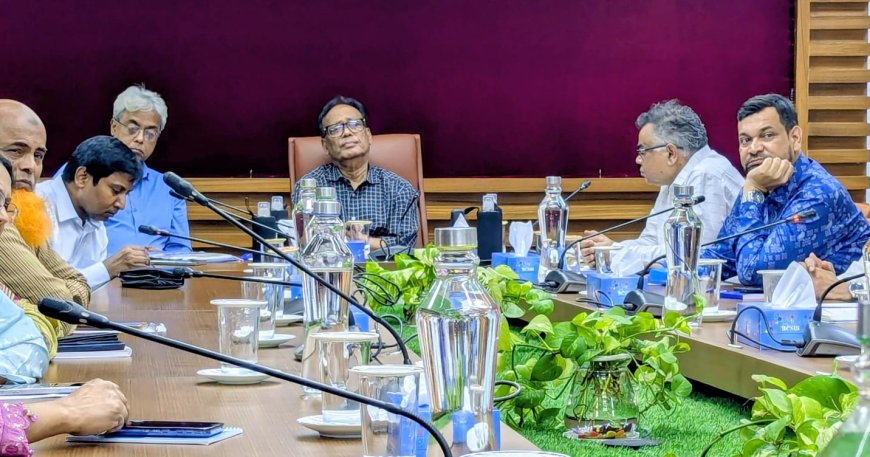
The announcement was made by BCSIR Chairman Dr. Samina Ahmed on Tuesday afternoon, June 2, during a visit by Faqir Mahbub Anam, Adviser to the Ministry of Science and Technology and the Ministry of Posts, Telecommunications and Information Technology, to BCSIR’s facilities on Science Laboratory Road in the capital. Science and Technology Secretary Md. Anwar Hossain accompanied the adviser during the visit.
Addressing a meeting held at the conference room of the Science Laboratory Building, the adviser emphasized the importance of extensive commercialization and marketing of BCSIR’s innovations. Speaking to researchers and scientists, he said, “I do not believe in tomorrow. I think it is either now or never.”
Praising the dedication of BCSIR scientists and researchers, he further stated, “It is a matter of great pride and joy that the products and innovations developed through your research are being sold in the market.” He called for greater efforts to bring these scientific discoveries closer to ordinary citizens and entrepreneurs.
Before the adviser, BCSIR Chairman Dr. Samina Ahmed presented the organization’s future plans aligned with the government’s election manifesto. These include expanding research in Bangladesh’s pharmaceutical sector, increasing exports, reducing import dependency, and addressing post-GSP withdrawal challenges in global markets.
In her welcome remarks, she highlighted the importance of establishing internationally standard Bioequivalence laboratory facilities in Bangladesh, expanding opportunities for advanced research, and adopting modern synthetic methods for the development of Active Pharmaceutical Ingredients (API).
Through a PowerPoint presentation, she noted that BCSIR is currently providing regular scientific services to international organizations and corporations including the World Food Programme (WFP), UNICEF, BASF, Unilever Bangladesh, Marico International, Novartis, and Nestlé Bangladesh. The organization also serves leading government and private institutions such as Bangladesh Customs, Police, Army, the National Curriculum and Textbook Board (NCTB), various public universities, Rahimafrooz, PRAN Group, and ACI.
BCSIR is actively engaged in detecting harmful nitrofuran metabolites in frozen shrimp, assessing the quality of imported food products, measuring aflatoxin levels in food, testing ceramics for hazardous lead, cadmium, and barium content, conducting chemical analyses of cement, clinker, and glass, examining water quality across 100 parameters including arsenic, and ensuring quality control of plastics and cosmetic products.
The organization is also providing significant technical assistance to Runner Automobiles in manufacturing motorcycle spare parts, contributing to the growth of Bangladesh’s automotive industry.
Among those present at the event were Manjur Morshed Ahmed, Director of the Institute of Food Science and Technology; Dr. Md. Abdus Sattar Mia, Director of the Biomedical and Toxicological Research Institute; Dr. Md. Hossain Sohrab, Director of the Dhaka Laboratories; and Sarkar Kamruzzaman, Director of the Institute of Energy Research and Development (IERD), among others.
DBTech/MJU/MUIM/OR









