

































AI-Driven Semiconductor Shock Sparks ICT Hardware Price Spiral, Straining Bangladesh’s Digital Infrastructure


Global semiconductor prices have increased fourfold due to the AI boom. As a result, Bangladesh’s IT market is going through an unprecedented crisis. According to sources, even price adjustments based on Development Project Proforma (DPP) data from three to four years ago are no longer sufficient. Concerns have emerged that this may soon pose risks to Bangladesh’s digital infrastructure projects.
Market analysts describe the situation as a “perfect storm” or a four-pronged major disaster. Global market analysis shows that due to the rapid expansion of artificial intelligence (AI), the prices of NAND flash and DRAM storage have increased significantly over the past six months. Experts say this upward trend may continue until 2028. In such a scenario, Bangladesh’s Tk 12,000 crore digital storage market faces major challenges due to the slow procurement processes of government agencies and large institutions.
Information gathered from the country’s IT market shows that prices of SSDs, RAM, and server components have skyrocketed over the past few months. Changes in global production systems and depreciation of the local currency are the main reasons behind this. Since Bangladesh is 100% import-dependent for these products, even minor fluctuations in the international market have a major impact locally. Currently, globally renowned chip manufacturers such as Samsung, SK Hynix, and Micron are prioritizing production of high-bandwidth memory for AI data centers instead of general computer memory.
This has created a severe shortage in the DDR4 and DDR5 RAM market required for consumers and small businesses. Regarding this crisis, Sanjoy Sarkar, General Manager of Enterprise Solutions at Global Brand PLC, said that global manufacturers are now shifting production capacity toward enterprise-grade DDR5 and NAND flash, resulting in a severe supply shortage of general computer and server components.
He further stated that with many DDR4 production lines shutting down, budget-friendly products have become scarce. In particular, high-capacity RAM modules are no longer available in the market and are often only available with pre-built systems. As a result, laptop and desktop sales in major markets such as Multiplan or IDB Bhaban in Dhaka have dropped by nearly 70 percent. Statistics show that a 16GB DDR5 RAM module, which cost only Tk 7,800 at the end of 2025, rose by more than 200 percent to Tk 28,500 at the beginning of 2026. Similarly, SSD prices have increased by around 40 percent, and entry-level server prices have risen by up to 60 percent in the last six months.
Sanjoy Sarkar also noted that due to the abnormal rise in server-grade component prices, enterprise-level IT upgrades have become difficult for the SME sector. The fall of the taka against the US dollar to 118–120, along with 15 percent VAT and import duties, has further complicated the situation. This price instability has directly impacted various government and private mega projects. Key initiatives such as Smart Bangladesh and e-Governance are being delayed due to high hardware costs. In many cases, tenders are being canceled because market prices exceed government-set procurement budgets.
According to sources, large system integrator companies working on major projects such as the Land Ministry are also facing losses and legal complications, including bank guarantee liquidation, due to failure to deliver goods on time. Overall, this instability in the IT sector is pushing the country’s digital transformation toward an uncertain future.
Meanwhile, Mujahid Al Beruni Sujan, director of channel sales at Smart Technologies (BD) Ltd, said that some people had stocked up from different sources 7-8 months ago on the news of rising prices in the global market. However, due to government rules and business policies, distributors could not stock up. Non-brand products have been introduced in the market. Low-priced products sold at a high price. The price of RAM has already increased 100 times. The 16GB RAM of 7 thousand rupees is 15 thousand rupees in the world market but it is available for 14 thousand rupees in Bangladesh. The price of the motherboard has also increased due to the increase in the price of memory-SSD. Even though there is a huge demand for the Corsair, Twin Moss brand, I am not able to supply 30 percent of my demand. Now if the import is not made easy then in future this market may become stagnant.
Recent reports from research organizations IDC and TrendForce state that the global storage market is currently in a nearly two-year growth cycle. Demand for high-bandwidth memory (HBM) and enterprise SSDs is rapidly increasing due to AI data centers in North America and China. As a result, major chip manufacturers such as Samsung, SK Hynix, and Micron are restructuring production toward AI component manufacturing.
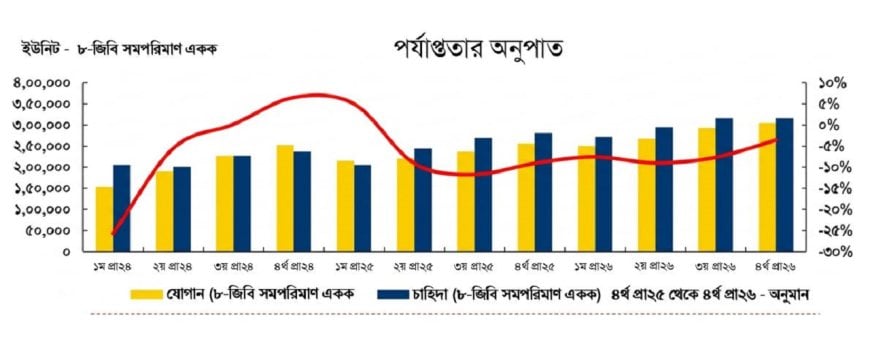
According to TrendForce data, supply shortages have emerged in the DRAM and NAND wafer markets, and the sufficiency ratio has consistently remained below zero, indicating a significant shortage of DRAM and NAND memory over the next two years. As a result, prices of these memories are expected to rise further. Analysis shows that enterprise SSD prices have increased by more than 400 percent in the last six months, and some DDR5 modules have nearly quadrupled in price. Analysts believe this supply-demand imbalance may continue until at least the end of 2028.
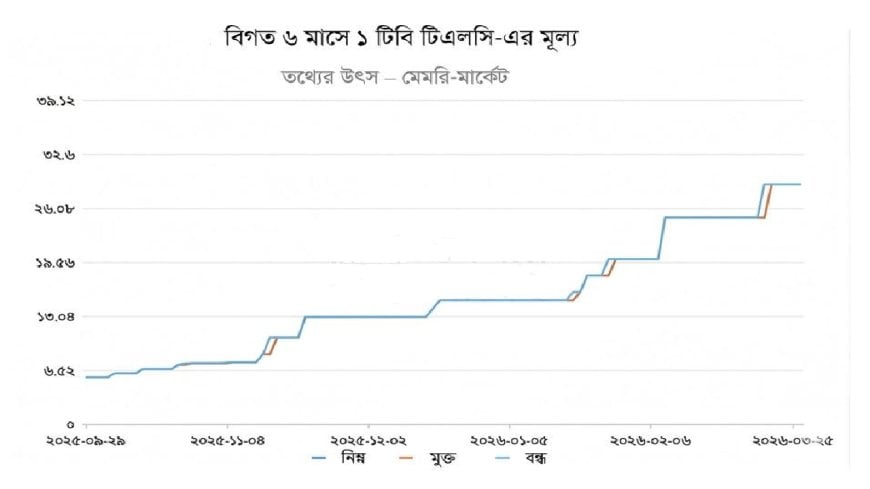
Data shows that over the past six months, the TLC flash wafer price index has risen from 5.7 to 29, an increase of more than 400 percent.
Source: memorymarket.com
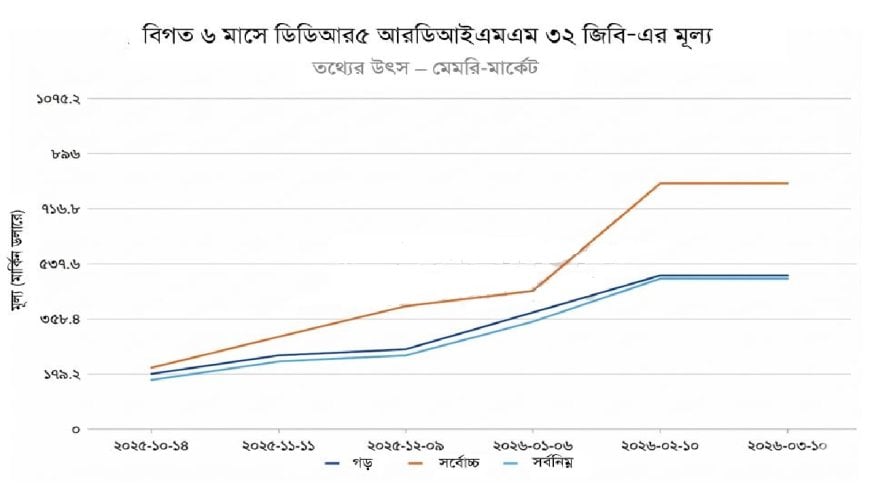
In the same period, the DDR5 price index increased from 180 to 500, a rise of more than 270 percent.
Source: memorymarket.com
According to findings, Bangladesh, as a developing economy, is particularly vulnerable in this situation. When global supply decreases, large manufacturers typically prioritize major technology companies in the United States and Europe. Local suppliers in Bangladesh have already reported long lead times and unstable pricing.
In the current situation, procurement delays mean not only higher purchase costs in the future but also risks of unavailability of critical supplies for important projects.
Discussions with suppliers and consumers reveal that long administrative and budget approval processes in Bangladesh’s government and corporate sectors have become a major bottleneck. In many cases, the combined processes of budget approval, feasibility studies, and tendering take more than a year. When prices are changing every few months in the market, delays often result in approved budgets being insufficient by the time procurement begins. This increases the likelihood of budget shortfalls.
Business stakeholders report that due to rising prices, large organizations have already reduced server expansion or been forced to cancel necessary IT upgrades. In addition, key initiatives such as governance and banking digitalization are facing significant delays, hindering technological development in the country. The traditional slow project implementation model is affecting not only individual projects but also digital progress across government, financial, and other sectors.
In such a situation, the founder president of Bangladesh IT Professional Friends Club, Saleh Mobin, said that if the price hike continues for the next three years, the decision-makers will have to move away from the strategy of "wait and watch." To reduce risks, companies need to make the procurement process more efficient, speed up and simplify the internal approval process, and implement projects in a scheduled and efficient manner. Also, it is advisable to ensure supply through long-term contracts or keep stock in advance strategically. In such a situation, you will have to bear more expenses than what you had to invest earlier. The government should come to power here. Instead of bypassing technology, the policymakers should decide what to do with the businessmen in advance and reschedule the pending project costs.
DBTech/IH/MUIM/OR









