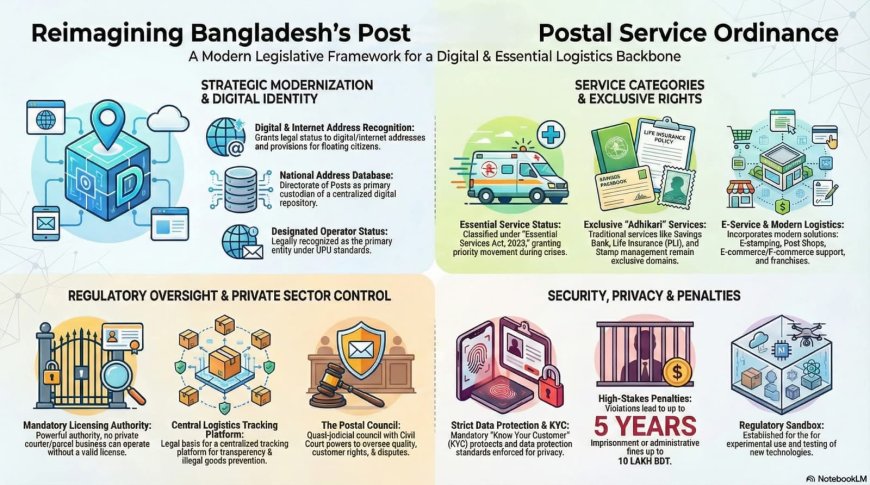
The Post Services Ordinance 2026, enacted through a comprehensive overhaul and update of the 127-year-old postal law, has received final approval from the Advisory Council on Thursday, February 5. The ordinance marks a major milestone in the digital transformation of Bangladesh Post.
According to Mohammad Jasim Uddin, Public Relations Officer of the ICT Division, the new ordinance gives the legal framework an entirely new shape by prioritising e-commerce compliance, modern address management, migration-related address solutions arising from climate change, personal data protection, and institutional capacity building.
The new law will be known as the Post Services Ordinance, 2026, and will formally replace the colonial-era Post Office Act, 1898.
Key changes introduced under the new ordinance
Modern regulatory framework:
The ordinance establishes a legally empowered licensing authority to issue licences to all commercial postal and courier operators and to regulate their service delivery and disciplinary matters.
Oversight of competition and non-discrimination:
The regulator will ensure fair competition and non-discriminatory practices in the sector. In particular, Bangladesh Post will be required to maintain separate accounts so that government resources allocated for universal postal services are not used to subsidise competitive commercial services.
Penalties for unlicensed operations:
The maximum administrative fine for operating postal, courier, or parcel services without a valid licence has been increased from Tk 50,000 (or Tk 200,000 for repeat offences) to up to Tk 1 million.
Designated operator and licensing authority:
Under the postal services law, Bangladesh Post will function as the designated operator mandated by the Universal Postal Union (UPU). A Mailing and Courier Licensing Authority will be formed to issue licences to courier and e-commerce operators. To prevent conflicts of interest, a Postal Council comprising public and private stakeholders will be established.
Digital stamps and e-services:
In addition to traditional postage stamps, digital postage stamps or e-stamping have been introduced. Customers will be able to pay bills online and receive secure QR codes or barcodes, which will carry the same legal validity as conventional postage stamps, whether printed or displayed on digital devices.
Personal data protection:
All policies and rights under the Personal Data Protection Ordinance, 2025 will apply. Operators will be required to use customer data solely for service delivery, destroy unnecessary data, and adopt technical and organisational security measures—such as encryption—to protect against cyber threats.
Central tracking and interoperability:
Provisions have been made for the operation and maintenance of a digital Central Logistics Tracking Platform (CLTP) and for ensuring interoperability among all commercial operators, enabling customers to easily access e-commerce tracking information.
Declaration as an emergency service:
Postal services operated by the designated operator have been declared an emergency service, recognising their importance to national security, public health, and economic stability. During national crises, postal operations, vehicles, and essential personnel will receive priority movement and access.
Recognition as national infrastructure:
The ordinance recognises Bangladesh Post’s network not merely as a service delivery system, but as an essential national infrastructure backbone supporting connectivity, communication, and economic transactions.
Priority for government communications:
All central and local government bodies, ministries, departments, and state-controlled institutions have been directed to prioritise the designated operator’s postal services for sending official letters, documents, examination scripts, and other sensitive parcels, both domestically and internationally.
Establishment of the Office of the Chief Controller of Stamps:
The ordinance formally establishes the Office of the Chief Controller of Stamps under Bangladesh Post to ensure administrative, financial, and logistics management of all postal and non-postal stamps, including revenue stamps.
Electronic Advance Data (EAD) requirement:
For all cross-border mail, courier items, and parcels, electronic advance data—including sender and recipient details, value, and item descriptions—must be digitally submitted in advance to customs and security agencies.
Know Your Customer (KYC) verification:
To prevent misuse of postal and parcel services, especially for international or high-value domestic shipments, mandatory KYC verification has been introduced. Government-issued identification documents such as national ID cards or passports must be verified and recorded using designated addresses.
Proactive security measures:
Designated and licensed operators will be required to implement proactive security strategies, including regular staff security training, X-ray scanning of mail and facilities, and contingency planning for emergencies.
Secure and modern savings and insurance services
Under the new law, Postal Life Insurance and the Post Office Savings Bank have been granted special status as authorised postal services, opening a new horizon for secure financial transactions and savings for the general public.
All postal life insurance policies will now be operated with a full sovereign guarantee from the Government of Bangladesh, making them among the most secure savings instruments in the country. A dedicated fund will be maintained to safeguard policyholders’ interests, operating independently of profit or loss.
Similarly, all deposits under the Post Office Savings Bank will be held in the government treasury and invested in state-backed ventures. Returns generated from these investments will determine depositor profits, making savings both safer and more rewarding.
Bangladesh Post has also undertaken a full digital transformation of all its financial services and management systems.
These reforms mark a significant step towards a new Bangladesh, ensuring that financial and postal services become more secure, transparent, and accessible.
Address archive and modern address management
At the individual and family levels, citizens’ addresses will be archived and managed to enable digital address creation, address-centric family-tree mapping, and geo-fencing, with permanent lifecycle-based digital archiving. This system will also support address re-identification and restoration in cases of climate-induced or migration-related displacement, such as river erosion, land submergence, or land reclamation.
The ordinance also outlines modern address management, including area codes, street codes, house-code-based digital addresses, geo-fencing, beat mapping, collective addresses and post boxes for floating populations and slum dwellers, and address solutions linked to climate change and river erosion.
Central Logistics Tracking Platform (CLTP)
To bring discipline to the courier sector, the ordinance provides a legal foundation for an escrow-enabled Central Logistics Tracking Platform, integrated with payment gateways, courier operators, and e-commerce platforms. The technical framework of the CLTP has already been developed, and operations are currently underway.
DigiBanglaTech/MZU/MM/OR