








































Infosarkar-3 PPP Revised to Strengthen Sustainable Revenue and National Fibre Use



The Public–Private Partnership (PPP) agreement for Infosarkar-3, a national priority project under the ICT Division, has been revised through policy clarifications on sustainable revenue structures and the use of national fibre. Following more than six months of renegotiations, the interim government has amended the previous contract to ensure greater alignment with national interests.
While earlier projects established connectivity on a limited scale, the Infosarkar-3 initiative has, through direct state intervention, installed thousands of kilometres of new fibre optic cables to build a strategic national network extending from district to upazila and union levels. The government believes this network will serve as the core foundation of Bangladesh’s existing national fibre backbone.
After assuming office, the interim government found that the post-construction operation of this large state-built infrastructure was being carried out under a PPP framework. Under this arrangement, the Bangladesh Computer Council (BCC) of the ICT Division, together with Summit Communications Limited and Fiber@Home Limited as project companies, formed separate Special Purpose Vehicles (SPVs) to manage and maintain this national asset on behalf of the state.
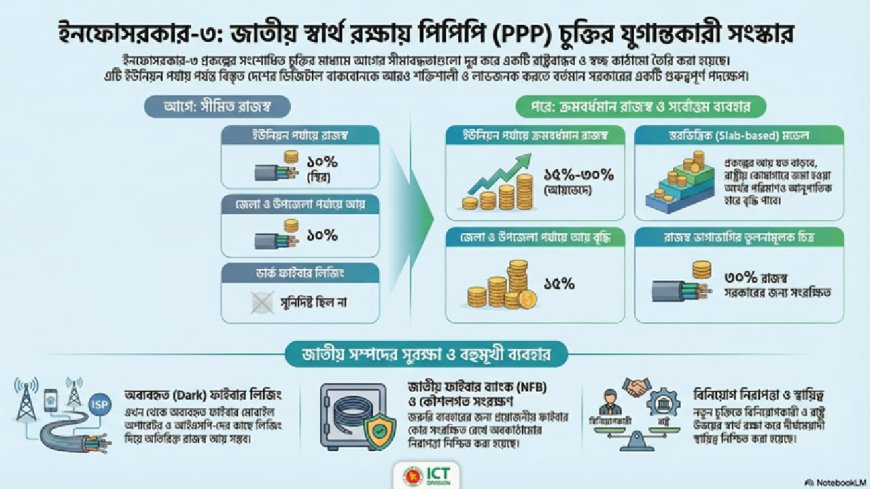
It was learned that there had previously been no clear provisions regarding fibre leasing, the use of unused fibre cores, or the concept of a fibre bank. As a result, the extensive fibre infrastructure built with state investment remained largely confined to a single project, limiting opportunities for national-level fibre reuse or sharing. For the first time, the revised agreement has explicitly incorporated provisions for leasing unused (dark) fibre cores. These fibres can now be used by government agencies, mobile network operators, internet service providers, and through the national fibre bank. At the same time, the agreement mandates that a reasonable amount of fibre must be reserved for ongoing operations, future bandwidth expansion, government connectivity projects, and emergency use, ensuring that national interests are not compromised.
Previously, the absence of a clear relationship between the project and any national fibre bank or similar initiative created the risk of uncertainty regarding the long-term stability of the agreement. The amended contract now clearly states that a fibre bank or fibre-sharing mechanism cannot be used as a tool to cancel, alter, or unilaterally amend the Infosarkar-3 PPP agreement. This provision secures investor confidence while safeguarding the state’s long-term digital infrastructure interests.
Until now, the revenue-sharing framework of the Infosarkar-3 project was fixed and limited. Regardless of income growth at the union level, the government’s share remained capped at 10 percent, with no direct linkage between the project’s overall financial success and state revenue. Similarly, the government’s share of income generated from active devices at district and upazila levels was relatively low and not aligned with actual usage or revenue expansion.
The revised agreement has restructured this model. Revenue sharing is now slab-based, determined by the project’s total monthly income, with the government’s share increasing as revenue grows. For monthly income below Tk 50 million, the government will receive 15 percent; for income between Tk 50 million and Tk 100 million, 20 percent; and for income exceeding Tk 100 million, up to 30 percent. This creates a direct linkage between the project’s financial performance and government revenue. Additionally, the government’s share of income from active devices at district and upazila levels has been increased from 10 percent to 15 percent.
By addressing multiple limitations, the revised agreement introduces structural changes that better protect government revenue interests and enhance the use of national digital infrastructure. Infosarkar-3 is a state-built national priority digital infrastructure project, through which Bangladesh, for the first time, established a single, integrated, and truly national fibre backbone network extending down to the union level.
According to the ministry, the Posts, Telecommunications and Information Technology Ministry believes that through this renegotiation, the Infosarkar-3 project has moved beyond its earlier constrained framework and evolved into a more state-friendly, transparent, and sustainable PPP model. This transformation is expected to play a crucial role in expanding rural broadband and strengthening the country’s national digital connectivity infrastructure.
DBTech/MZU/EH/OR









