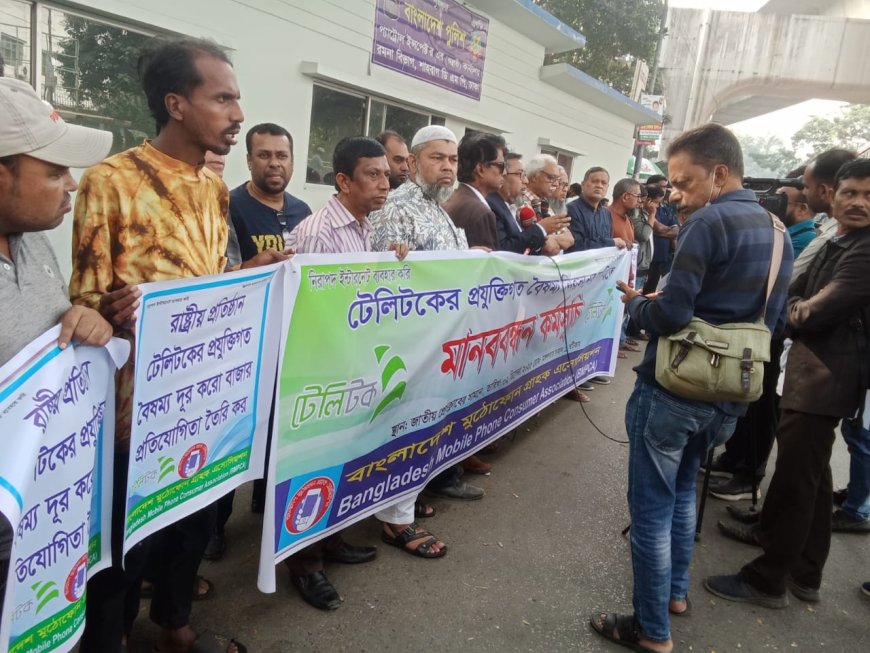
A one-hour human chain was held in front of the National Press Club in Dhaka demanding an end to what protesters described as technological discrimination against the state-owned telecom operator Teletalk.
The event began at 11 a.m. on Tuesday, 2 December, with participation from former CPB General Secretary Ruhin Hossain Prince, former Director of the Bangladesh Competition Commission Khalid Abu Naser, President of the Bangladesh Mobile Phone Consumers Association Mohiuuddin Ahmed, human rights activist Sadhana Mahal, Chairman of the Jatiya Swadhinata Party Mizanur Rahman Mizu, President of the Bangladesh Mobile Phone Recharge Traders Association Aminul Islam, Green Party Chairman Raju Khan, among others.
Former Competition Commission Director Khalid Abu Naser said they are not against technological advancement or the use of the 700 MHz spectrum band. However, he criticised the government’s move to allocate spectrum while excluding Teletalk.
He pointed out that one operator currently enjoys 90% profit, another earns 8%, while Teletalk and another private operator are facing losses. “If Teletalk is left behind in this process, competition in the market will collapse,” he warned.
Association President Mohiuuddin Ahmed demanded allocation of the 700 MHz band to Teletalk. He said that a recent decision by the Bangladesh Telecommunication Regulatory Commission (BTRC) has raised serious concerns, as the 700 MHz “golden band”—crucial for mobile coverage and 5G expansion—is being partially auctioned without securing spectrum for the national operator.
According to organisers, in a recent meeting involving BTRC and all operators, it was announced that the auction will take place on 14 January 2026. At the meeting, one private operator reportedly urged that no spectrum be reserved for Teletalk—an approach experts say is discriminatory and harmful to national interests.
Speakers reminded that from 1995 to 2005, foreign operators dominated Bangladesh’s market, when high call charges, incoming call fees, and deduction of unused balance caused significant public hardship. Teletalk was established to provide affordable, citizen-friendly mobile services and played a major role in forcing call charges down. It pioneered online admission systems, job applications, and online bill payments in Bangladesh.
While foreign operators have invested over TK 40,000 crore, Teletalk has served the nation with barely TK 6,000 crore.
Experts stressed that the 700 MHz band is crucial for Teletalk because it offers the strongest coverage, requires fewer towers, and is essential for providing stable connectivity in rural and remote areas—thus supporting the expansion of 5G.
Without this band, they warned:
-
Rural populations will be deprived of quality service,
-
The government’s Smart Bangladesh vision will be hindered,
-
Consumers will face poor network coverage,
-
Foreign operators will enjoy excessive market advantage,
-
Emergency public services may be disrupted, and
-
Teletalk’s operating costs will rise sharply due to the need for more towers.
Leading telecom experts have called the decision “a severe blow to Teletalk,” “a strategy to push the national operator out of the market,” and “a decision against state interests.”
“Without the 700 MHz band, Teletalk’s future will be critically endangered—almost a death warrant,” they stated.
Speakers emphasised that Teletalk is not just another operator, but a symbol of Bangladesh’s technological sovereignty. Ensuring fair market competition, affordable rural connectivity, and secure national communication systems requires that Teletalk receive its due spectrum allocation.
DBTech/MA/IK/OR