





































E-Family Facilitation: Digital Courts Debut
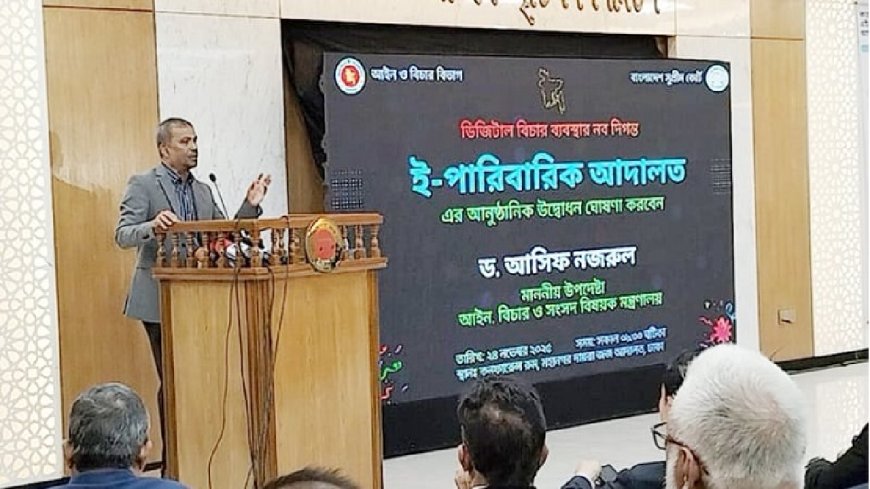



The formal operations of the e-Family Court have officially begun to reduce the hardships of litigants. On Monday, 24 November, the service was inaugurated at the Jagannath-Sohel Memorial Hall of the Dhaka Metropolitan Sessions Judge Court by Asif Nazrul, Adviser on Law, Justice, and Parliamentary Affairs. Daffodil International University collaborated in establishing this e-Family Court.
During the event, the chief guest highlighted that it is time to move towards digitization in all areas, including the judiciary. Asif Nazrul stated that the introduction of e-Family Courts will undoubtedly reduce both inconvenience and corruption while saving time, as litigants will no longer have to physically navigate multiple offices.
Citing examples of various reform initiatives, Adviser Asif Nazrul said that the Ministry of Law has already implemented 21 reforms. He emphasized that these reforms will not succeed unless all stakeholders, including lawyers, are actively involved and continuity is maintained.
He noted that the Ministry has initiated e-Judiciary and e-Registration projects and hopes that all political parties, who presumably care deeply for the nation, will support these efforts.
Regarding family disputes, the Adviser explained that previously, one had to approach the Family Court directly. Now, litigants must first go to the Legal Aid Office. Only if they are not satisfied there can they proceed to the Family Court, thereby reducing inconvenience, corruption, and time.
Under legal reforms, the Legal Aid Office now has provisions for appointing three judges instead of one. Such significant changes are expected to have a positive impact if implemented properly. Currently, this program is active in 20 districts, with plans to expand to all 64 districts. Once fully implemented, it is expected that one-fourth to one-third of all cases in Bangladesh will be resolved through the Legal Aid Office, potentially reducing case backlogs by at least 50% within five years.
Asif Nazrul stressed that reform does not only mean constitutional amendments. For instance, the introduction of VAT—the country’s largest economic reform—was achieved through law, not constitutional change. Similarly, many environmental policies and controls over acid attacks were implemented through legal reform. He cited Singapore as an example, noting that former Prime Minister Lee Kuan Yew took 10 years to implement reforms, highlighting that change cannot happen overnight. Lessons from the Maldives and Tunisia show that excessive reform should not weaken state structures. Reforms must be grounded in realistic planning and public readiness, ensuring continuity across successive governments.
He clarified a common misconception that technology alone will reduce case loads; rather, it enables lawyers to provide faster and more effective services.
Environment Adviser Syeda Rizwana Hasan stated, “Through this, we have entered a paperless judicial process.”
Foyez Ahmed Taiyeb, Special Assistant to the Chief Adviser responsible for the Ministry of Post, Telecommunication, and ICT, said the digital initiative will help lawyers deliver faster and more efficient services.
Other speakers included Lyakat Ali Molla, Secretary of the Law and Justice Division, and Muhammad Habibur Rahman Siddique, Registrar General of the Supreme Court. The Registrar General added, “This process will advance the judiciary towards a paperless system.”
The e-Family Court is expected to address long-standing issues such as prolonged cases, high costs, distance challenges, paper management, delays, and overcrowding. Additionally, it will provide rapid online processes, minimal cost, home-based service access, digital documentation, 24/7 registration, and online scheduling.









