






































Livestock Leap: National Awareness Week Launches



The National Livestock Week will commence on Wednesday, 26 November, aiming to raise public awareness about livestock development and safe food production through technology expansion. Under the theme “Local Breeds, Modern Technology: Advancing Livestock”, this year, for the first time, fifteen individuals will be honored across five categories for their contributions to the fisheries and livestock sector.
The categories include: livestock farmers (cattle, buffalo, goats, sheep, and others); poultry farms (ducks, chickens, pigeons, turkeys, quails, etc.); animal and animal product processing, marketing, and export (meat, milk, and eggs); contributions to livestock development and management by individuals, institutions, associations, cooperatives, media, NGOs, or community-based organizations; and recognition of contributions by marginalized farmers, women, and smallholder livestock farmers.
During the inaugural ceremony of the National Livestock Week, gold, silver, and bronze awards will be presented to first, second, and third place winners in each category.
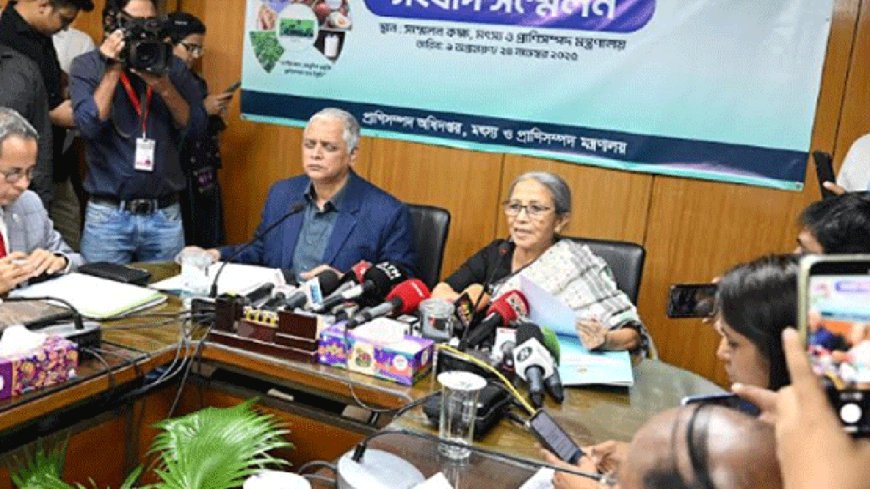
On 24 November, Monday, Fisheries and Livestock Adviser Farida Akhtar provided this information at a press conference at the Secretariat. Also present were Additional Secretary Md. Imam Uddin Kabir, Director General of the Department of Livestock Dr. Md. Abu Sufian, and senior officials from the Ministry and Department.
She stated that the National Livestock Week will be celebrated simultaneously at the central level in Dhaka and across districts and upazilas nationwide from 26 November to 2 December. Activities during the week include award ceremonies, awareness campaigns, rallies, discussions, seminars, workshops, and exhibitions.
The main objective of the week is to increase awareness among the public about livestock development, technology expansion, and safe food production.
She highlighted the economic importance of the livestock sector in Bangladesh, contributing 1.81% to GDP, 3.19% growth rate to GDP, 16.58% to agricultural GDP, and a total livestock GDP value of 91,036 crore taka.
The poultry industry is currently the country’s second-largest employment sector, with over 40,000 crore taka in private investment. Bangladesh has 85,227 registered commercial poultry farms and approximately 191,000 small-scale farms. Daily egg production averages 66.8 million eggs—a significant achievement.
The government has taken major steps for disease control, including administering 1.7 million doses of the Lumpy Skin Disease (LSD) vaccine, implementing zoned campaigns to eradicate Foot-and-Mouth Disease (FMD), and providing nearly 60 million doses of vaccines for goat PPR disease control.
The central events and livestock exhibition will be inaugurated on 26 November at 9:00 am at the Bangladesh-China Friendship Conference Center. Planning Adviser Wahiduddin Mahmud will be the chief guest, and Chief Adviser Dr. Muhammad Yunus will deliver a video message. The livestock fair will run for three days.
Two-day seminars will be held on 27–28 November at the Sher-e-Bangla Nagar old trade fair ground in Dhaka. The central celebrations will showcase livestock and related products, equipment, and feed through various stalls and pavilions, including government and private institutions, local livestock breeds, live animal farms, pet and bird care shops, livestock equipment and genetics companies, food processing and value-added companies, animal health companies, associations, watchtowers, prayer facilities, seminar halls, cultural programs, and safety and emergency service booths.
Key events and activities include the inaugural ceremony, National Livestock Awards, technology dissemination, safe food, animal husbandry, milk, meat, and egg production, disease prevention, international trade, modern technology seminars and discussions, food festivals and exhibitions, award distribution, and central closing ceremonies. Rallies, discussion sessions, exhibitions, vaccination camps for livestock and poultry, free deworming campaigns, artificial insemination services, veterinary medical camps, school feeding programs, painting and quiz competitions, and youth and women entrepreneurship discussions in livestock sustainable development will also take place across districts and upazilas.









