








































Salting-Out Solution: Students’ Smart System to Recycle Detergent-Polluted Water



Every day, vast amounts of water are polluted by detergent during laundry, directly contaminating rivers, canals, and wetlands. Addressing this growing environmental concern, two young scientists from Dhaka’s BAF Shaheen College have developed a plan to make detergent-contaminated water reusable using a protein separation process known as Salting Out combined with sand filtration.
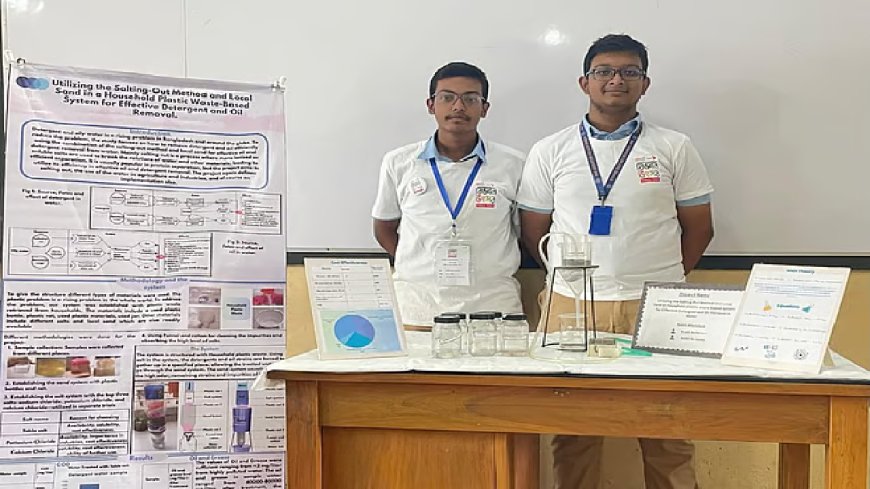
The duo, Arib Bin Faruq and Sayem Ibne Sarowar, both tenth-grade students, presented their innovative project, “The Salting-Out System 2.0”, at a science festival held at St. Joseph Higher Secondary School in Dhaka—where they won the top prize for their groundbreaking idea.
In their demonstration, the students showed how dissolving specific salts in water can effectively separate pollutants such as oil and detergent. This process works by introducing highly ionized salts that act like inert gases, rendering substances such as detergent, oil, and protein insoluble. Consequently, the pollutants precipitate, allowing the water to be purified.
Through this method, Arib and Sayem were able to remove up to 99 percent of detergent from contaminated water. Their innovation demonstrates that detergent- and oil-polluted water, though saline, can be converted into clean water suitable for industrial and agricultural reuse.
Looking ahead, the young inventors aim to revolutionize water recycling in Bangladesh using their Salting-Out System 2.0. They envision its application in textile, dyeing, and other industries that consume massive amounts of chemically mixed water. The purified saline water could then be reused in cooling systems, boilers, and various industrial processes.
Since the process removes nearly all harmful oils and detergents, the treated saline water could also be used for irrigating salt-tolerant crops or in specialized agricultural systems. The young scientists hope their innovation will reduce the strain on freshwater resources and promote a sustainable solution to industrial water pollution.
DBTech/JHA/MUIM/OR









