






































South’s Only Permanent Seismograph at PSTU Remains Inoperative for 15 Years
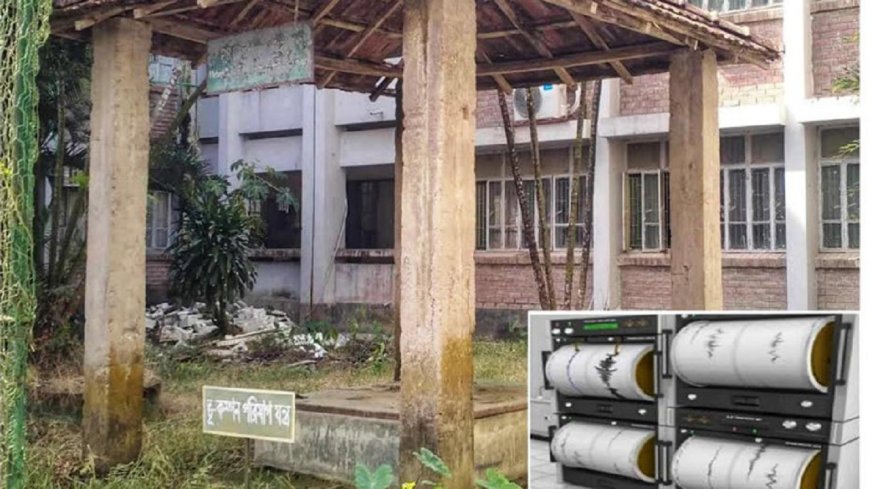



The only permanent earthquake-monitoring seismograph installed at southern region in Bangladesh’s-located at Patuakhali Science and Technology University (PSTU)-has remained inactive for the past 15 years, despite being set up at a cost of nearly Tk 50 lakh. Because the equipment has been out of order, neither the recent tremors nor any seismic activity in the region could be measured. As a result, more than 45 million coastal residents remain at heightened risk, prompting urgent calls for the government to install a new, modern seismograph system.
According to sources, the device was installed on the PSTU campus in 2010 under a joint initiative involving Columbia University (USA), the Department of Geology at the University of Dhaka, and five universities across Bangladesh. Professor Dr Syed Humayun Akhter of the University of Dhaka’s Geology Department represented Bangladesh in the project.
During the first year of installation, only two earthquakes were recorded. But in January 2011, the machine developed a technical fault. Although it was restored temporarily by reconnecting it to internet lines via an academic building, it became inactive again within a year and has not functioned since.
Experts note that a seismograph detects primary and secondary waves well before surface waves arrive, offering several seconds of early warning that can be crucial for public safety. The underground plates attached to the device can also track vertical land movement, helping assess local geological risks. However, due to the prolonged shutdown of the equipment, no reliable seismic data is available for the geologically vulnerable southern region.
Assistant Professor Munibur Rahman of PSTU’s Electrical and Electronic Engineering Department is currently on study leave in Germany. Another faculty member, Professor Dr S. M. Tawhidul Islam, said the equipment is outdated and based on analog technology. “Digital seismographs are used globally today. Only the project authorities can determine how effective this old device could have been,” he added.
PSTU Vice-Chancellor Professor Dr Kazi Rafiqul Islam confirmed that the equipment has remained nonfunctional for many years. “Our examinations show it can no longer be restored. A new project proposal is being prepared by our ESDM department. Once finalized, it will be forwarded to the appropriate authorities for approval,” he said.
DBTech/BN/Muim









