








































Travel Trade Turmoil: Agencies Protest New Aviation Ordinance




In an effort to ensure transparency and fairness in airline ticket distribution—by preventing ticket blocking, artificial shortages, and price manipulation—the Advisory Council on 13 November approved drafts of the Civil Aviation (Amendment) Ordinance-2025 and the Bangladesh Travel Agency (Registration and Control) Amendment Ordinance-2025. The proposed laws mandate compulsory registration with the Global Distribution System (GDS), New Distribution Capability (NDC), and API-based digital channels for airline ticket sales.
However, on 15 November (Saturday), members of the Association of Travel Agents of Bangladesh (ATAB) held a human chain in front of Hotel Victory in Dhaka, demanding the withdrawal of what they described as several harmful provisions in the draft ordinances. They warned that the moment the new laws come into effect, “hundreds of thousands of skilled workers in travel agencies, Hajj agencies, and recruiting agencies will lose their jobs overnight.”
Following the human chain, former ATAB President S. N. Manzur Morshed Mahbub addressed a press conference on behalf of travel agencies, Hajj agencies, and recruiting agencies. He stated that if implemented, the ordinance would put approximately 6,000 travel agencies, 1,400 Hajj agencies, and 2,700 recruiting agencies at direct risk.
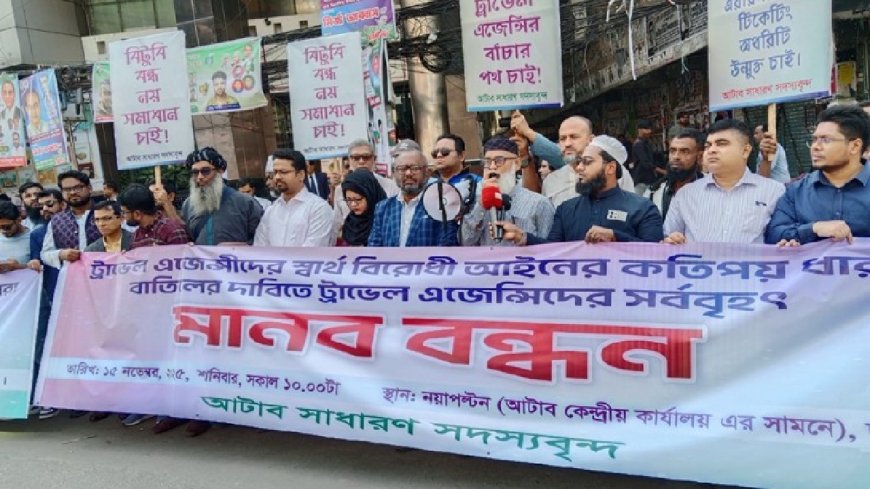
He explained that, under the new rules, all travel agencies must be integrated into IATA’s ticket-selling platform. “Currently, around 6,000 licensed travel agencies operate in the country, but only about 1,000 are connected to IATA. If this ordinance comes into force, the remaining agencies will effectively be forced to shut down overnight, along with the businesses dependent on them,” he said. This, he warned, would leave “hundreds of thousands of skilled workers jobless.”
Mahbub added that several clauses impose unreasonable pressure on small and medium-sized entrepreneurs. These include mandatory submission of family information, CIB (loan-related) clearance, a bank guarantee of Tk 10 lakh for offline operations and Tk 1 crore for online operations, annual financial reporting as a condition for license renewal, and strict technical compliance requirements.
Speakers expressed concern that such provisions could trigger major instability in the country’s tourism industry and demanded their withdrawal.
Mahbub further stated that business-to-business (B2B) ticket transactions between agencies—a globally accepted practice—would effectively be banned under the new ordinance. “If B2B is banned, every travel agency must obtain IATA accreditation, which costs around Tk 30 lakh. Additionally, an extra Tk 22 lakh must be deposited for Bangladesh Biman ticket sales alone. Ninety percent of agencies cannot afford this. As a result, they will be forced to shut down.”
He criticized the Ministry for failing to act against online travel agencies (OTAs) that fled the country after allegedly embezzling hundreds of crores of taka. “We had requested that OTA operations be suspended until a proper policy was in place. But no action was taken. Fraudsters left the country easily, and no meaningful measures have followed,” he said.
According to him, while ordinary consumers and small agencies suffered from OTA fraud, the authorities are now “trying to shift the blame onto regular travel agencies to cover their own failure.” He alleged that the new ordinance appears designed to benefit “certain individuals or groups.”
“We want solutions through dialogue that safeguard the interests of all stakeholders. The government must not push thousands of travel entrepreneurs and workers toward a bleak future,” Mahbub added.
ATAB leaders urged the Chief Adviser of the Interim Government and the Adviser to the Ministry of Civil Aviation and Tourism to ensure that the new laws do not become “a tool to shut down existing businesses,” but instead support “a fair, sustainable, and equitable travel industry.”
Addressing the human chain, former ATAB President Abdus Salam Aref called for amending the provisions that threaten the viability of travel agencies and for removing obstacles that hinder their operations. Members also appealed for “business-friendly and fair legislation that protects employment and strengthens the tourism and travel sector.”
They demanded revisions to controversial sections to ensure a realistic, inclusive law aligned with industry needs.
Key Features of the Draft Ordinance
For the first time, the phrase “ensuring passenger services” has been included in the law’s title and preamble—establishing passenger safety, comfort, and rights as legal obligations.
Appointment of General Sales Agents (GSAs) for foreign airlines has been made optional, aligning with global best practices. Local airlines may also appoint GSAs.
Penalties of up to Tk 10 lakh and imprisonment for up to one year have been included for misconduct such as fraudulent ticket sales, overcharging, artificial shortages, selling tickets to third countries, or altering passenger information after group booking confirmation.
Eleven new grounds for suspension or cancellation of registration have been added, including illegal ticket sales and fraudulent practices.
For the first time, mandatory tariff submission and monitoring for air operators have been introduced. The ordinance also empowers authorities to promote sustainable aviation fuels and adopt environmentally responsible policies to reduce carbon emissions.
The ordinance allows the government to establish a Civil Aviation Economic Commission to determine airport fees, charges, and rents, ensuring financial transparency and fair pricing.
The use of artificial intelligence, blockchain, and digital systems is encouraged for cybersecurity and adoption of frontier technologies, aiming to make the civil aviation sector smarter and more technology-driven.
The ordinance aligns with the Chicago Convention, ICAO annexes, and global governance norms, and is expected to enhance Bangladesh’s competitiveness in international aviation.
DBTech/SS/IK/OR









