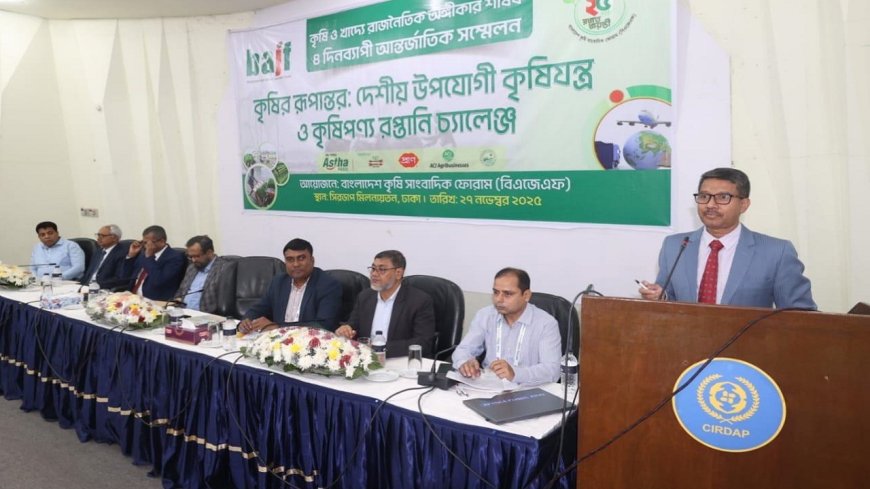
The Ministry of Agriculture has returned Tk 600 crore from the agricultural mechanisation project to the government, completing the project with only Tk 20 crore. By cutting corruption and waste, a total of Tk 2,500 crore has been returned to the state treasury. Overall, the ministry saved about Tk 4,000 crore last year, Agriculture Secretary Dr. Md. Emdad Ullah Mian has said.
He stated that to ensure comprehensive development and the modernisation of the agriculture sector, a long-term plan for the next 25 years is being formulated. The final draft of this plan will be prepared by December. “We are planning in a way that will save Tk 2,000 to 3,000 crore annually on fertiliser. This year alone, we have already saved Tk 1,000 crore on fertiliser,” he added.
He made these remarks on Thursday, 27 November, at the opening seminar titled “Agricultural Transformation: Locally Suitable Farm Machinery and Challenges of Agricultural Export” at the four-day international conference on “Political Commitment in Agriculture and Food” organised by the Bangladesh Agricultural Journalists Forum (BAJF) at the CIRDAP auditorium in Dhaka.
The session was moderated by BAJF General Secretary Abu Khaled and chaired by the organisation’s President Sahanowar Said Shaheen.
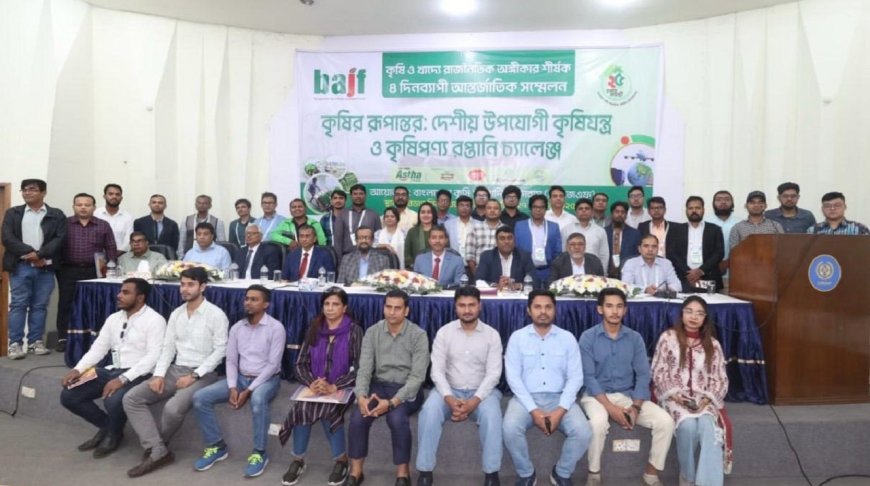
As the chief guest, the Agriculture Secretary said Bangladesh will stop importing onions and ginger within the next three years. “We have saved Tk 4,000 crore in a year by reducing project corruption and unnecessary expenditure. Spending is being made in areas essential for farmers. There can be no farmer-friendly agriculture economy unless farmers receive fair prices,” he said.
He further stated that vegetable prices at Tk 100 per kilogram are usually accepted without protest, but onion prices at Tk 100 per kilogram trigger public debate. “Should farmers not be paid fairly for onions?” he asked. He expressed deep concern over farmers’ suffering, saying, “When potato prices fall and farmers are forced to commit suicide, it pains me. The government must step up further to ensure fair prices.”
BAJF President Sahanowar Said Shaheen said political commitment is essential to protect farmers’ interests. “Every political party must outline a clear, long-term agricultural strategy in its election manifesto. Our goal is to link agriculture with political vision to ensure sustainability,” he said.
Dr. K M Saiful Islam, Director of BRRI’s Mechanised Rice Cultivation Project, presented the keynote. He said Bangladesh is giving priority to “Made in Bangladesh” in agricultural mechanisation. With technological support from Sri Lanka, Japan, and others, the local production of advanced agricultural machinery is becoming a reality. These developments will save time, reduce costs, and help build a domestic agricultural machinery industry. BRRI is working to end dependence on imported machinery by building local capacity while maintaining international quality standards.
BRRI Chief Scientific Officer Dr. Durul Huda said the biggest challenge to domestic production of modern farm machinery is the weakness of the light engineering sector and inadequate infrastructure. “We have no state-owned facility capable of manufacturing engines. Past facilities such as Machine Tools Factory, Diesel Plant, and Chittagong Steel Mills failed, weakening the industrial base. The private sector has also not advanced sufficiently,” he said.
PKSF Managing Director Md. Fazlul Kader said agriculture must be transformed into a profitable, dignified, and educated profession. PKSF, working through its partner organisations, distributes around Tk 1,40,000 crore annually at the field level, 40% of which goes to agriculture. Currently, about 85% of agricultural financing in Bangladesh comes through the microfinance sector, underscoring its critical importance.
BRRI Director General Dr. Md. Khalekuzzaman said the institute has been advancing rice-based research for decades to ensure national food security. Rice productivity has increased significantly—from 1.5–2 tonnes per hectare after independence to 8–10 tonnes in some areas today due to improved varieties and technologies. He said BRRI is focused on developing hybrid varieties to further raise yields above 10 tonnes per hectare.
Pran-RFL Group Director (Marketing) Kamruzzaman Kamal said the global agro-processing market is worth USD 4 trillion, whereas Bangladesh’s share is only USD 1 billion, leaving huge potential untapped. But product variety and quality gaps persist. Complex approval processes involving 18 agencies hinder agricultural exports, increasing cost and time. He emphasised the need for one-stop service, country branding, quality control, and internationally recognised labs.
Presenting a paper, Arifur Rahman, Project Director of the Mango Export Expansion Project, said mango exports have tripled in the past five years, with imports falling to zero. Mangoes are now exported to 38 countries, with the UK being the largest destination. Although Europe offers huge opportunities, high transport and air freight costs remain obstacles. Sometimes even paying higher fares does not guarantee space on flights. He stressed the need to allocate specific cargo space for agricultural exports.
The four-day BAJF conference is co-sponsored by Aastha Feed Industries Ltd. Supporting partners include ACI Agribusinesses, Pran-RFL Group, Lal Teer Seeds Ltd., World Poultry Science Association (Bangladesh Branch), BRRI, the Forest Department, Department of Agricultural Extension, Department of Fisheries, and Department of Livestock Services.
DBTech/AHT/MUM/OR