






































Draft E-Participation Framework Aims to Boost Citizens’ Role in Government Decision-Making
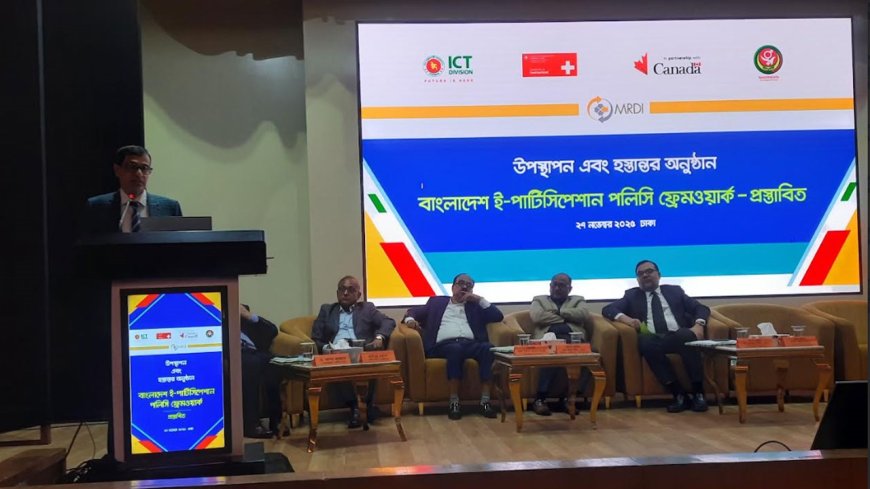



To enhance public participation in Bangladesh’s policy formulation and government decision-making, the Media and Resources Development Initiative (MRDI) has prepared a draft of the Bangladesh E-Participation Policy Framework. The draft was presented and handed over on Thursday, 27 November, at the Bangladesh Computer Council (BCC) conference room in the ICT Tower, Agargaon.
Speakers at the event said that once implemented, the framework will enable citizens to share their opinions on government policies and decisions through digital means.
The session began with a welcome address by Md. Mamunur Rashid Bhuiya, Additional Secretary of the ICT Division. MRDI Executive Director Hasibur Rahman provided an overview of why the draft framework was developed. A copy of the draft was later handed over to Katharina Konig, Deputy Team Leader of the Citizenship–Civic Engagement Fund, on behalf of MRDI.
Dr. Ononna Raihan, Chairperson of iSocial, presented the proposed policy framework. Highlighting the nation’s rapid digital transformation, she said that approximately 91 percent of the country’s population now uses mobile phones—92 percent in urban areas and 90 percent in rural areas—indicating the growing feasibility of digital engagement in government processes.
Special guests included Md. Dawood Mia, Director General (Additional Secretary) of the NGO Affairs Bureau; Md. Mahmudul Hossain Khan, Secretary (Attached) to the Chief Advisor’s Office; and Shish Hayder Chowdhury from the ICT Division under the Ministry of Posts, Telecommunications, and Information Technology.
Secretary (Attached) Md. Mahmudul Hossain Khan remarked that as the world advances through digitalization, Bangladesh must keep pace. Increasing e-participation, he added, will reduce the need for physical presence and help curb corruption.
Shish Hayder Chowdhury stated that Bangladesh has made significant progress in digital adoption—recalling a time when households lacked electricity, compared to today’s near-universal access. Even residents of informal settlements now use mobile phones, and many have laptops. He emphasized the need to continue prioritizing digital transformation.
Chairing the event, Dhaka Divisional Commissioner Sharaf Uddin Ahmed Chowdhury noted that digitalization brings both advantages and challenges. While it increases convenience, it also affects emotional connection, reduces privacy, and introduces other concerns. Nevertheless, he stressed that e-participation must be strengthened to remain aligned with the developed world.
DBTech/DP/MEM/OR









