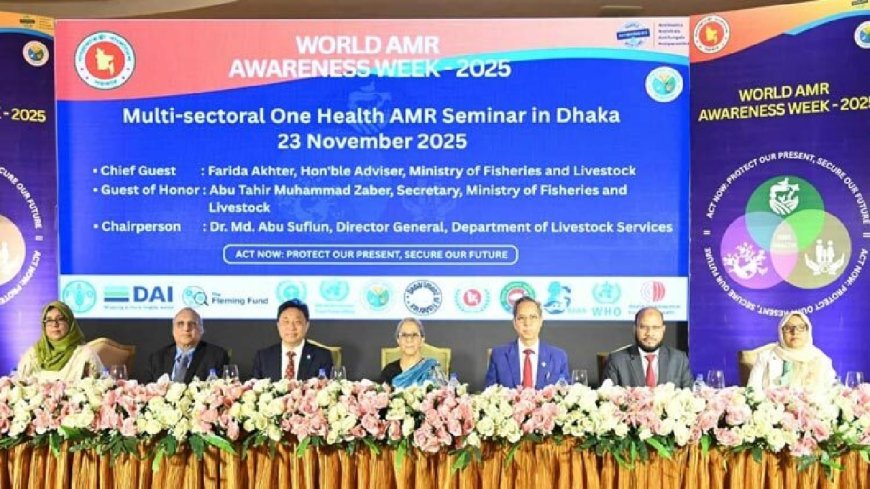
Fisheries and Livestock Affairs Adviser Farida Akhter has said that although the recent 5.7-magnitude earthquake caused widespread fear among the public, an even bigger and more long-lasting threat is being created by the excessive and irrational use of antibiotics in the country. She noted that while the damage from an earthquake occurs at once and ends, the effects of antibiotic resistance are long-term and put future generations at risk.
She made these remarks on Sunday, 23 November, while speaking as the chief guest at the Multi-Sectoral One Health AMR Seminar organized at Hotel Westin in Dhaka to mark World Antimicrobial Resistance Awareness Week 2025.
The adviser said that the uncontrolled use of antibiotics is now creating serious crises across the health, livestock, fisheries—even agriculture—sectors. Under such circumstances, preventive practices, One Health cooperation, and strong regulatory systems are essential to combat antimicrobial resistance (AMR). Therefore, adopting integrated preventive measures is urgently necessary.
She stated that according to the data presented at the seminar, the antibiotic resistance rate in Bangladesh has already reached 94 percent, which is extremely alarming. In addition, the rate of antibiotic use in the poultry sector stands at 76.9 percent, directly affecting human health and the environment.
The adviser added, “Among rural communities, the belief still exists that a doctor who gives injections is good, and one who prescribes antibiotics is the best.” She said parents often demand antibiotics for their children if fever does not subside quickly. Even infants as young as 11 months are becoming resistant—something she described as deeply concerning.
She further said that thinking only about human health is not enough. “We must protect animal, forest, and wildlife health as well. The health of food, animals, and people is deeply interconnected. That is why the concept of ‘One Health’ is so important. With antibiotics being used across all animals, there is no solution without the One Health approach.”
She added that human health can never be safe if food is not safe. For this reason, public demand must grow stronger for “antibiotic-free chicken” and “antibiotic-free fish.” Creating social pressure and awareness around safe food is one of the most effective ways to combat resistance.
Referring to her recent experience at a climate conference held in Brazil, the adviser said that as global warming intensifies, the prevalence of new diseases and the risks of antimicrobial resistance also increase.
She noted that climate change and antimicrobial resistance are two global crises that are deeply interconnected and stressed that integrated and well-planned initiatives are needed to tackle these twin challenges.
Senior officials from government and private institutions, university professors, livestock and poultry farmers, and other relevant professionals were present at the event.
DBTech/GN/Muim