








































Telecom and Technology Tackle Threats: Dhaka Hosts Early Warning Workshop
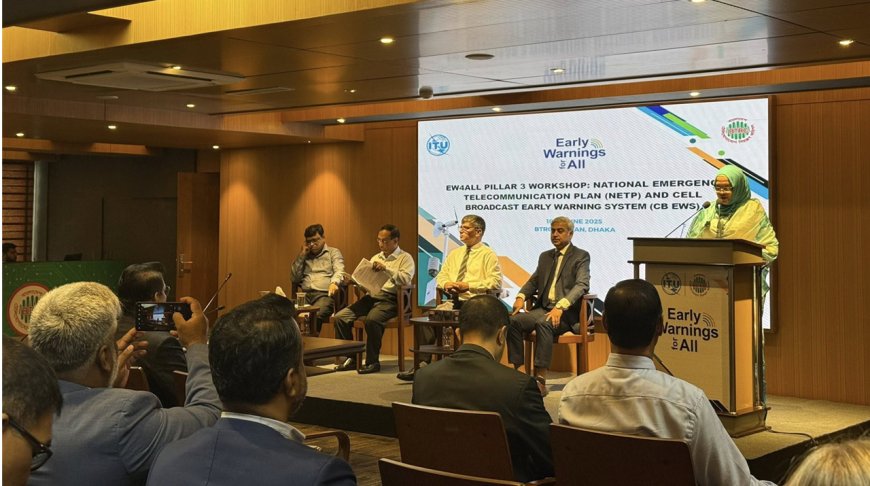



To strengthen Bangladesh’s disaster preparedness, a two-day multilateral workshop titled "Early Warning for All" began on Wednesday, June 18, at the Bangladesh Telecommunication Regulatory Commission (BTRC) headquarters in Agargaon, Dhaka. The workshop aims to enhance geolocation-based Cell Broadcast Early Warning Systems (CB-EWS) and formulate a National Emergency Telecommunication Plan (NETP) to ensure resilient communication during emergencies.
The event brought together a wide array of stakeholders, including representatives from the International Telecommunication Union (ITU), Department of Disaster Management, Bangladesh Meteorological Department, Bangladesh Water Development Board, Armed Forces Division, Red Cross, UNICEF, World Food Programme, Asian Development Bank, World Bank, mobile operators, telecom licensees, ICT experts, academia, and national and international agencies. Senior officials from the BTRC and the Ministry of Posts and Telecommunications also attended.
Presided over by BTRC Chairman Major General Md. Emdad Ul Bari (Retd), the inaugural session featured distinguished guests such as Karen Woo, Project Officer of ITU’s Connect2Recover initiative; Rezwanur Rahman, Director General of the Department of Disaster Management; Ahmedul Haque, Director of the Cyclone Preparedness Programme; and Brigadier General Iqbal Ahmed, Commissioner of BTRC's Engineering and Operations Division.
Among the industry leaders present were Lt. Col. (Retd.) Mohammad Zulfikar, Secretary General of the Association of Mobile Telecom Operators of Bangladesh (AMTOB), and Aminul Hakim, President of the Internet Service Providers Association of Bangladesh (ISPAB), along with members of ISPAB’s executive committee including Rashedur Rahman Rajon, Md. Mithu Howlader, and Sabbir Ahmed.
The workshop focused on strategic planning at national and international levels to utilize telecommunication capabilities during disasters. Speakers emphasized sustainable use of telecom and ICT tools to deliver early warnings effectively to at-risk populations, reduce losses, and improve coordination among stakeholders.
In his presidential address, Major General Md. Emdad Ul Bari (Retd) said, "Bangladesh is no stranger to natural disasters. Cyclones, floods, and other climate-induced hazards have repeatedly posed threats to lives, livelihoods, and national development. In such contexts, access to reliable, real-time, and accessible communication systems becomes not just important, but life-saving." He further noted that mobile phones, given their widespread use and the country’s dense population, make cell broadcast an immediate and dependable tool to deliver warnings directly to vulnerable communities.
Highlighting the urgency of mobile-based early warning systems in disaster-prone countries like Bangladesh, Karen Woo of the ITU outlined global action plans under the "Early Warning for All Pillar 3" framework. She explained that the pillar’s goal is to ensure effective dissemination of alerts and maintenance of communication systems. “This pillar ensures that once a disaster is detected and a warning is issued, it reaches all, especially vulnerable communities, in a timely, understandable, and actionable manner,” she said. She emphasized the UN-led global initiative’s target to ensure every individual on earth is covered by an early warning system by 2027. The initiative is structured around four pillars: disaster risk knowledge and management, observation and forecasting, warning dissemination and communication, and preparedness with rapid response teams.
Rezwanur Rahman, Director General of the Department of Disaster Management, described early warning systems as “processes that provide advance alerts of impending hazards and ensure timely dissemination based on reliable data, enabling at-risk populations to take appropriate action.” He added that Bangladesh has already made progress in issuing alerts for river erosion and cyclones. The Bangladesh Meteorological Department can now predict lightning up to 20–30 minutes in advance, he said, calling on private stakeholders to step forward in alerting high-risk areas.
Ahmedul Haque, Director of the Cyclone Preparedness Programme, noted that Bangladesh joined the World Meteorological Organization’s Early Warning System for All initiative in 2023. Reflecting on the evolution of emergency communication, he stated, “In 1970 and 1991, cyclones caused massive loss of life and property. In 1970 alone, Bhola saw fatalities reach 1 million. In contrast, in 2024, with the help of telecom services, fatalities dropped to just 120. The earlier the alert, the greater the potential to reduce loss.”
Delivering the welcome speech, Brigadier General Iqbal Ahmed emphasized a unified approach to issuing early warnings in disaster-prone areas through coordinated use of telecommunication infrastructure by multiple stakeholders.
According to sources, the workshop will culminate in the formulation of a National Emergency Telecommunication Plan (NETP), based on the insights and inputs from the participating stakeholders. A strategic implementation document will also be released.
Throughout the two-day event, seven sessions are scheduled to cover topics such as CB-EWS, technical demonstrations for flood, cyclone, and earthquake warnings via cell broadcasting, coordination with mobile network operators, and nationwide implementation techniques. These sessions aim to evaluate the emergency telecom infrastructure, engage key agencies including the Disaster Management Department and BTRC, and ensure stable telecom systems during crises.









