











































Water Beyond Borders: Global Experts Urge Trust and Transparency in South Asia



The two-day 11th International Water Conference concluded through digital exhibitions of water museums, organized in collaboration with the Global Network of Water Museums. The virtual conference showcased Morocco’s Oasis Eco-Museum and Bangladesh and Asia’s first water museum. In addition, special artistic presentations—including a water-themed drama performed by girl children from Happy Home—highlighted the deep and inseparable relationship between rivers, culture, and human life.
This year’s conference theme was “Rethinking Water Governance for a Just and Sustainable Future.” Held on a virtual platform, the conference brought together more than 500 river experts, researchers, policymakers, water rights activists, and climate protection advocates from over 20 countries around the world.
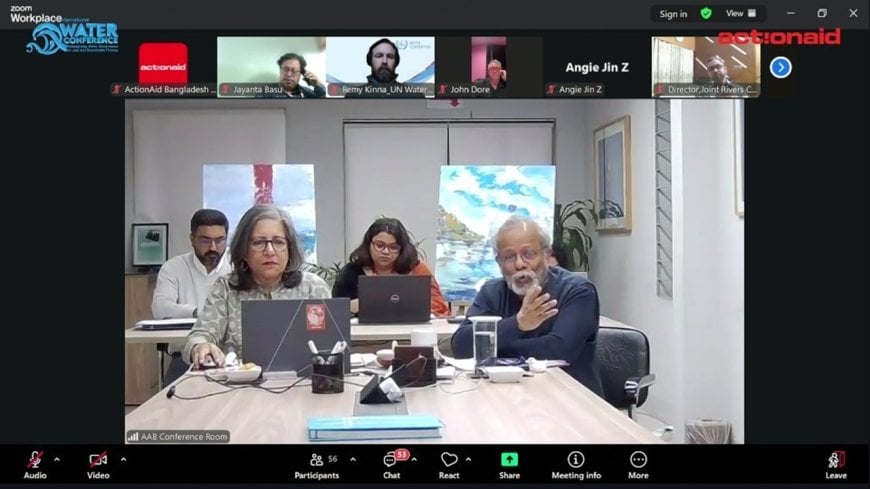
On the concluding day of the conference, Thursday, January 22, distinguished global water experts and researchers called for addressing the existing “trust deficit” in transboundary water management in South Asia. They emphasized that transparent data sharing and basin-based cooperation have become urgent necessities to confront climate change impacts and safeguard the region’s survival.
Speakers at the closing session noted that the traditional state-centric “water diplomacy” approach has failed to address climate instability and growing human vulnerability. They urged the adoption of a “hydro-social” perspective, prioritizing river flows, ecological integrity, and transboundary accountability over narrow geopolitical interests.
The session titled “Transboundary Water Accountability” was moderated by Professor Dr. Imtiaz Ahmed, Executive Director of the Centre for Alternatives. Highlighting the limitations of conventional diplomacy, he advocated for a multidisciplinary approach involving hydrologists, social scientists, and youth.
“If we can cultivate a community that views water beyond borders, only then can a truly cooperative framework be built in South Asia,” he said.
Farah Kabir, Country Director of ActionAid Bangladesh, stated that climate change has stripped water of its predictability, placing livelihoods and food security at risk.
“Water patterns are changing before we can prepare. How we farm or survive has become uncertain. Climate justice is not merely an environmental issue—it is fundamentally a question of justice,”
she said, calling for a shift “from borders to bridges.”
Dr. Jayanta Basu of Calcutta University stressed the importance of data transparency to rebuild trust in geopolitically sensitive river basins.
“Data brings transparency and stability. Instead of relying on 50-year-old records, we must depend on updated and short-term data aligned with current climate realities,”
he observed.
Mohammad Abu Saeed, Director of the Joint Rivers Commission of Bangladesh, urged stakeholders to move beyond narrow water-sharing debates.
“We often forget the most important stakeholder—the river itself,”
he said, emphasizing basin-based cooperation to ensure ecological flow and security for millions dependent on the Teesta and Ganges basins.
From a global legal perspective, Remi Kinna, a member of the UN Water Convention Secretariat, described Bangladesh’s accession to the Convention as a “strong message” for transparency and cooperation. He noted that it would facilitate collective learning and institutionalize accountability among countries.
Referring to the Mekong River Commission, Dr. John Dore, Lead Specialist at Australia’s Department of Foreign Affairs and Trade, underscored the importance of multi-track engagement, involving governments, researchers, civil society, and youth.
The conference concluded with calls to develop seasonal data-sharing protocols, establish a regional Water School, and place affected communities at the center of water governance.
Among the participants were Dr. Mansi Bal Bhargava, National President of the Water Resources Council of the Women’s Indian Chamber of Commerce and Industry; Faiyaz Bakir, Director of Pakistan’s Akhter Hameed Khan Resource Centre; and Dr. Zhang Jin, Associate Professor at Shanghai Normal University, China. More than a hundred river experts, researchers, policymakers, water rights activists, and climate advocates from home and abroad also took part in the discussions.
DBTech/SR/ZH/OR









