






































Google Transparency Report Shows Sharp Decline in Bangladesh’s Content Removal Requests



Google has been publishing its ‘Google Transparency Report’ on government data and content-removal requests since 2010. According to its latest disclosure, between 2011 and June of this year, the tech giant received 4,535 requests from the Bangladesh government to remove 19,419 pieces of content.
In 2024 alone, the then government submitted 5,827 content-removal requests to Google. During the same period, Facebook’s parent company Meta received requests seeking information on 3,771 accounts. Based on those requests, Meta restricted access to 4,220 pieces of content in Bangladesh. Earlier, from January to June of that year, the government sent 1,501 requests related to 2,285 accounts, of which Meta responded to 68.40%. In total, the government sought information on 3,771 accounts in 2024.
During the final six months of that year, Meta restricted access to around 1,280 pieces of content in Bangladesh— including over 1,140 comments, 123 posts, and 8 profiles.
In the first six months, Meta blocked over 2,940 items, including more than 2,600 Facebook comments, 317 posts, one page or group, and five profiles.
Earlier, in the last half of 2023, Bangladesh had requested Google to remove 2,943 items, most of which were YouTube videos: 52% were categorized as criticism of the government, and 175 items were related to defamation. Google took no action on 58.6% of those requests.
Since 2011, Bangladesh has submitted at least 3,766 requests for the removal of 12,569 pieces of content.
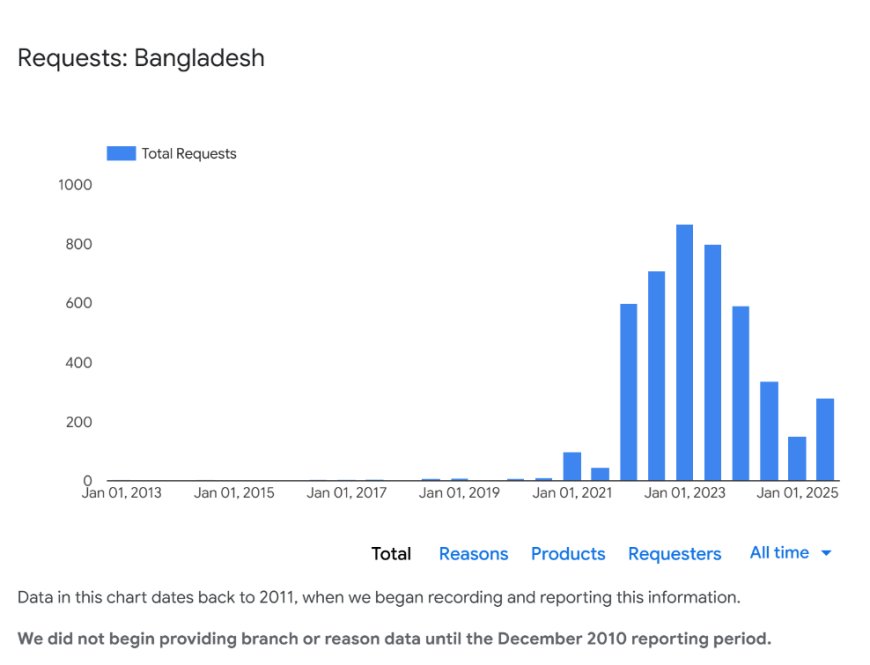
In the most recent reporting period—January to June 2025—the interim government requested removal of 279 pieces of content from Google concerning 1,023 items. This figure is less than one-third of the 867 requests sent by the ousted Awami League government during June–December 2022. It is also less than one-sixth of the 153 highest requests sent during July–December 2024, and less than half of the 591 lowest requests sent during June–December 2023.
Google said more than 65% of the requests from Bangladesh lacked sufficient information. No action was taken in 16.1% of cases. Another 9% had already been removed, 2.5% were taken down through legal processes, 3.7% removed under Google’s own policies, and 3.5% could not be found.
These details were published in Google’s January–June 2025 Transparency Report for Bangladesh.
In a social media post responding to the report, the Chief Adviser’s Special Assistant for Posts, Telecommunications and ICT Affairs, Faiz Ahmad Taiyeb, said the government assures citizens that it has not requested the removal of any newspaper reports, social media posts, videos, reels, online articles, or political criticism unless they involved misinformation, propaganda, or character assassination.
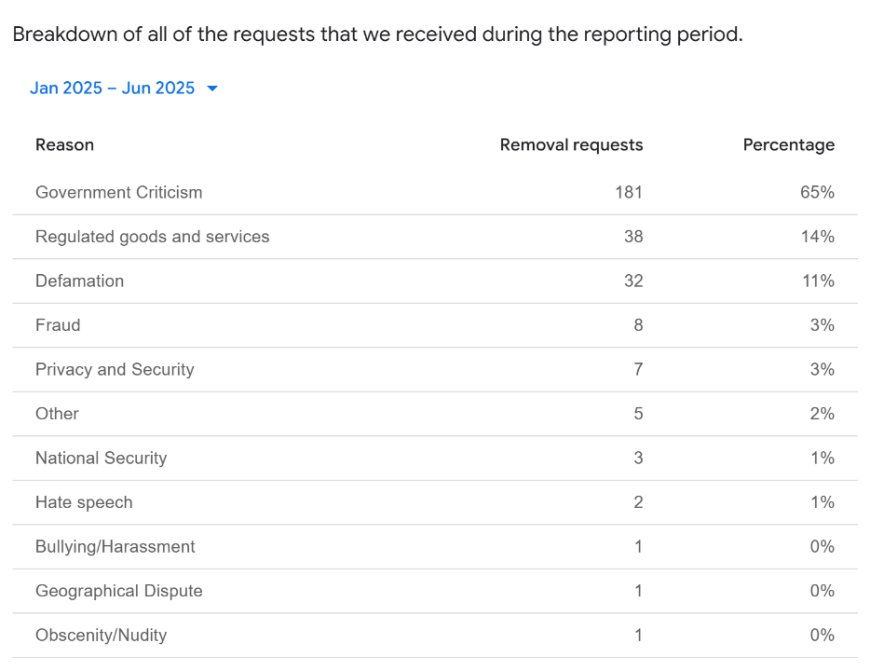
According to him, the number of requests sent by the current government is insignificant compared to the previous Awami League government. He added that, in Google’s report, 65% of Bangladesh’s requests were listed as ‘Not enough information,’ meaning they were not submitted with malicious political intent.
He also noted that, during this period, the Awami League became banned under anti-terrorism law, and as the International Crimes Tribunal (ICT) initiated proceedings over killings during the July mass uprising, the party launched ongoing misinformation campaigns against Bangladesh and the government across cyberspace.
“Ensuring cybersecurity, political stability, religious harmony, and the protection of ethnic and minority groups—both online and offline—is the government’s daily responsibility,” he wrote.
Since social media now plays a central role in social and political stability, Bangladesh, like other countries, must report certain issues to global tech platforms. The government has also filed takedown requests regarding online gambling and betting.
Requests related to misinformation, propaganda, and unlawful character assassination are submitted to BTRC by law-enforcement agencies and the National Cyber Security Agency, he added.
He said Bangladesh faced an unprecedented wave of misinformation between January and June 2025—both domestic and foreign. Media from a neighboring country repeatedly spread anti-Bangladesh propaganda, compelling the government to issue several reports to platforms like Google.
Taiyeb added that early 2025 saw a number of destabilizing incidents—over a hundred major protests, several mob attacks, shrine vandalism, communal unrest, and multiple mob lynchings. A major anti-discrimination student movement also intensified. Alongside internal tension, political intolerance and retaliatory behavior rose. In this environment, the government made responsibility-based reports to maintain social harmony.
He also clarified that the current government does not operate any bot force like the Awami League’s CRI or similar groups. Agencies like BTRC or NTMC do not have the power to remove content directly from social media; they can only submit requests to the platforms.
Because Google has no separate category for misinformation, propaganda, or character assassination, such requests are often labeled under “government criticism.” Even then, the number is less than one-fifth of the Awami League era.
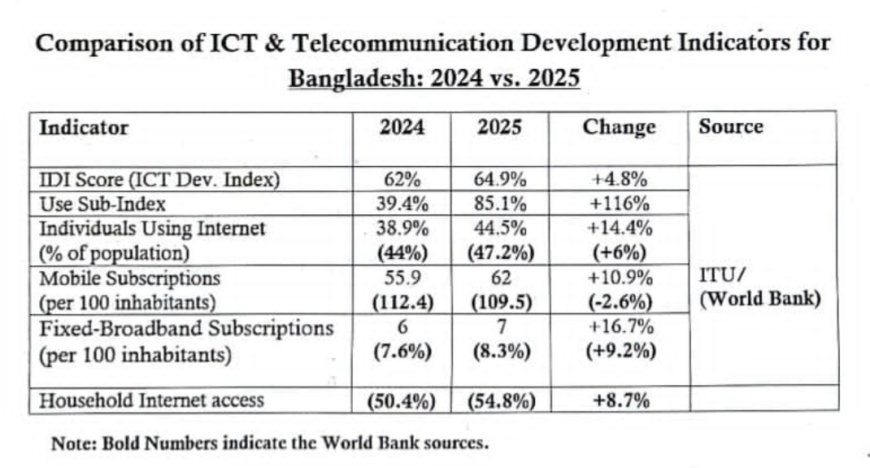
Meanwhile, Freedom House’s Freedom on the Net report stated that Bangladesh recorded the highest improvement worldwide in internet freedom this year. The country’s score rose from 40 to 45, the highest in seven years. The report attributes this progress to the fall of the repressive government after the student-led movement in August 2024 and subsequent reforms by the interim government.
Welcoming the government’s explanation, BD-SAF Secretary General Muhibul Muqtadir Tanim said such clarification is positive. However, publishing a separate dataset showing how many of the 279 “Government Criticism” items involved foreign propaganda, anti-terrorism issues, or online gambling would strengthen the government’s position further.
He added that Google’s latest report shows Bangladesh’s takedown requests have fallen sharply—279 in January–June 2025, compared with the previous government’s peak of 867. This decline is positive, but since Google found that 69% of government requests lacked essential information like specific links, evidence, or legal basis, the government should improve its administrative efficiency in handling such matters.
DBTech/GU/IH/OR









