





































Dhaka’s Dangerous Day: Double Disaster of Disturbing Earthquakes
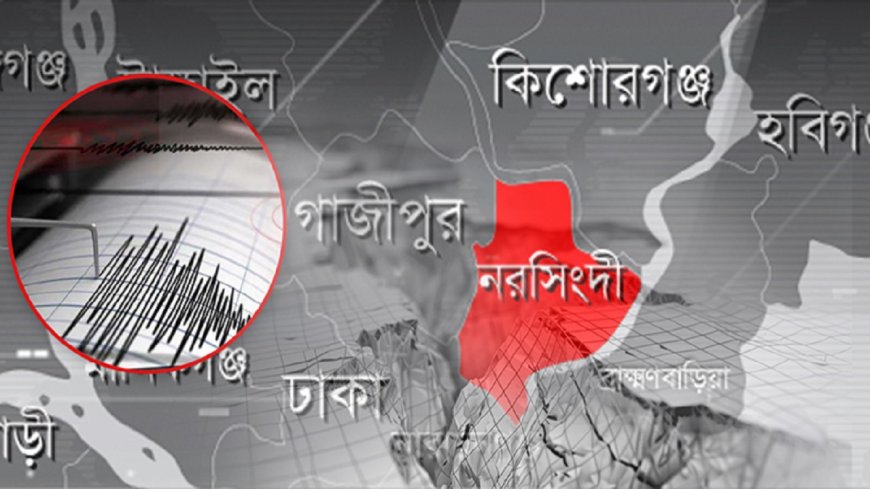



Bangladesh has experienced the strongest earthquake in Dhaka in a century on Friday, November 21. Continuous earthquakes are heightening public anxiety across the country. Less than 24 hours after Friday’s strong tremor, another earthquake was felt in and around the capital. The tremor recorded in Baipail, Gazipur, was identified by the Earthquake Monitoring and Research Center of the Meteorological Department as an aftershock of the earthquake that originated in Madhabdi, Narsingdi.
On Saturday, November 22, at 10:36:12 a.m., a 3.3-magnitude earthquake on the Richter scale was recorded. Its epicenter was in Polash Upazila, Narsingdi. Although initially reported as originating in Baipail, Savar, the Meteorological Department later clarified in the afternoon that the epicenter was actually in Polash, Narsingdi. The misidentification was due to analytical errors.
Rubayet Kabir, the acting head of the Earthquake Research Center, said, “This morning’s tremor was an aftershock of yesterday’s earthquake. Aftershocks can occur 10–20 kilometers away from the main epicenter. Its source was in the Polash area of Narsingdi.”
He further stated, “Such an earthquake has not occurred in Dhaka in the last 100 years. We are at risk of a major earthquake.”
Earlier, on Friday, November 21, at 10:39 a.m., a strong earthquake measuring 5.7 on the Richter scale was felt. This tremor caused the deaths of 10 people, including two children, in Narsingdi, Dhaka, and Narayanganj, and injured over six hundred others.
The tremor was also felt in various parts of India. Since the earthquake, panic has spread throughout different regions of Bangladesh.
According to the earthquake risk map of the Meteorological Department, Bangladesh is divided into three zones:
-
Zone 1: Highest risk areas
Areas near fault lines are most vulnerable, including nine districts of the Sylhet and Mymensingh divisions, parts of Tangail, Gazipur, and Narsingdi in Dhaka division, the whole of Kishoreganj and Brahmanbaria, and parts of Khagrachhari and Rangamati in the Chattogram Hill Tracts. -
Zone 2: Medium-risk areas
Includes parts of central and southeast Bangladesh. -
Zone 3: Low-risk areas
Relatively safer regions such as Khulna, Jessore, Barishal, and Patuakhali.
Experts note that weak building structures, high population density, and lack of disaster preparedness put Dhaka at the greatest risk.
Aftershocks are normal following a major quake. Following recent tremors, people are worried about the possibility of a larger earthquake. Experts warn that small and moderate aftershocks may continue in the coming days, and the likelihood of a major quake cannot be entirely ruled out. To reduce risk, building inspections, awareness campaigns, and safety preparedness are crucial.
DBTech/DT/IK/OR









