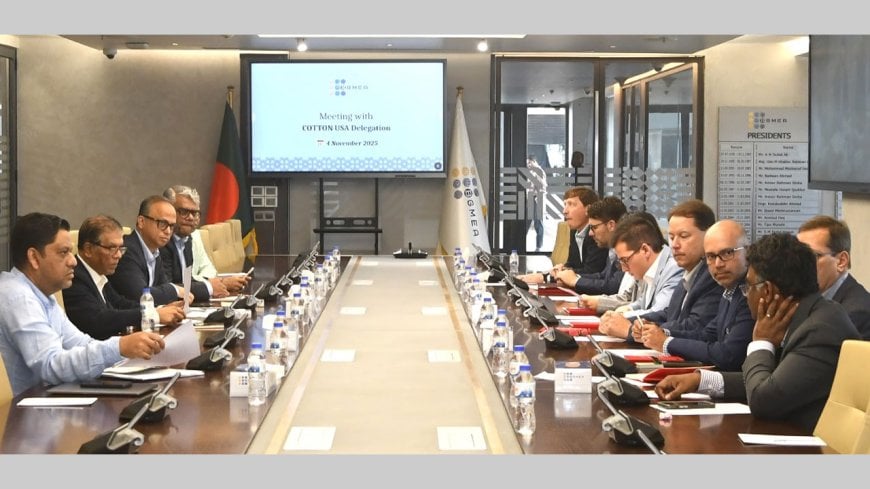
The Bangladesh Garment Manufacturers and Exporters Association (BGMEA) has sought training and technical support from U.S. cotton exporters to enhance efficiency and productivity in the country’s textile and apparel factories.
Meanwhile, a high-level delegation of American cotton exporters, representing Cotton USA, requested BGMEA’s assistance in resolving several challenges and complexities related to commercial documentation for cotton exports to Bangladesh.
These discussions took place on Tuesday, November 4, at the BGMEA Complex in Uttara, Dhaka. During the meeting, BGMEA also urged for technical expertise and knowledge support to facilitate research at the BGMEA Innovation Centre, particularly in improving mill production and reducing waste.
Responding to the U.S. delegation’s requests, BGMEA President Mahmud Hasan Khan asked them to submit their proposals in writing. He assured that BGMEA would place the issues before the Ministry of Commerce for appropriate and timely resolution.
The U.S. delegation included Lee Inn from Ecom, Krista Rickman from Cargill, Diego Lozada from LDC, Wesley Rentz from Olam Agri, Owen Bosman from Carolina Cotton Growers Association, Chris Jones from Staplcotn Cooperative, and Will Bettendorf and Ali Arslan from Cotton Council International.
From the BGMEA side, the discussion was led by President Mahmud Hasan Khan, Senior Vice President Inamul Haque Khan, and Director Nafis-ud-Doula.
The meeting also focused on enhancing bilateral trade, expanding the use of U.S. cotton in Bangladesh, and leveraging newly announced U.S. tariff facilities on garment exports. The discussion referenced a recent U.S. executive order stating that apparel containing at least 20 percent U.S. raw materials may receive proportional exemptions from newly imposed additional tariffs.
Representatives from Cotton Council International noted that Bangladesh holds a significant position in the global textile and apparel market, while U.S. cotton is recognized worldwide for its sustainability, reliability, and high quality. They expressed confidence that using U.S. cotton would help Bangladeshi exporters improve product quality and expand their presence in the U.S. market by utilizing tariff benefits.
The two parties also discussed ways to improve logistics and infrastructure to ensure easier and faster supply of U.S. cotton to Bangladesh. One proposal considered was the establishment of a warehouse to expedite cotton imports from the United States, which could reduce lead times for the industry if implemented.
Both sides agreed to work jointly to ensure transparency and traceability in measuring the proportion of U.S. raw materials under the new tariff policy.