








































Critical Concerns Surround Cyber Protection Ordinance Draft



Ordinance Criticized for Rushed Review and Conflict of Provisions
Stakeholders have expressed sharp criticism regarding the hasty three-day review of the Cyber Protection Ordinance draft. Legal experts, politicians, and victims of cybercrimes alike have voiced their dissatisfaction with the new law. According to them, despite claims that multiple stakeholders were consulted during the drafting process, the ordinance contains several conflicting provisions. They argue that the law conflates cyber security with cyber bullying, leading to provisions that may backfire as overly arbitrative. Additionally, concerns have been raised about the creation of a Cyber Security Council comprising only government officials, resembling another NTMC (National Telecommunication Monitoring Centre).
Legal Experts Highlight Inconsistencies
Describing the Cyber Protection Ordinance 2024 draft as disappointing, Supreme Court senior lawyer Barrister Jyotirmoy Barua highlighted several inconsistencies in its provisions. He pointed out that Section 12, which establishes the Security Council, has little to show beyond surveillance efforts. Sections 17–19, addressing unauthorized access to critical information infrastructure, lack clarity on who will implement the measures and how. While Section 18 includes hacking under its scope, it omits “positive hacking.” Section 19 concerning damage to physical infrastructure remains unchanged from previous laws.
Although Section 25 is lauded for its language, Barrister Barua criticized its interpretation of defamation and harassment. He stated, “Adding clauses like ‘lacking artistic or educational merit’ to cases of insult, harassment, blackmail, or defamation has turned this section into a potential boomerang.” He further argued that civil offenses like defamation are inappropriately criminalized under this provision.
Barrister Barua also noted that Section 26 mirrors Section 57 of the previous law and fails to address children’s rights. Moreover, he criticized the ordinance for imposing fines of up to 1 million BDT and prison terms starting at 1.5 years, contrary to penal code standards. Gender-sensitive provisions or separate guidelines for individuals under 18 are absent, which violates Article 27 of fundamental rights.
A “Jumbled” Law with Broad Powers
Transparency International Bangladesh (TIB) Director Mohammad Tawhidul Islam described the ordinance as a “jumble” that conflates physical infrastructure, unauthorized access, and other unrelated issues. He warned that the law could criminalize legitimate digital scribes, advocating for separate laws for cyber security and cyber safety. He also criticized the lack of accountability for government institutions and questioned who would safeguard internet rights.
Concerns Raised at Citizens’ Dialogue
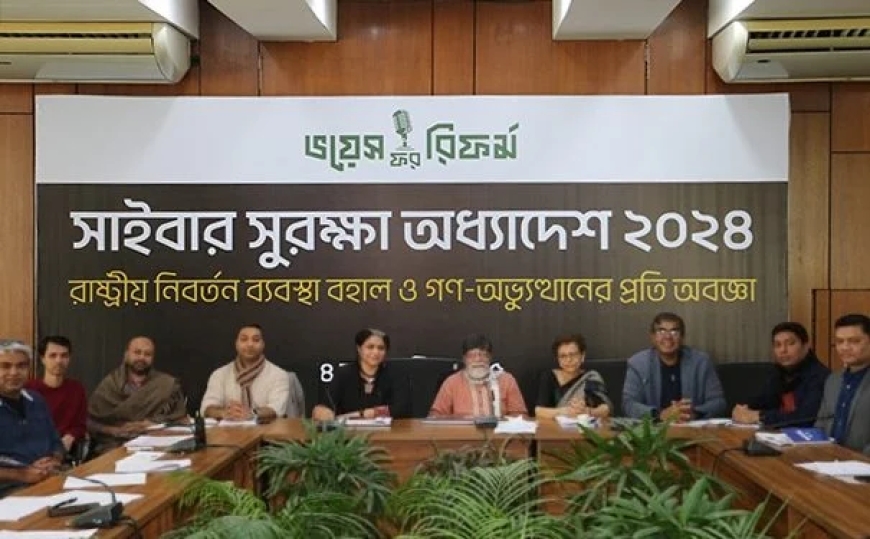
During a citizens’ dialogue titled “Cyber Protection Ordinance 2024: A Perpetuation of State Repression,” held on Saturday at Bishwo Shahitto Kendro in Dhaka, participants strongly criticized the draft. The event was organized by the civic platform “Voice for Reform” and moderated by human rights activist and photographer Shahidul Alam. Speakers included UN Special Rapporteur Irene Khan, human rights lawyer Barrister Sara Hossain, political reformist Didarul Alam Bhuiyan, politician Barrister Fuad, politician Bobby Hajjaj, e-Raki’s Chief Sima Nasir, and Fahim Mashroor, co-convenor of Voice for Reform.
Ordinance Threatens Human Rights and Freedom of Expression
The speakers highlighted how the ordinance disregards fundamental human rights. UN Special Rapporteur Irene Khan stated, “The ordinance contains clauses that conflict with human rights conventions signed by Bangladesh.” She criticized the vague language in the ordinance, which could lead to misuse by those in power. She also noted that sections 25 and 26 undermine freedom of expression and that the ordinance does not adequately address misinformation and disinformation.
Human rights lawyer Barrister Sara Hossain acknowledged the need for such a law but questioned whether all stakeholders were genuinely consulted during its drafting. She emphasized that the ordinance’s controversial roots trace back to the ICT Act of 2006 during the BNP government and were later retained by subsequent governments.
Calls for Separate Legal Frameworks
Tech policy expert Sabhanaz Rashid Dia criticized the ordinance for failing to differentiate between cyber security and online safety, arguing that these require separate legal frameworks. Politician Didarul Alam alleged that cases of harassment under the previous cyber security law remain unresolved, while politically influential individuals have had their cases withdrawn.
Fahim Mashroor expressed concerns over provisions granting police the authority to arrest without a warrant and to search mobile phones, which he described as violations of privacy and personal liberty. Politician Bobby Hajjaj argued that criminalizing satirical content with excessive penalties is not suitable for a progressive Bangladesh.
A Call to Protect Human Rights
Shahidul Alam, the moderator, condemned the ordinance, stating, “Such a human rights-violating ordinance cannot be expected from a government formed after a people’s revolution.” He urged the government to prioritize human rights and to consult citizens comprehensively before finalizing any cyber-related legislation. Alam called for the immediate withdrawal of the draft ordinance.
Speakers collectively demanded a complete overhaul of the ordinance to safeguard fundamental rights and ensure a balanced approach to cyber security and online safety.









