






































Solar Shift Strategy: Youth Seek Roadmap for 10,000 MW Clean Power
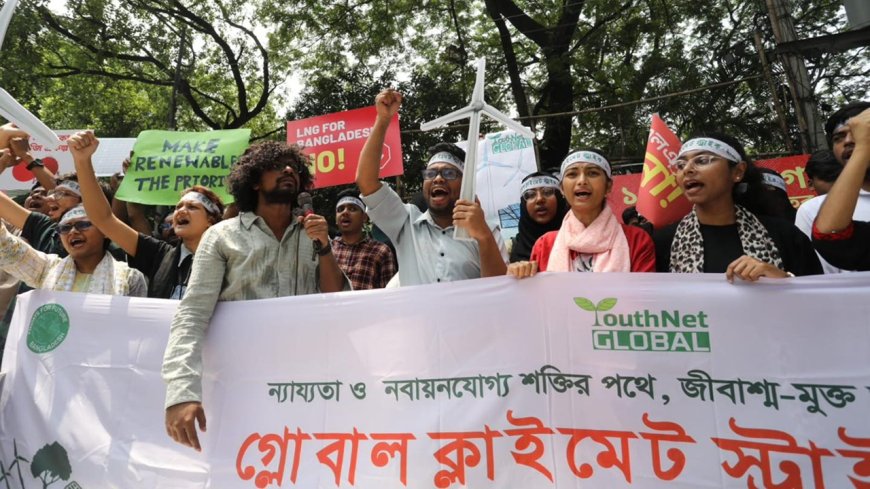



Young climate activists who took part in a global climate strike held in Dhaka have welcomed the government’s plan to generate 10,000 megawatts of solar power by 2030. However, they called for the declaration of a clear roadmap to implement this target. They also urged increasing the share of renewable energy in the draft Energy and Power Sector Master Plan (EPSMP) and gradually reducing dependence on fossil fuels.
These demands were raised on 8 May, Friday, during a programme held in front of the National Press Club in the capital. More than two hundred young climate activists participated in the event, organized by YouthNet Global and Youth for NDC.
Through banners, posters, and slogans, participants highlighted the financial burden and environmental damage caused by the import of oil, gas, and coal. They chanted slogans such as, “No false solutions, we want renewable energy for future generations.”
At the rally, YouthNet Global Executive Coordinator Sohānur Rahman said, “The plan to produce 10,000 megawatts of solar power must be implemented swiftly. Renewable energy must be given top priority in the draft EPSMP.”
Amanullah Parag stated that global instability and geopolitical crises are affecting Bangladesh’s economy. Rising costs of electricity and energy have increased the cost of living for ordinary people. He said, “We need more affordable energy, and for that we must rapidly move toward renewable sources.”
Speakers noted that due to geopolitical tensions in the Middle East and volatility in the global energy market, Bangladesh is being forced to import LNG, oil, and coal at higher prices. This is increasing government expenditure and putting pressure on the economy. In many cases, industrial production is being disrupted due to energy shortages, they added.
The young activists also reminded that the previously announced target of generating 3,300 megawatts of rooftop solar power in government buildings by December 2025 has yet to be achieved.
They further said that high taxes on solar equipment, investment complexities, and policy uncertainties are major barriers to the expansion of renewable energy. They demanded tax reductions on solar equipment, faster project approvals, and stronger coordination among relevant agencies.
Welcoming the government’s recent announcement to expand Public-Private Partnership (PPP) in the renewable energy sector, the youth said that effective implementation measures are needed alongside policy declarations.
Expressing solidarity with the youth movement, Shafiqul Alam, Lead Energy Analyst at the Institute for Energy Economics and Financial Analysis, said, “There is no alternative to renewable energy for building a livable planet. While the government’s plans are positive, clear strategies and effective monitoring systems are essential for implementation.”
Sharif Jamil, Coordinator of Waterkeepers Bangladesh, said, “In the current global context, the development of renewable energy has become a matter of national energy security and independence.”
Organizers said that similar climate strike programmes were held simultaneously in 50 districts across the country, with participation from school, college, and university students.
DBTech/YNG/MUIM/OR









