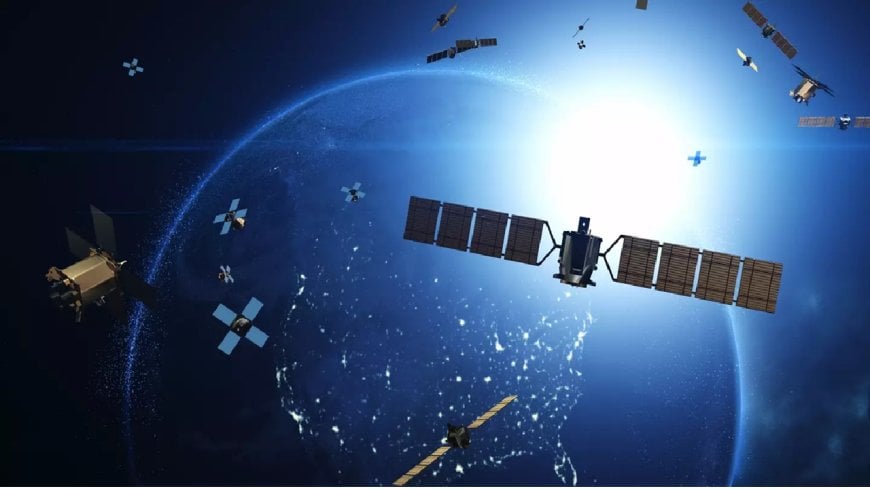
Solar flares and geomagnetic storms triggered by heightened solar activity are significantly shortening the lifespan of satellites orbiting Earth, with SpaceX’s Starlink satellites being the most affected. This revelation comes from scientists at NASA’s Goddard Space Flight Center, who studied satellite behavior in low Earth orbit (LEO).
The findings were presented by heliophysicists Denny Oliveira, Eftyhia Zesta, and Katherine Garcia Sages from NASA’s Goddard Space Flight Center and the Goddard Planetary Heliophysics Institute at the University of Maryland. Their research, covering data from 2020 to 2024—during the ascending phase of the solar cycle—was published on the arXiv preprint server.
The study’s publication comes at a time when Elon Musk, head of Starlink, is grappling with both personal controversies and professional instability. As his feud with Donald Trump plays out in public, Musk's flagship space venture is under pressure from the sun’s intensifying emissions. An increasing number of Starlink satellites are losing altitude and disintegrating as they re-enter Earth’s atmosphere due to increased solar radiation.
According to a report published in the UK-based popular science magazine New Scientist, solar activity peaks during the “solar maximum” phase of the solar cycle. This surge results in geomagnetic storms that heat and expand Earth’s atmosphere, increasing atmospheric drag on satellites. Consequently, satellites descend more quickly and re-enter the atmosphere earlier than expected, often burning up prematurely.
The researchers warn that future satellite design must take the sun's natural cycles into account to prevent potential disasters. Without such precautions, satellites face heightened risks of orbital collisions, data disruptions, and broader technological breakdowns.
Referencing data from Physics.org, the research team found that increased geomagnetic drag causes Starlink satellites to deorbit faster than anticipated. Although these satellites are designed to last approximately five years, the team observed that during periods of intense geomagnetic activity, the final descent phase—typically from about 280 km altitude—shortens by 10 to 12 days.
NASA heliophysicist Denny Oliveira, lead author of the study, explained: “We found that during geomagnetic storms, satellites are not surviving the expected duration. Their lifespan can be shortened by up to 10 days.” He noted that during a strong solar storm in late 2024, 37 Starlink satellites fell out of orbit within just five days—despite being expected to remain aloft for 15 days or more under normal conditions.
From 2020 to 2024, a total of 523 Starlink satellites re-entered Earth’s atmosphere and completely burned up. These satellites are intentionally designed to disintegrate upon reentry to avoid causing damage on the ground. However, with new Starlink launches occurring almost weekly, scientists predict that satellite burn-ups may soon become a daily occurrence.
To date, SpaceX has launched over 7,000 Starlink satellites and has plans to deploy more than 30,000 in the future.
While this trend poses risks, some experts also see potential benefits. Shaun Elvidge of the University of Birmingham commented: “If dead or defunct satellites are cleared from orbit, it could reduce the risk of collisions. But operating satellites below 400 km altitude will become increasingly difficult.”
A more pressing concern, however, is the possibility that some satellites may not completely burn up. In August 2024, a 2.5-kilogram piece of Starlink debris was recovered from a farm in Saskatchewan, Canada—the first confirmed instance of Starlink material surviving atmospheric reentry.
Experts believe that such incidents may increase during the current solar maximum phase, presenting new challenges for the satellite industry. Starlink satellites are relatively inexpensive, lightweight, and mass-produced, with less advanced orbital maintenance systems. As a result, they are more vulnerable to the increased atmospheric drag during solar flare activity.
Wang Yanan, editor-in-chief of the Beijing-based aerospace magazine Aerospace Knowledge, remarked: “When solar activity increases, the atmosphere expands. As a result, low-orbit satellites experience greater drag, making it harder for them to remain in orbit.”
Fortunately, most Starlink satellites disintegrate fully before reaching Earth’s surface. However, the uncontrolled descent of these satellites creates new hazards for other spacecraft and newly launched satellites operating in the same orbital space.