











































Bangladesh to Install Air Quality Stations in Dhaka and Chattogram



To monitor pollution levels, air quality stations are set to be installed in Dhaka and Chattogram. In the capital, the stations will be placed in Uttara House Building, Banani, Rampura, Jatrabari, and Dhanmondi, while in Chattogram, they will be set up on land owned by the Chattogram Development Authority (CDA) and the Bangladesh Semiconductor Industry Association (BSIA). Additionally, a mobile station will patrol high-traffic areas to monitor pollution levels. These devices will provide real-time data on air quality and assess the extent of pollution caused by transportation in both cities.
Under The Project for Improvement of Equipment for Air Pollution Monitoring, a total of eight Japanese technology-based devices will be installed. Each unit will cost the government over BDT 75 million. Japan has pledged a grant of BDT 6.487 billion for the project.
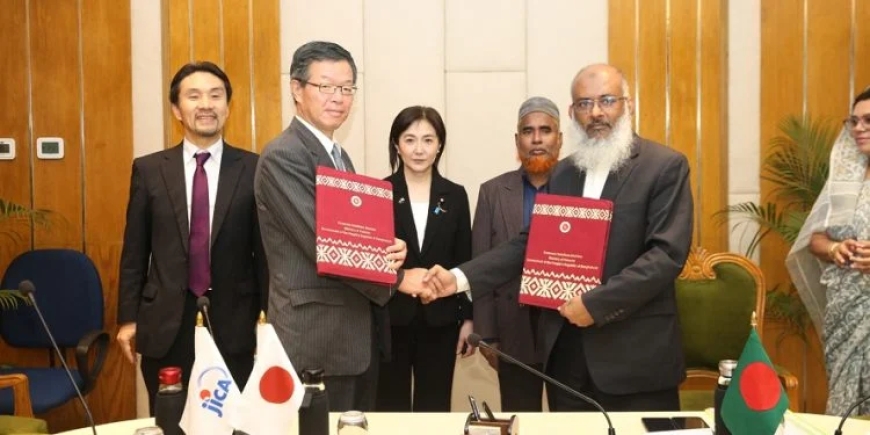
On Monday, February 3, an Exchange of Notes and Grant Agreement were signed between the governments of Bangladesh and Japan at the Economic Relations Division (ERD). Japanese Ambassador to Bangladesh, Saida Shinichi, and ERD Secretary Md. Shahriar Kader Siddiky exchanged the grant aid documents. Meanwhile, JICA Bangladesh Office Chief Representative Ichiguchi Tomohide and Md. Shahriar Kader Siddiky signed a related grant agreement.
Japan’s Parliamentary Vice Minister for Foreign Affairs, Ikuina Akiko, attended the signing ceremony, along with Additional Secretary of the Ministry of Environment, Forest, and Climate Change, Md. Khairul Hasan.
Vice Minister Ikuina Akiko stated, “Under our strategic partnership, Japan will continue to support Bangladesh’s development and prosperity, contributing to regional and international peace, stability, and strengthened bilateral relations.”
According to Mohammad Abdul Motaleb, Deputy Director (Air Quality Management) of the Department of Environment (DoE), “Once installed, these devices will provide 24-hour air quality data. Roadside pollution levels will be measured, and the extent of vehicle emissions will be identified. Based on this data, the government will formulate policies on necessary actions.”
The project, set to run from March 2025 to June 2028, will be implemented by the DoE. Its primary objective is to analyze the impact of vehicle emissions on air quality in Dhaka and Chattogram through continuous air monitoring stations. These stations will enable measurement and assessment of air pollutants originating from vehicular emissions.
The DoE has confirmed that the advanced monitoring devices will provide real-time data, aiding the government in determining pollution levels caused by different types of vehicles and formulating measures to curb emissions. The collected data will also assist in modernizing and restructuring the transport sector. Japan has shown interest in making significant investments in Bangladesh’s transportation sector. Following the installation of Japanese technology in FY 2025-26, the devices are expected to remain operational for at least ten years.
The estimated total cost of the project stands at BDT 10.895 billion, of which BDT 4.111 billion will come from the government, while Japan’s grant will cover BDT 6.784 billion. The project has already been approved by the Project Evaluation Committee (PEC) of the Planning Commission and is awaiting final approval from the Executive Committee of the National Economic Council (ECNEC).
Additionally, under a new initiative, roadside monitoring stations will be set up in both cities to assess transport-related air pollution and implement necessary countermeasures. The equipment will be imported from Japan. Besides monitoring vehicle emissions, the project aims to identify other sources of air pollution, assess the adverse health effects of air pollution, and address related environmental challenges through strategic interventions.
Japan remains Bangladesh’s largest bilateral development partner, having pledged $32.61 billion in assistance since the country’s independence. Japan continues to play a crucial role in Bangladesh’s economic development through concessional loans, grants, and technical assistance in sectors such as human resource development, socio-economic progress, and environmental protection.









