
































































































































































Data-Driven Democracy: Mapping Bangladesh’s 300 Seats



As elections approach, opinion polls inevitably multiply. Several field-level survey results have already been published in the media, each based on structured questionnaires and interview-driven methodologies. Public reactions to these polls are mixed. Some support them, others oppose them—often questioning the survey questions themselves. Many debate the respondents’ locations, sample size, or ideological leanings. Some accept the findings; others quietly dismiss them. Politicians and candidates, even if they do not admit it publicly, are often unsettled by such polls.
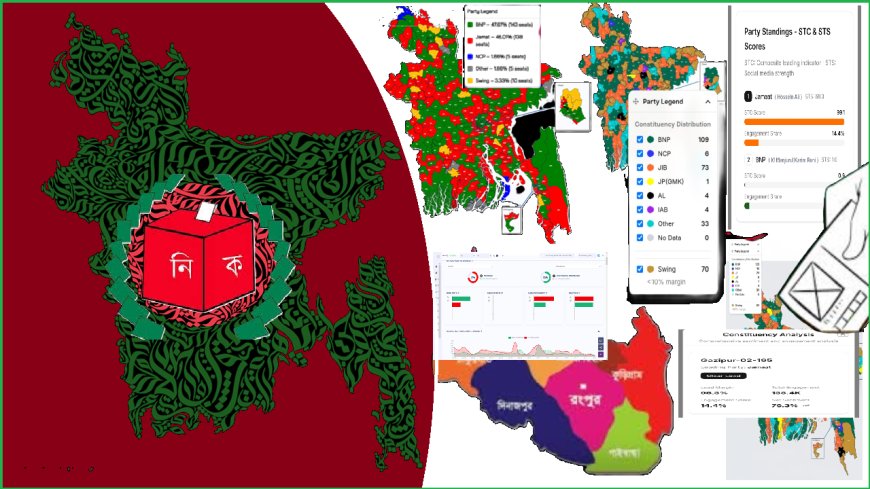
This unease has intensified ahead of the 13th National Parliamentary Election, particularly because candidates are unable to showcase themselves through posters, banners, or gateways. Unsurprisingly, social media has emerged as the virtual battleground of the vote. In this context, technology has opened up powerful opportunities for data analysis. Using AI and data mining, Bangladesh’s Socian AI is presenting a live picture of the electoral contest across all 300 parliamentary seats, while Loosely Coupled is mapping the pulse of citizens moment by moment.
Live Battle Across 300 Seats
Elections are traditionally associated with calculations, speculation, and last-minute drama. But what if all of this could be viewed through the lens of data and analytics rather than guesswork? That is precisely the question behind Socian AI’s new initiative, “Election Buzz.”
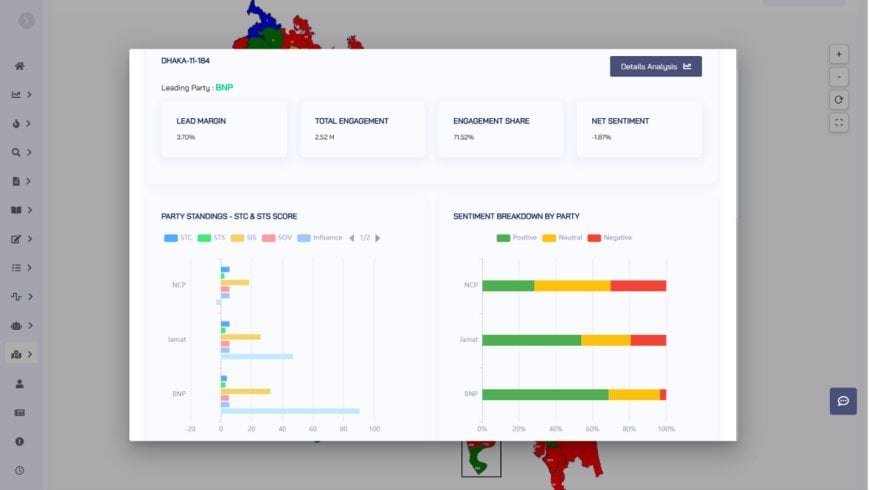
Election Buzz is an interactive analytics dashboard designed for Bangladesh’s electoral landscape. It shows, in real time, which candidates or parties are leading in each constituency, where contests are neck-and-neck, and where public sentiment is shifting rapidly. The platform features over a hundred analytical tools, including interactive maps that instantly display the electoral situation in every parliamentary seat, alongside candidates’ and parties’ social impact scores.
What Does Election Buzz Show?
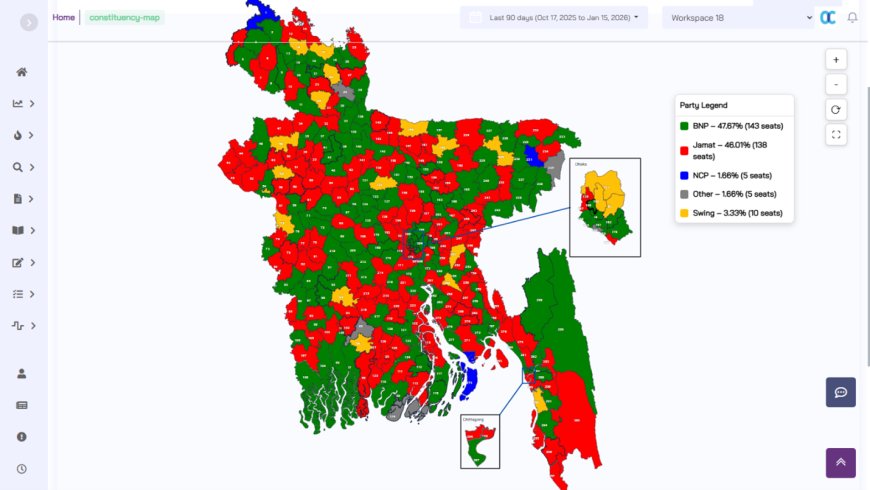
Upon entering the platform, users see a map of Bangladesh with all 300 constituencies marked using different colours and indicators. Clicking on a seat opens a summarised snapshot:
-
which party or candidate is dominating online discussions,
-
the ratio of positive and negative sentiment,
-
key issues attracting voter interest, and
-
how discussions are rising or falling over time.
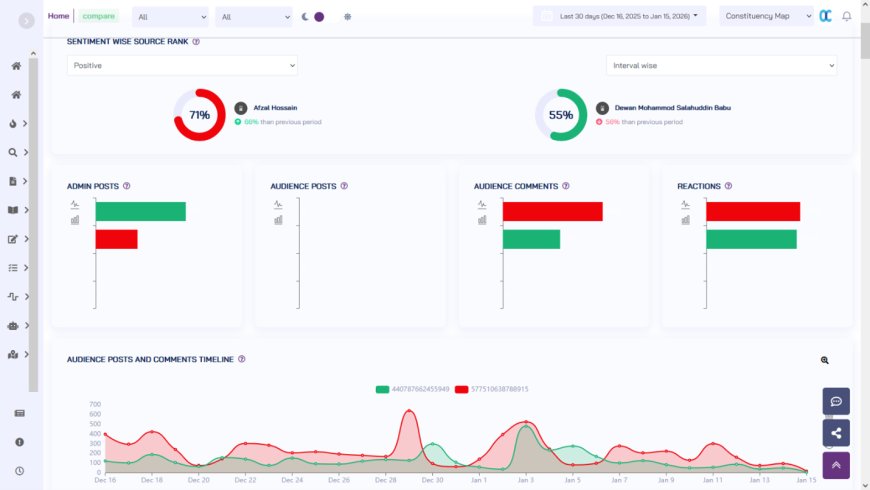
Within seconds, users can grasp the electoral dynamics of a constituency. Metrics such as share of voice, social impact score, sentiment score, engagement levels, and discussion themes become visible through Election Buzz’s analytical lens.
Beyond summaries, the platform allows constituency-wise deep-dive analysis, offering multidimensional analytics powered by artificial intelligence. Side-by-side data comparisons enable detailed interpretation of trends—making it easier to understand where public opinion is heading and what citizens truly want.
Data Sources and Methodology
Election Buzz is built entirely on open and public data. Social media posts and comments, online news, blogs, and public forum discussions are categorised using AI and language-processing technologies. Text is also extracted from images, audio, and video content for analysis.
Importantly, the system includes Bangla, regional dialects, and Romanised Bangla, ensuring that online conversations from both rural and urban areas are reflected accurately.
Why It Matters
Until now, understanding public opinion in Bangladesh’s electoral politics largely depended on field impressions or limited surveys. Election Buzz adds a new dimension. Journalists can quickly identify why tensions are rising in certain seats. Analysts can track which issues might swing the vote. Ordinary readers gain a data-based, comprehensive picture.
In short, the platform makes election discourse more transparent and data-driven.
Fake News and Early Warnings
Disinformation is a major challenge during elections. One notable feature of Election Buzz is its alert system, which flags sudden spikes in misinformation or abnormal campaigns. This allows journalists and observers to respond quickly and remain vigilant.
Ethics and Privacy
Socian AI emphasises that Election Buzz relies solely on publicly available data. No personal or sensitive information is collected. The analysis focuses on overall trends and statistics, not individuals—placing public opinion at the centre.
What Lies Ahead
As election day draws closer, Election Buzz is expected to become a key reference point for readers, analysts, and political observers seeking answers to who is ahead and where contests are tight. Addressing this growing demand, Socian AI CEO Tanvir Sourav noted that UNDP is already using Election Buzz for social cohesion monitoring, and political parties as well as individual candidates have shown strong interest.
In the digital age, elections are no longer just about posters or processions—they are also a battle of data. Election Buzz captures that battle, offering a contemporary data portrait of Bangladesh’s 300 parliamentary seats.
Mapping the Citizen Pulse
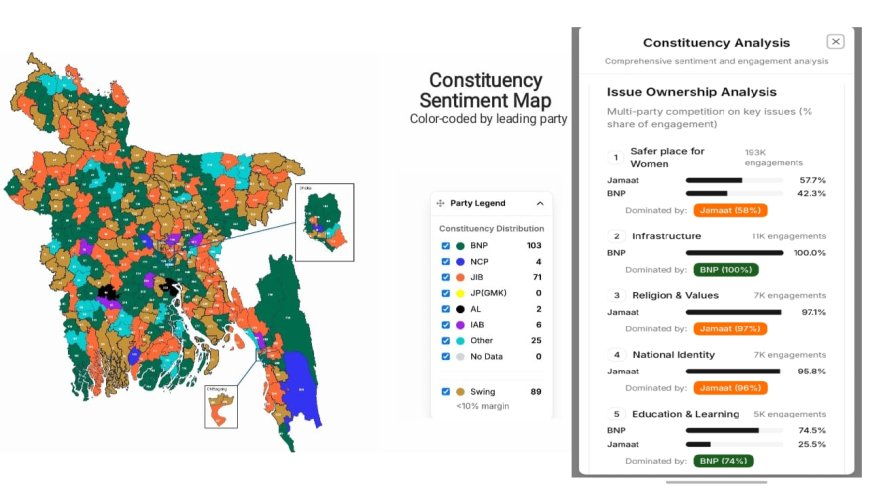
With less than a month left for the elections, social media campaigning is still quite unstructured for candidates and parties. Although almost all candidates have now started appointing social media campaign managers, social media has become a new gateway to attract voters easily, especially with restrictions on posters, arches, and microphone sound limits. The previous DUCSU (Dhaka University Central Students' Union) election proved that one can gain an advantage by understanding the sentiments of voters in their area and designing campaigns accordingly. This was reflected in the saffron-green battle of the 'BD Election Map'. Social sentiment indicates that Jamaat holds a sentiment margin of over 90% in 15 constituencies. This means that Jamaat's candidates in these 15 seats are talking more about issues that people want to discuss or consider problems. Jamaat-e-Islami Bangladesh has never come to power independently in the history of Bangladesh.
However, after the disappearance of former Prime Minister Khaleda Zia and Tarique Zia assuming full responsibility after being acquitted, their green camp is leading with a significant margin in 30 constituencies across the country, including three in Dhaka. Of course, the number of swing seats is now higher than other parties, totaling 101. According to sentiment analysis on social media, this number is increasing every day.
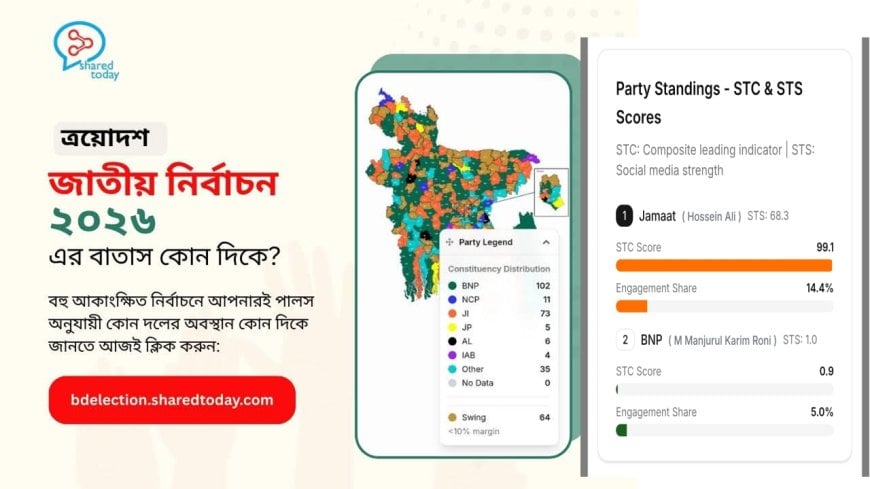
This is where Loosely Coupled’s “BD Election Map” comes in. The platform visualises citizen sentiment across all constituencies using colour-coded maps. Based on a weighted score—60% shares, 30% comments, and 10% reactions—it displays an average sentiment pulse. Seats scoring below a threshold are classified as swing constituencies.
According to social sentiment data, 15 seats currently show over 90% sentiment margin for Jamaat, indicating strong alignment between candidate messaging and public concerns. While Jamaat-e-Islami Bangladesh has never formed a government alone, analysts note that shifts following major political developments have significantly altered the electoral map. At present, the number of swing seats stands at 101, and this figure is changing daily. Insights from this data are also published as blogs under “Pulse Today” on sharedtoday.com, offering daily interpretations of voter sentiment across issues, posts, shares, and comments. Loosely Coupled's BD Election Map is showcasing citizens' sentiments from all 300 parliamentary constituencies of the country on a map. They are calling this map Bangladesh's Sentiment Map. The organisation says that this time, for the national elections, political parties, candidates, and voters can gauge public opinion using social media data, moving beyond just guesswork. Using machine learning tools, they are showing what voters are thinking, where the excitement lies, where there are doubts, and where there is hope.
How the Map Works
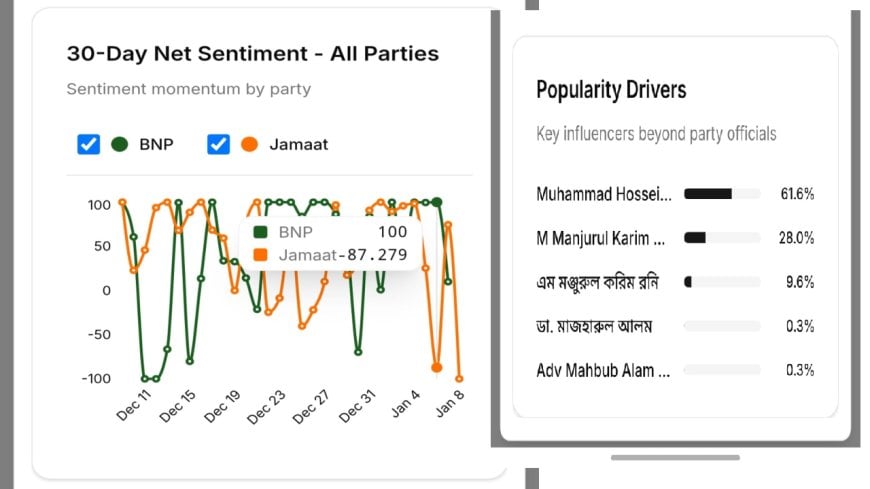
The BD Election Map analyses data from Facebook pages, regional and local social media communities, and the platform formerly known as Twitter, now X. The map updates hourly, reflecting changes in online discussions, emoji usage, and sentiment analysis derived from natural language processing (NLP).
Loosely Coupled Technologies' Country Manager Rubaiyyat Salam mentioned that these tools understand Bangla, "Balinglish" (Bangla in English script), phonetics, and English. He spoke about their AI-driven technology initiative in machine learning, developing a Bangla LLM in the lead-up to the elections. They have created six tools, both paid and free. The map includes map, map inside, and dashboard services. He said that there are area-wise pages for all 300 constituencies. By analysing 12 crore data points from these, the map is showing the instant pulse of the election atmosphere. Political parties and candidates can learn about citizens' thoughts and identify real local issues from this data. Voters can also understand the true efforts of candidates or parties based on politicians' activities. However, service recipients need to subscribe to avail these services.
Why this Map?
In Bangladesh, the total number of voters is over 12 crores. However, slightly more than 4 crores of people directly use social media. The number using it indirectly is almost double. Also, there's a segment that uses social media but doesn't actively comment or participate. A significant portion of these 12 crore voters are young people this time. Their innovative thoughts, opinions, emotions, likes, and dislikes are all expressed first and foremost through social media, constantly reflecting people's sentiments on various issues. This is open and public, containing people's emotions, opinions and their changes, reasoning, likes, dislikes, hope, and despair – all kinds of sentiments. This information helps people in decision-making. By creating and analysing this data, voters, candidates, and parties automatically receive information about decision-making, what to do, and their standing relative to competitors. Besides understanding voter sentiment, each candidate can see the top 5 pages discussing them from within the candidate map, understanding the trending score on the ground. Candidates can generate reports from the dashboard with a single click, showing how much they are advancing or falling behind each day, and what they should do.
“My Parliament” Game
Ahead of the election, a web-based game called “My Parliament” has also been launched. It functions as a real-time survey tracker. After registering and voting for their constituency, users can predict outcomes across all 300 seats once candidates are finalised. Participants with the most accurate predictions will even get the opportunity to attend a session of the 13th National Parliament.
Observers believe these two initiatives are giving Bangladesh’s election a global, tech-driven dimension. They are enabling environmentally friendly campaigning, data-informed decision-making for candidates, and empowering voters to evaluate choices from home—reshaping how elections are understood and conducted in the digital era.