













































IEB Calls for Taskforce to Prevent Corruption in Development Projects, Demands Job Policy for Private-Sector Engineers
Engineers must be placed in key decision-making roles to ensure quality and accountability in national development projects, say IEB leaders



The Institution of Engineers, Bangladesh (IEB) has proposed forming a task force to ensure transparency and accountability in the country’s development projects, while also demanding a national job policy for private-sector engineers.
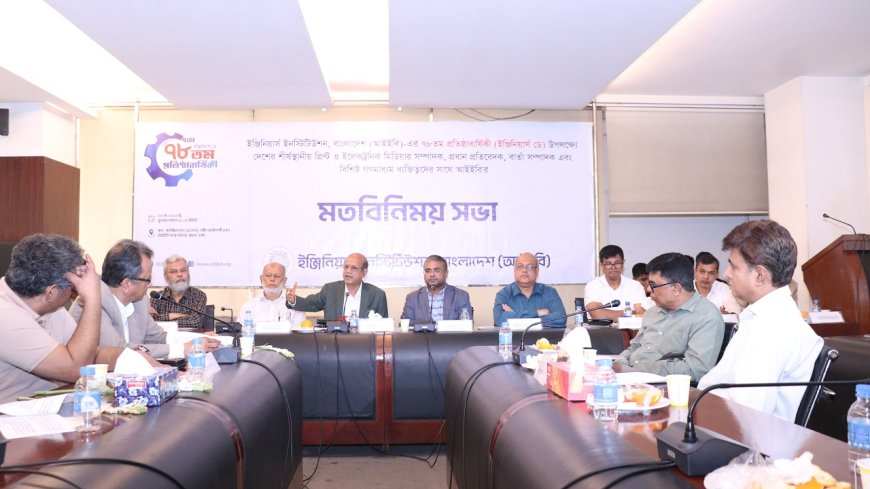
The issues were highlighted at a media interaction session organized on Wednesday (6 May) at the IEB headquarters in Ramna, Dhaka, marking the institution’s 78th founding anniversary (Engineers Day).
The session was chaired by IEB President Mohammad Riazul Islam and moderated by Honorary Assistant General Secretary (Administration and Finance) Muhammad Ahsanul Russell.
In his welcome speech, Vice-President (Administration and Finance) A.T.M. Tanbir-Ul-Hasan emphasized the critical role of the media in presenting the contributions of engineers and the country’s development initiatives to the public.
Presenting an overview of IEB’s activities, Honorary General Secretary Dr. Md. Sabbir Mostafa Khan said more than 70 percent of the country’s engineers currently work in the private sector, where many face low salaries, job insecurity, and limited professional benefits.
“Most government development projects are implemented on the ground by private-sector engineers, yet there is no specific job policy for them. This is a major disparity,” he said.
Dr. Sabbir also criticized the practice of appointing non-technical individuals to top positions in engineering organizations and state-owned institutions, saying it negatively affects project implementation. He called for ensuring qualified engineers are appointed to key roles, including chairpersons, managing directors, and project directors.
He further urged authorities to provide timely promotions and grade adjustments for engineers serving long periods in acting or additional-charge positions.
In his presidential speech, Mohammad Riazul Islam said allegations of corruption and irregularities have surfaced in several development projects undertaken in recent years. To address these concerns, IEB is planning to form a dedicated task force.
“To strengthen the engineering sector, it is not enough to build infrastructure alone; good governance must also be ensured. Professionalism, efficiency, and accountability have to be established in development projects,” he said.
He also noted that nearly 12,000 new members joined IEB during the tenure of the current committee, making the organization more dynamic and representative.
Among other IEB leaders present at the event were Vice-President (Academic and International) Khan Monjur Morshed, Vice-President (HRD) Sheikh Al Amin, Vice-President (S&W) Niaz Uddin Bhuiyan, Honorary Assistant General Secretary (HRD) Md. Nur Amin, and Honorary Assistant General Secretary (S&W) Sabbir Ahmed Osmani.
Also present were Dhaka Centre Chairman Helal Uddin Talukdar, Vice-Chairmen Abdullah Al Mamun and Md. Kamrul Hasan, and Honorary Secretary K. M. Asaduzzaman.
Representatives from leading media outlets also attended the event, including Loton Ekram, Touhid Shanto, Farhana Nishu, Md. Kamrul Islam, Md. Rafiqul Islam, Gausul Azam Bipu and Abul Hasan, alongside senior journalists and media professionals.
Participants at the discussion stressed the need for greater transparency in development projects, policy reforms in the engineering sector, and stronger coordination between the media and IEB to support sustainable national development.
DBTech/SI/EK









