






































Girls’ Growth in Gadgets: Coastal STEM Project Celebrates Success
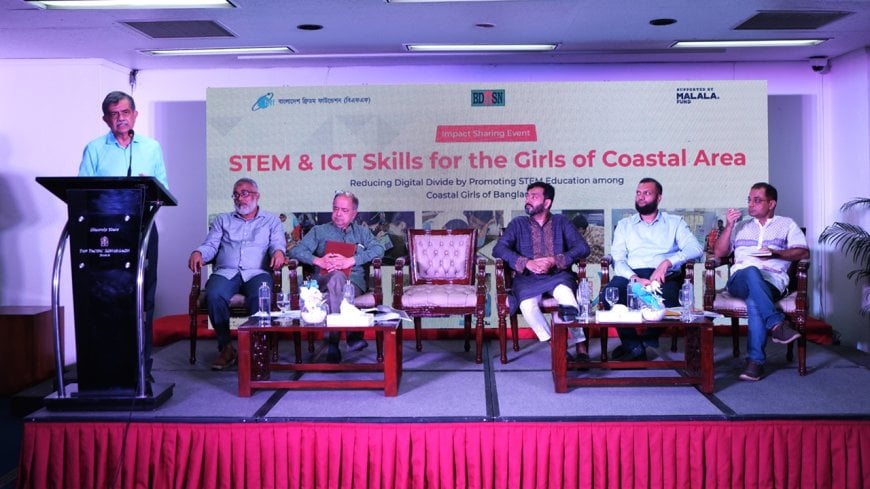



A two-day review and experience-sharing meeting highlighted the achievements of the “STEM and ICT Skills for the Girls of Coastal Areas” project, emphasizing the need for public and private initiatives to enhance students’ skills in robotics, programming, and other emerging technologies. The event was held on Saturday, 13 September, at a hotel in Dhaka, organized by the Bangladesh Freedom Foundation and the Bangladesh Open Source Network, with support from the Malala Fund.
The primary aim of the meeting was to assess the impact of increasing girls’ participation in STEM education in coastal regions and to discuss sustainable strategies for future initiatives. The event’s chief guest, Bangladesh’s Interim Government Education Advisor Professor Dr. Chowdhury Rafiqul Abrar, addressed the gathering.
The program began with a documentary screening showcasing the project, which over the past three years has engaged six secondary schools across three sub-districts in Khulna, Bagerhat, and Satkhira. The initiative targeted girls in grades six to eight, providing a customized STEM curriculum and portable STEM labs. These mobile labs allowed neighboring schools to participate without incurring extra costs for lab construction or maintenance.

Through the project, over 1,200 students directly engaged in STEM activities, more than 200 teachers received training to implement STEM in classrooms, and over 500 parents and community gatekeepers were encouraged to create supportive environments for girls in technology. Students also participated in national-level Olympiads, visited technology-based workplaces, and showcased their abilities in regional and national competitions.
Students from Khulna University of Engineering and Technology (KUET) presented research findings on the project, reporting significant increases in girls’ participation and teacher confidence in STEM. Programming and robotics skills rose from near zero to 64 percent, with 21 percent achieving advanced proficiency. Parental support increased by 21 percent, while gender awareness grew nearly fivefold.
Bishnupad Biswas, headteacher of Jhunjhuniya Secondary School, remarked, “Two schools in Rampal got to participate in this project, which my institution did not. But I believe that over such a long period, these opportunities are timely and essential for every teacher and student.” Ninth-grade student Tanvi said, “I thought science and programming were only for city students. It seemed very difficult for us. But now I am learning coding from scratch myself.” Eighth-grader Sakib Al Hasan from Tala added, “I want to share what I learned from this project with younger students.”
Professor Dr. Chowdhury Rafiqul Abrar said, “I am impressed by the students’ articulate presentations. Although our time is limited, from 2027 onwards, the new curriculum will place greater emphasis on STEM—science, technology, engineering, and mathematics.” Geneticist Dr. Abed Chowdhury commented, “We cannot forget natural sciences. Most remote areas outside cities lag in technology education. Considering their needs, such initiatives must be expanded.” Professor Dr. Syed Sayem Uddin Ahmed, Vice-Chancellor of Habiganj Agricultural University, added, “Implementing such programs in rural and haor regions is crucial for students.”
Speakers also included former Malala Fund Country Director Mosharraf Tansen, who said, “To advance girls’ STEM education, strategic policy collaboration and public-private coordination are essential.” KUET Professor Dr. Helal An-Nahian noted, “What university students learn, school students in this project are now gaining hands-on exposure to.”
Teachers, students, mentors, parents, and various stakeholders involved in the project attended the event. The initiative was implemented by the Bangladesh Freedom Foundation and the Bangladesh Open Source Network.









